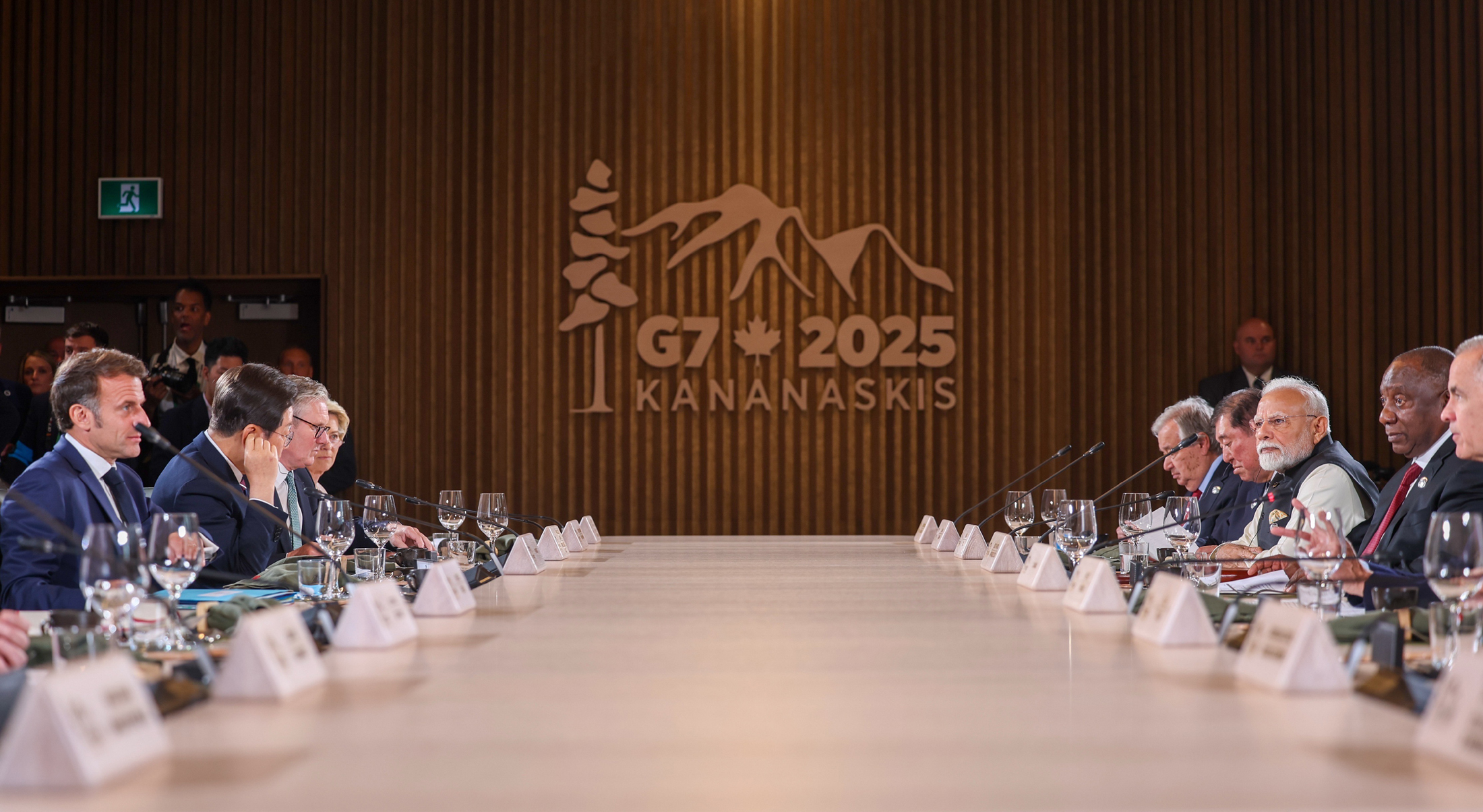
Prime Minister Narendra Modi at the 51st G7 summit meeting in Kananaskis, Canada on June 17, 2025.
The Indian Prime Minister calls the terrorist attack in Pahalgam a “brutal and cowardly” assault on the soul, identity, and dignity of all humanity
Kananaskis, Canada: At the G7 Summit’s Outreach Session, Indian Prime Minister Narendra Modi placed clean energy at the forefront of global priorities, calling for collective action to address escalating demands driven by technologies like artificial intelligence (AI).
Speaking at a session themed “Energy Security: diversification, technology and infrastructure to ensure access and affordability in a changing world,” on June 17, 2025, Modi highlighted India’s ambitious clean energy strides while pressing G7 nations to support global initiatives for a sustainable future.
Hosted by Canadian Prime Minister Mark Carney, the summit, marking the G7’s 50th anniversary, also saw Modi address terrorism and the Global South’s challenges. However, clean energy emerged as the central issue demanding international cooperation.
Modi began by thanking Mark Carney for the invitation and warm hospitality, congratulating the G7 on its half-century milestone. He framed clean energy as a critical responsibility for securing future generations, particularly as technologies like AI strain global energy resources. India, he emphasised, pursues energy security through availability, accessibility, affordability, and acceptability, driving inclusive development. Nearly all Indian households now have electricity, and the country offers some of the lowest per-unit electricity costs worldwide. As the fastest-growing major economy, India has exceeded its Paris Agreement commitments and is advancing toward Net Zero by 2070, with renewable energy comprising about 50% of its installed capacity. The nation is targeting 500 gigawatts of renewable energy by 2030, bolstered by investments in green hydrogen, nuclear energy, ethanol blending, solar power, and small modular reactors.
India’s clean energy leadership extends globally through initiatives like the International Solar Alliance, Coalition for Disaster Resilient Infrastructure, Mission LiFE, Global Biofuels Alliance, and One Sun One World One Grid. Modi urged G7 nations to strengthen these efforts, advocating for a collaborative energy transition rooted in a “not I, but us” ethos. He highlighted AI’s energy-intensive nature, particularly its data centres, which amplify global energy demands. India is addressing this through smart grids, energy storage systems, and green energy corridors to connect renewable energy production with consumption hubs, ensuring sustainable, reliable, and affordable energy. Modi’s call for clean energy solutions resonated with the summit’s focus on diversification and infrastructure, underscoring the need to power technological advancements responsibly.
Modi also addressed the Global South’s vulnerabilities, noting that global conflicts and uncertainties disproportionately disrupt food, fuel, fertiliser, and financial systems, impacting masses, materials, manufacturing, and mobility. Positioning India as a voice for these nations, he argued that sustainable development remains elusive while double standards persist in global policies. He pressed the G7 to prioritise the concerns of developing countries, which bear the brunt of crises they contribute least to, emphasising the need for equitable progress.
The address also tackled terrorism, described as an enemy of humanity and a threat to democratic values. Modi referenced the April 22, 2025, terrorist attack in Pahalgam, India, as a “brutal and cowardly” assault on the soul, identity, and dignity of all humanity. Thanking global leaders for their condemnation, he criticised nations that support terrorism while evading accountability, contrasting this with selective sanctions based on national interests. He posed pointed questions: Are nations serious about combating terrorism? Will they recognise its gravity only when targeted? Can perpetrators and victims be equated? Are global institutions risking credibility by remaining passive? Modi warned that inaction or support for terrorism betrays humanity, urging decisive action against countries fostering it.
On the intersection of clean energy and technology, Modi noted AI’s role in enhancing efficiency and innovation, but stressed its high energy demands require clean energy solutions. India’s human-centric approach measures technology’s value by its impact on marginalised communities, such as farmers or fishermen in remote villages. He cited BHASHINI, an AI-based language app, and India’s Digital Public Infrastructure as models for democratizing technology to empower communities and economies. Modi proposed three AI-related actions: international governance to balance innovation with risk, resilient supply chains for critical minerals and technology to prevent their weaponisation, and mandatory watermarks or disclosures for AI-generated content to counter deep fakes, which threaten societal stability. India’s diverse data—spanning languages, lifestyles, and geography—positions it as a key source for inclusive, capable, and responsible AI models, supported by a robust data empowerment and protection framework and a skilled talent pool rooted in democratic values.
Modi concluded by advocating for cooperation over competition in clean energy and technology, invoking India’s philosophy of “Sabka Saath, Sabka Vikas, Sabka Vishwas, aur Sabka Prayas” (Together with all, Development for all, Trust of all, and Efforts of all). He invited G7 leaders to the AI Impact Summit in India next year, signalling continued engagement on clean energy and global challenges. Modi’s address highlighted the complexities of aligning global priorities—balancing clean energy innovation, equitable access, and security concerns—while emphasising the urgent need for international collaboration to secure a sustainable future.
– global bihari bureau