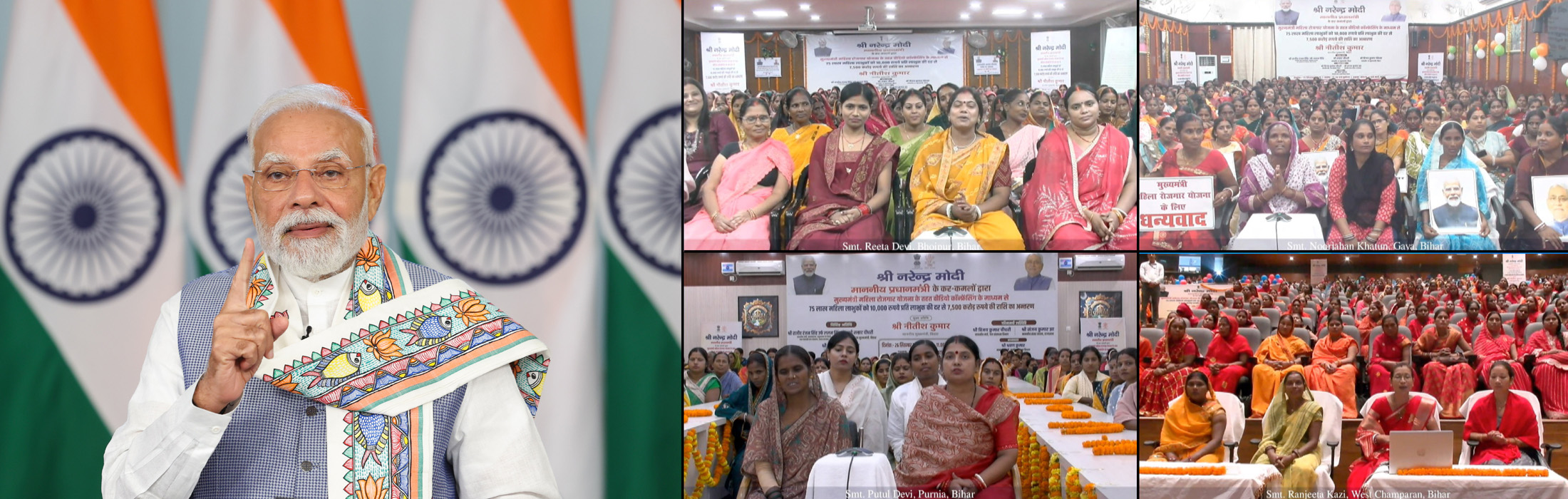
Prime Minister Narendra Modi launches Bihar Mukhyamantri Mahila Rojgar Yojana via video conferencing on September 26, 2025.
Mahila Rojgar Yojana: Aid or Election Ploy?
Bihar Scheme Fuels Freebie Row in Polls
Patna: Prime Minister Narendra Modi transferred ₹10,000 each to the bank accounts of 75 lakh women across Bihar today during the virtual launch of the state’s Mukhyamantri Mahila Rojgar Yojana, amounting to ₹7,500 crore in initial disbursements. The scheme, approved by the Bihar Cabinet on August 29, 2025, targets women aged 18 to 60 from families without prior self-employment loans, offering grants for ventures in agriculture, animal husbandry, handicrafts, tailoring, weaving, or small businesses like grocery shops or poultry farming. Beneficiaries can access up to ₹2 lakh in additional phased support after six months, contingent on enterprise performance, with training provided by community resource persons from self-help groups and market linkages through expanded Gramin Haat-Bazaars. The programme reportedly drew participation from over 1 crore women at events across districts, blocks, clusters, and villages, integrating with Bihar’s network of 11 lakh self-help groups and the Jeevika Nidhi Credit Cooperative Society launched earlier this month.
Modi described the initiative as a step toward women’s economic independence, noting it aligns with the central Lakhpati Didi campaign, which has enabled over 2 crore women nationwide to earn more than ₹1 lakh annually through self-help groups, including lakhs in Bihar. He credited the Jan Dhan Yojana for opening over 30 crore bank accounts for women, linked to Aadhaar and mobile numbers, facilitating direct transfers without intermediaries. The Prime Minister also referenced complementary central schemes, including Mudra Yojana for micro-loans, Drone Didi for agricultural drone operations, Bima Sakhi for insurance outreach, Bank Sakhi for banking services, Ujjwala Yojana providing gas connections to 10 crore households, Pradhan Mantri Awas Yojana constructing over 50 lakh homes with women as co-owners in Bihar, Ayushman Bharat offering ₹5 lakh in free annual treatment, and Pradhan Mantri Matru Vandana Yojana for financial aid to pregnant women. He highlighted the Swasth Nari Sashakt Parivar Abhiyan, launched on September 17, which has organised over 4.25 lakh health camps nationwide, screening more than 1 crore women for anaemia, diabetes, hypertension, and cancer as of September 26.
The launch occurs amid Bihar’s upcoming Assembly elections, expected in October-November, where the National Democratic Alliance of the Bharatiya Janata Party and the Janata Dal (United) faces competition from the Rashtriya Janata Dal-led INDIA bloc. Modi contrasted the current welfare focus with past Opposition rule in Bihar, citing issues like lawlessness, poor infrastructure, and Naxalite violence that affected women’s safety and access to services. Recent Goods and Services Tax (GST) reductions effective from September 22, 2025, on essentials like soap, toothpaste, ghee, stationery, clothes, and footwear were mentioned as relief for household budgets during festivals such as Navratri, Diwali, and Chhath Puja.
Beneficiaries expressed positive reactions during the event. A Jeevika Didi from Bhagalpur said the funds would enable independent ventures, while another from Nalanda stated, “We are very happy that something is finally being done for us. Now we are not dependent on anyone.” In Champaran, a participant noted the scheme’s potential for business expansion up to ₹2 lakh. Bhagalpur Mayor Vasundhara Lal described Modi’s interaction as connecting directly with women. BJP National General Secretary Tarun Chugh praised the initiative for shifting Bihar from the past “jungle raj” to empowerment through schemes like Ujjwala and Jan Dhan.
Critics, however, questioned the timing and fiscal implications. Prashant Kishor’s Jan Suraaj Party termed it financially irresponsible, pointing to Bihar’s ₹2.8 lakh crore debt in the 2025 budget and projecting potential costs of ₹15,000-20,000 crore if scaled. RJD leader Tejashwi Yadav countered with a promise of ₹2,500 monthly stipends for women if elected, framing the race as a competition in welfare commitments. On social media, some users labelled the transfers a “bribe” for votes, with one post calling it “shame for an elected representative who reaches out to voters through bribery.” Lawyer and activist Prashant Bhushan shared a 2014 video of Modi criticising freebies as anti-development, accusing him of hypocrisy.
Data from Bihar’s welfare history shows mixed outcomes for similar programmes. The state’s bicycle scheme for schoolgirls, launched in 2010, increased female enrollment by 20-30 per cent in rural areas according to education department records. However, audits by the Comptroller and Auditor General in 2023 found 20 per cent misuse in schemes like Kanya Vivah, where ₹50,000 marriage aid reached 1.5 lakh girls but was diverted from education in some cases. Ujjwala’s refill rates in Bihar stand at 40 per cent due to cylinder costs exceeding ₹800, per 2024 household surveys. The Lakhpati Didi programme reports 2 crore successes nationwide, but a 2025 study by the Indian Council for Research on International Economic Relations indicated only 60 per cent sustained incomes beyond a year, often due to limited market access.
Bihar’s gender indicators reveal ongoing challenges: female labour force participation at 19.4 per cent versus the national 37 per cent in the 2024-25 Periodic Labour Force Survey, high anaemia rates of 63 per cent among women in the National Family Health Survey-5, and maternal mortality at 149 per 100,000 births. Crime against women saw a 15 per cent rise in FIRs in 2024, according to National Crime Records Bureau data, with Naxalite activity persisting in 10 districts. The scheme could stimulate rural economies, where women contribute 70 per cent of farm labour but own less than 13 per cent of land per the 2022 Agriculture Census, potentially boosting state GDP by 1-2 per cent if 30 per cent of ventures succeed, based on World Bank models. NITI Aayog estimates suggest it could lift 10-15 per cent more women into formal income by 2027 if effectively monitored.
The one-woman-per-family criterion may exclude some in larger or polygamous households, affecting an estimated 10-15 per cent of potential beneficiaries based on state demographic data. Fiscal experts warn the initial ₹7,500 crore outlay, part of Bihar’s ₹50,000 crore welfare budget for 2025-26, risks pushing the deficit beyond the 5.5 per cent GSDP target without revenue growth.
– global bihari bureau