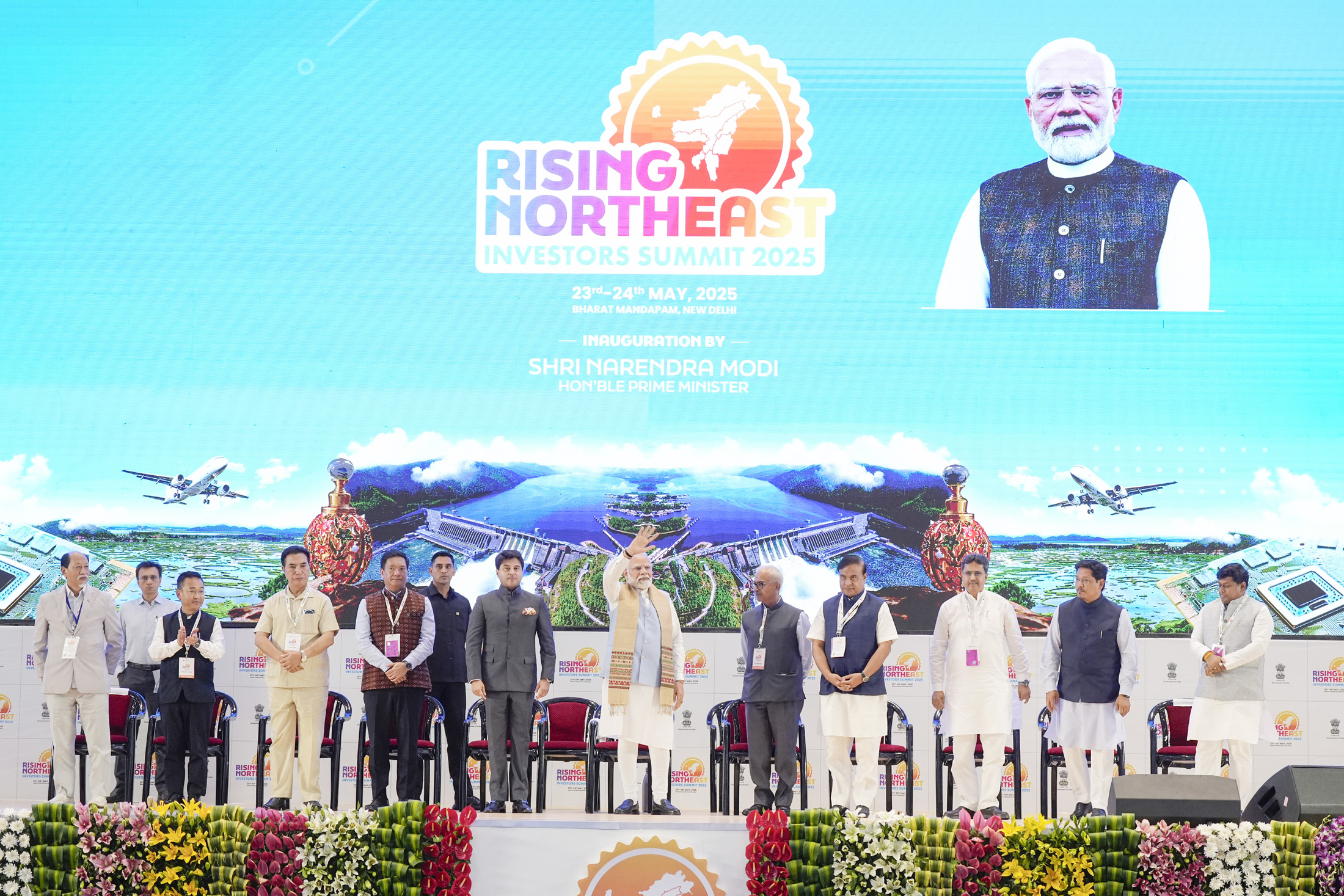
Prime Minister Narendra Modi at the Rising North East Investors Summit in Bharat Mandapam, New Delhi on May 23, 2025.
New Delhi: Prime Minister Narendra Modi opened the Rising North East Investors Summit 2025 at Bharat Mandapam here today, positioning India’s Northeast as a potential hub for trade, technology, and tourism to attract investment from domestic and global stakeholders.
Addressing industry leaders, policymakers, and chief ministers from the eight Northeastern states, Modi outlined plans to leverage the region’s proximity to ASEAN markets and its resources to drive economic growth.
The two-day summit, held May 23-24, 2025, follows roadshows and bilateral meetings to promote sectors including tourism, agro-food processing, textiles, healthcare, education, information technology, infrastructure, energy, and sports.
Despite ambitious goals, the region’s infrastructure gaps, security issues, and limited industrial capacity raise questions about the feasibility of rapid transformation.
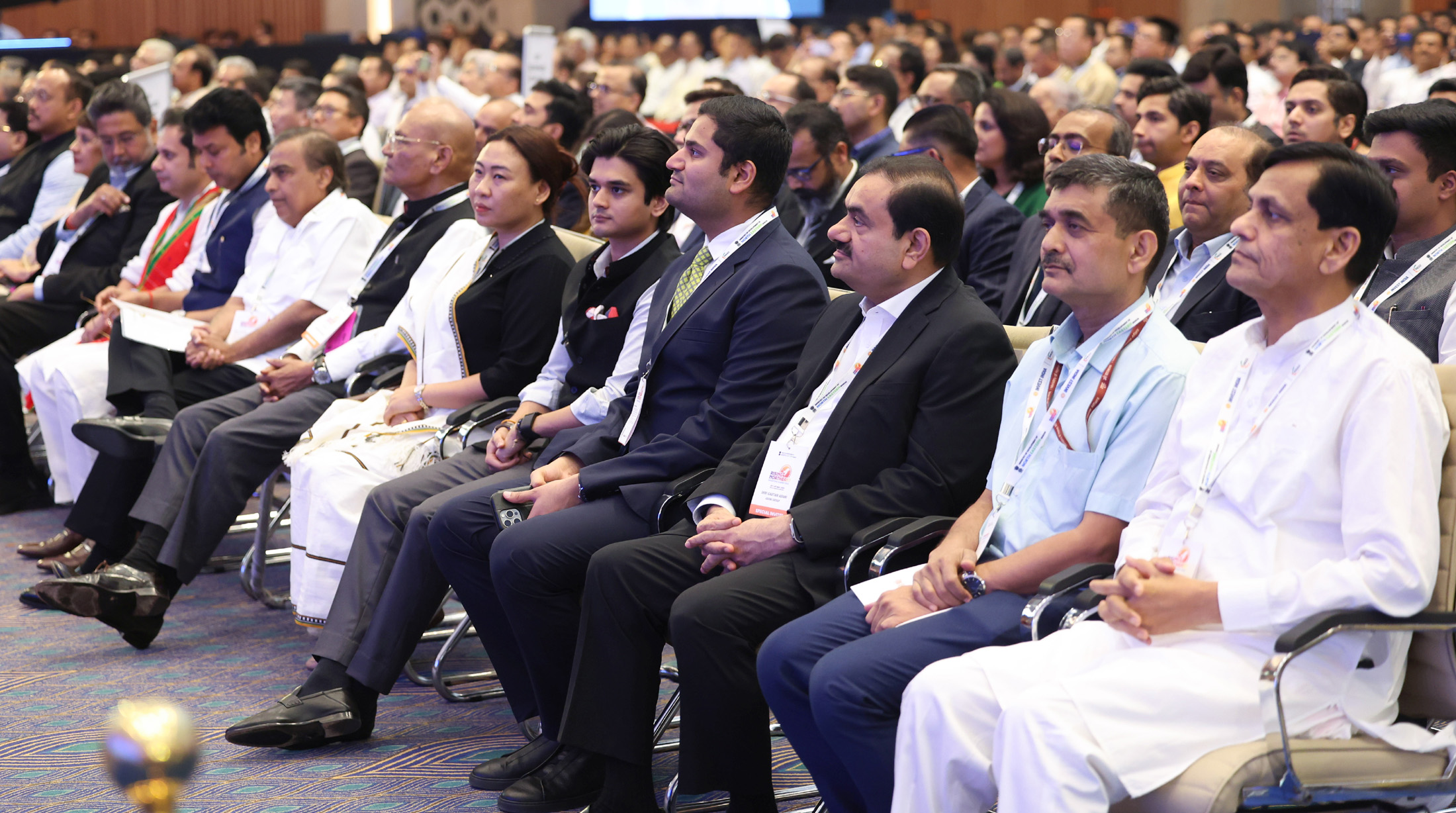
Modi acknowledged the work of state governments and ministries, including Union Minister Jyotiraditya M. Scindia and chief ministers from Assam, Arunachal Pradesh, Meghalaya, Mizoram, Nagaland, Sikkim, and Tripura, in fostering conditions for investment. He highlighted the Northeast’s diversity, noting its contributions to bamboo, tea, and petroleum production, alongside potential in eco-tourism and organic products, framed as the Ashtalakshmi concept of prosperity. Each state, he said, is ready to attract capital. However, the Northeast’s economic contribution remains below 3% of India’s GDP, constrained by its remote location and decades of underinvestment, which could challenge investor confidence.
The Prime Minister tied the Northeast’s development to India’s growth strategy through the EAST policy: Empower, Act, Strengthen, and Transform. He cited 700 Union Minister visits over 11 years as evidence of engagement, informing policies based on local needs. The shift from Look East to Act East, he claimed, has repositioned the Northeast as a growth contributor. Infrastructure projects include 11,000 kilometres of highways, doubled airports, new railway lines, and waterways on the Brahmaputra and Barak rivers. A 1,600-kilometre Northeast Gas Grid supports industrial energy needs, and 13,000 kilometres of optical fibre with 4G/5G coverage aim to close the digital gap. Yet, many projects remain incomplete, and connectivity to remote areas is inconsistent, potentially limiting industrial scalability.
Modi projected the Northeast as a trade gateway, with India’s $125 billion ASEAN trade expected to surpass $200 billion. The India-Myanmar-Thailand Trilateral Highway and the Kaladan Multimodal Transit Project, linking Kolkata to Myanmar’s Sittwe Port via Mizoram, aim to streamline trade routes. Guwahati, Imphal, and Agartala are being developed as logistics hubs, with Land Customs Stations in Meghalaya and Mizoram targeting Indo-Pacific trade.
Union Minister Sarbananda Sonowal noted 20 National Waterways and the Jalvahak scheme to boost cargo movement and connect to ASEAN and BBIN markets of over 600 million consumers. Delays in these projects, coupled with Myanmar’s instability, could disrupt timelines and deter investors wary of geopolitical risks.
The Northeast’s biodiversity and cultural heritage were presented as assets for India’s “Heal in India” initiative, with potential for wellness tourism. Its music, dance, and festivals could support global conferences and destination weddings, with tourism doubling and creating jobs in homestays and guiding. Peace agreements have led 10,000 youth to abandon arms, supported by the MUDRA scheme’s financial aid to lakhs of youth. Investments of ₹21,000 crore in education have funded 850 schools, an AIIMS, nine medical colleges, two IIITs, and a sports university under Khelo India. However, outmigration of skilled workers and limited local industries challenge job creation, with many graduates seeking opportunities elsewhere.
Dr. Pemmasani Chandra Shekhar, Minister of State for Communications, outlined digital progress, with ₹1.5 lakh crore invested, including ₹50,000 crore for BharatNet, achieving 4G coverage for 90% of the region and fibre connectivity for 80% of rural households. Startups like AgSpert use AI and drones, while 5G-enabled telemedicine in Arunachal Pradesh and AI-driven translation in Tripura aim to improve services. The Northeast targets ASEAN’s $5 trillion digital economy with 98% border connectivity, but digital literacy gaps and unreliable power supply could hinder progress. Organic farming has doubled, with tea, pineapples, and turmeric meeting global demand, though the Oil Palm Mission faces environmental concerns. Assam’s planned production of India’s first Made-in-India semiconductor chip signals high-tech potential, but global competition and supply chain issues pose risks.
Modi described the summit as a call to action, urging investors to seize the Northeast’s opportunities. While the region’s strategic location, resources, and recent progress offer potential, analysts note that sustained investment, governance reforms, and resolution of local conflicts will be critical to achieving these goals. The summit’s success will hinge on translating policy commitments into tangible outcomes in a region long overlooked.
– global bihari bureau