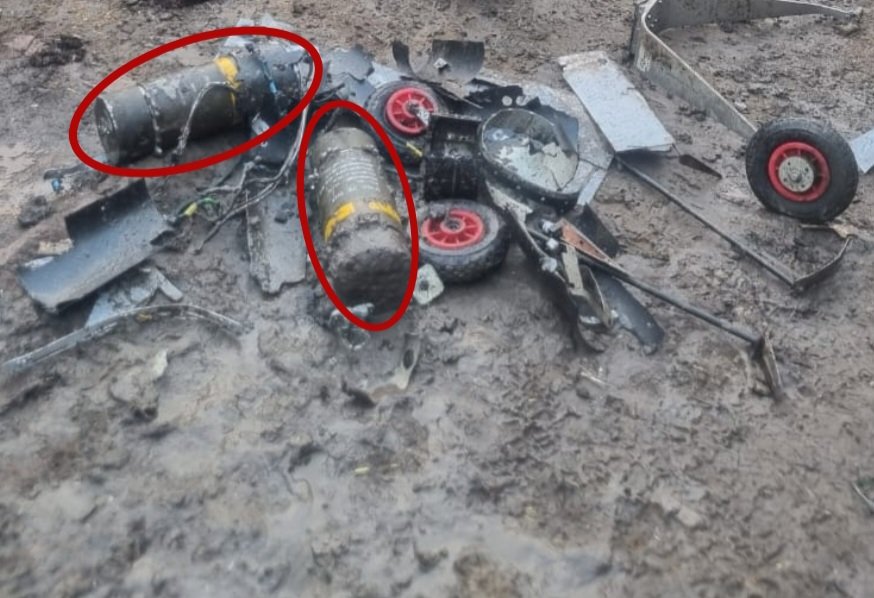
The fallen Pakistani drones on Indian soil.
New Delhi: India’s Operation Sindoor decisively dismantled Pakistan’s terrorist headquarters, in retaliation for the April 22 Pahalgam attack, thwarting Pakistan’s reckless counterattacks and prompting its desperate appeal for de-escalation, Prime Minister Narendra Modi announced, reinforcing India’s zero-tolerance policy against terrorism. “I am repeating again, we have just suspended our retaliatory action against Pakistan’s terror and military camps,” Modi reiterated, stressing that India will measure Pakistan’s future attitude closely.
In a powerful videoconference address to the nation, Modi detailed how Operation Sindoor’s precision missile and drone strikes, launched late on May 6 and early on May 7, obliterated terrorist strongholds in Bahawalpur and Muridke, eliminating over 100 dangerous terrorists, including masterminds behind global atrocities like the 9/11 attacks, London Tube bombings, and decades of violence in India. The operation, a direct response to the Pahalgam attack that targeted civilians’ faith, showcased India’s unified resolve and advanced military prowess. Pakistan, stunned by India’s bold move, launched a reckless counteroffensive against Indian schools, colleges, gurudwaras, temples, civilian homes, and military bases, but its drones and missiles were neutralised in the sky by India’s cutting-edge air defence systems. On the afternoon of May 10, Pakistan’s military, reeling from losses far beyond its expectations, contacted India’s Director General of Military Operations, pledging to halt terrorist activities and military audacity. India’s Army, Air Force, Navy, Border Security Force, and paramilitary units remain on high alert, vigilantly monitoring Pakistan’s compliance to ensure national security. Modi emphasised that the operation, a reflection of the emotions of millions, marked a new era in counter-terrorism, driven by an unwavering commitment to justice for every mother, sister, and daughter whose dignity was targeted.
Also watch: Prime Minister Narendra Modi’s address to the nation
The success of Operation Sindoor, executed with Made in India defence systems, devastated Pakistan’s terrorist infrastructure and boasted airbases within three days, demonstrating India’s unparalleled capabilities in desert, mountainous, and new-age warfare. The strikes shattered not only physical structures but also the confidence of terrorist networks, leaving Pakistan bewildered and searching for ways to escape the consequences of India’s aggressive action. Modi saluted the valiant armed forces, intelligence agencies, and scientists for their bravery, courage, and valour, dedicating their efforts to the nation’s women, whose Sindoor symbolised the honour avenged by the operation. The operation, rooted in a Nation First spirit where national interest drives bold decisions, established a new policy against terrorism, building on India’s history of surgical and air strikes. Modi outlined three pillars of India’s security doctrine: “We will give a befitting response on our terms only,” targeting terrorism’s roots with decisive retaliation; rejecting nuclear blackmail through precise strikes on terrorist hideouts; and treating terrorists and their state sponsors as one, as evidenced by Pakistani army officers openly attending the funerals of slain militants, exposing Pakistan’s ugly face of state-sponsored terrorism. “Terror and talks cannot coexist, terror and trade cannot go hand in hand, and water and blood can never flow together,” Modi warned, insisting that any future dialogue with Pakistan will focus solely on terrorism and Pakistan-Occupied Kashmir (PoK).
The April 22, 2025, Pahalgam attack was a calculated attempt to fracture India’s harmony, “a very gruesome face of terror and cruelty,” with terrorists mercilessly killing innocent civilians in front of their families and children based on their religion. Modi, deeply pained by the brutality, noted that the attack shocked both India and the world, uniting every citizen, community, class, and political party in demanding swift action. This solidarity empowered the armed forces with full freedom to neutralise key militants who had orchestrated attacks against India for two to three decades, delivering justice in a single stroke. Pakistan’s subsequent aggression, a desperate and cowardly act born of frustration, targeted civilian and military sites but exposed its technological and strategic weaknesses as India’s air defences prevailed. Historically, India has consistently defeated Pakistan on the battlefield, from conventional wars to precision strikes, and Operation Sindoor added a new dimension to this legacy, reinforcing India’s dominance and sending a message that terrorists could never imagine such a decisive response from India.
Pakistan’s terror hubs in Bahawalpur and Muridke, long-serving as global centres of terrorism, were linked to major attacks worldwide and decades of violence in India, making their destruction a significant blow to international terror networks. Modi warned that Pakistan’s persistent encouragement of terrorism risks its own destruction, urging it to dismantle its terror infrastructure as the only path to survival. Pakistan’s appeal for de-escalation, as it pleaded with the global community to ease tensions, underscored its desperation after suffering losses beyond its calculations. **“Today, I would also like to tell the global community that our stated policy has been: if there are talks with Pakistan, it will be only on terrorism; and if there are talks with Pakistan, it will be only on Pakistan-occupied Kashmir (PoK),”** Modi declared, signaling India’s resolute stance to the world. The conditional suspension of operations is a strategic pause, with India closely scrutinising Pakistan’s every move to ensure compliance with its pledges, maintaining a posture of readiness to act if commitments falter.
Modi framed Operation Sindoor within a broader vision of a terrorism-free world, asserting that while the current era shuns war, it must equally reject terrorism. He advocated for zero tolerance as the cornerstone of global safety, positioning India’s actions as a model for decisive anti-terrorism measures. On Buddha Purnima, Modi reflected on Lord Buddha’s teachings, emphasising that India’s recent actions demonstrated both strength and patience, and that the path to peace necessitates the exercise of power when required to protect national principles. India’s unity, its greatest strength, underpins its ability to confront terrorism and pursue the vision of a Viksit Bharat, where every citizen lives with dignity. The global community, witnessing the rise of Made in India defence equipment as a formidable force in 21st-century warfare, recognises India’s technological and strategic ascent. Modi concluded by saluting the armed forces and honouring the collective courage and resolve of every Indian, affirming that India’s power, when wielded, safeguards its values and paves the way for a prosperous, peaceful future.
– global bihari bureau