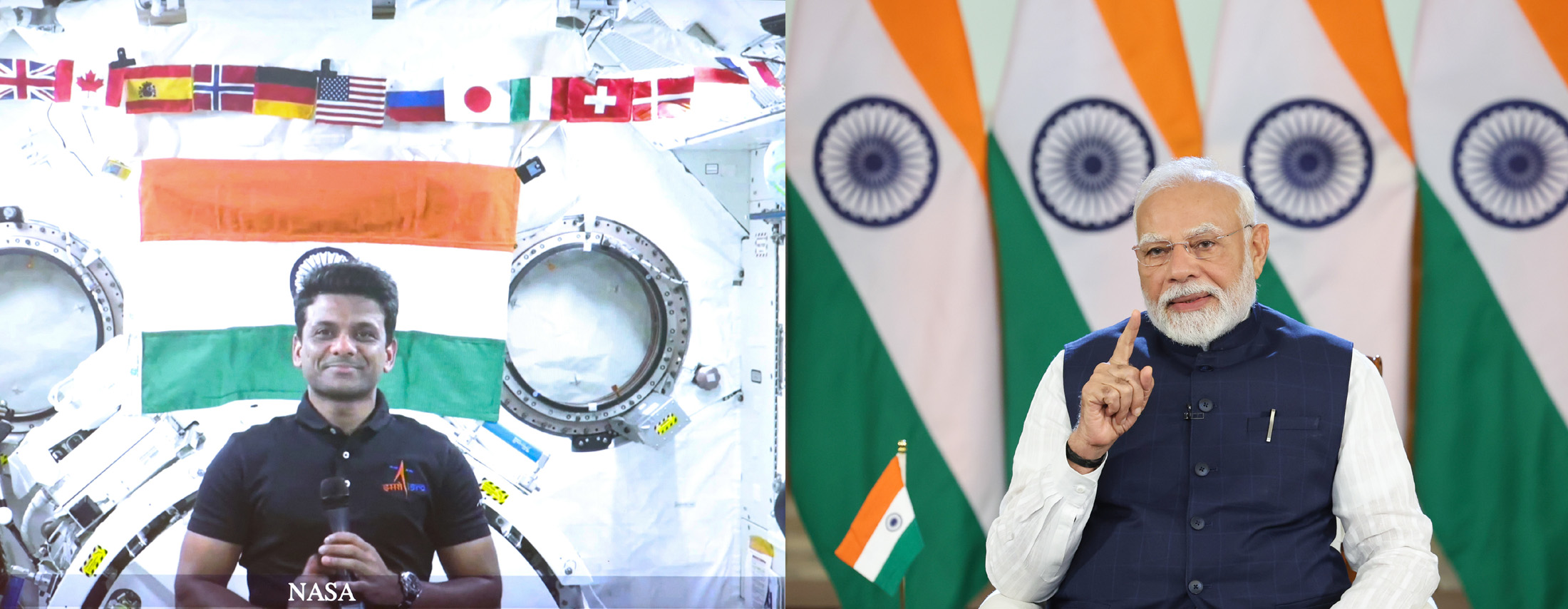
Prime Minister Narendra Modi interacted with Group Captain Shubhanshu Shukla, who is aboard the International Space Station, on June 28, 2025.
Shukla’s Orbiting Vision Uplifts India
New Delhi: From 400 kilometres above Earth, Group Captain Shubhanshu Shukla, the first Indian astronaut to reach the International Space Station (ISS), spoke with Prime Minister Narendra Modi on June 28, 2025, in a conversation that captivated a nation. The exchange, broadcast live, echoed the historic 1984 dialogue between then-Prime Minister Indira Gandhi and India’s first astronaut, Wing Commander Rakesh Sharma, who, aboard the Soviet Soyuz T-11, famously said, “Saare jahaan se achha,” when asked how India looked from space. Shukla’s interaction with Modi marked a new milestone in India’s space journey, blending national pride with scientific ambition.
Shukla, part of Axiom Mission 4, which docked with the ISS’s Harmony module on June 26, as confirmed by NASA, joined commander Peggy Whitson, a former NASA astronaut and Axiom Space’s director of human spaceflight, alongside mission specialists Sławosz Uznański-Wiśniewski from Poland and Tibor Kapu from Hungary. This all-private mission, a collaboration between NASA’s international partners and American commercial space companies, involves microgravity research, educational outreach, and commercial activities over a two-week stay, showcasing global cooperation in space exploration.
Modi greeted Shukla warmly: “You are farthest from the motherland, yet closest to the hearts of 140 crore Indians. Your name, meaning ‘auspicious,’ heralds a new era for India. I speak with the enthusiasm of every Indian, congratulating you for raising India’s flag in space.” Shukla, orbiting at 28,000 kilometres per hour, responded with gratitude: “Thank you, Prime Minister, and 140 crore Indians. I’m safe and well here, thanks to your blessings. This journey isn’t just mine—it’s our country’s. Under your leadership, India is giving wings to dreams I never imagined as a child.”
The conversation lightened when Modi asked if Shukla had shared Indian delicacies like gajar ka halwa, moong dal ka halwa, and mango ras with his crewmates. Shukla laughed, sharing how his international colleagues savoured these flavours, some expressing eagerness to visit India for more. “They experienced our rich culinary heritage,” he said, a moment of cultural exchange that aligned with NASA’s emphasis on Axiom Mission 4’s collaborative spirit.
Modi noted India’s tradition of circumambulation, asking where Shukla was orbiting. “I don’t have exact details now, but earlier we passed over Hawaii,” Shukla replied. “We orbit Earth 16 times daily, seeing 16 sunrises and sunsets. It’s awe-inspiring, moving at this speed while talking to you, yet it reflects how fast our country is progressing.” Modi exclaimed, “Wow!” as Shukla added, “We’ve reached here, and now we must go further.”
Reflecting on space’s vastness, Shukla shared his first thought upon reaching orbit: “Earth looks borderless—no lines, no divisions, just oneness. India looks majestic, far grander than maps show. It reinforces our motto of unity in diversity.” Modi, struck by Shukla’s humility despite near-zero gravity, remarked, “You’re in space, yet so down-to-earth.”
On adapting to the ISS, Shukla described microgravity’s challenges: “Everything’s different. My body’s used to gravity, so simple tasks like drinking or sleeping are tough. I’m strapped down now, or I’d float away! Even the microphone floats if I let go. Training prepared me, but it took a couple of days to adjust.” He credited mindfulness, rooted in India’s spiritual heritage, for keeping him calm. “Science and spirituality are India’s strengths,” Modi affirmed, noting Shukla’s journey mirrored the nation’s ascent.
Shukla detailed experiments designed by Indian scientists, including one on stem cells to study muscle loss in microgravity, with the potential to help elderly patients on Earth. “Without gravity, muscles weaken, so we’re testing supplements to delay this,” he explained. Another experiment explores microalgae growth for nutrition, offering solutions for food security. “Space accelerates these processes, giving results faster than on Earth,” he noted, highlighting the mission’s scientific promise.
Modi linked Shukla’s mission to the enthusiasm sparked by Chandrayaan, inspiring youth to dream of space. Shukla’s message to them was resolute: “India is chasing bold dreams, and we need you. Success has many paths, but one truth: never stop trying. Success will come.” Modi, assigning “homework,” emphasised that Shukla’s experiences would shape India’s Gaganyaan mission, a national space station, and a lunar landing by an Indian astronaut. Shukla, absorbing lessons “like a sponge,” promised to apply them, noting his crewmates’ curiosity about Gaganyaan: “They asked when they can join it, and I said, ‘Soon!’”
The call ended with Shukla’s pride in raising India’s flag on the ISS, a first achieved the previous day. “This is a collective achievement for India,” he said. “To every child and youth: if you shape your future with effort, it will shine, and so will India’s. The sky is never the limit—not for you, me, or India.” Modi moved, declaring this the first chapter of Gaganyaan’s success, envisioning India building platforms for future space missions. “We await your return, Shubhanshu. Keep honouring Mother India. Bharat Mata ki Jai!” Shukla echoed, “Bharat Mata ki Jai from space!”
This exchange, set against Axiom Mission 4’s global collaboration, as NASA highlighted, showcased India’s rising stature in space. Like Sharma’s words four decades ago, Shukla’s carried a nation’s dreams, proving India’s reach extends beyond the stars.
Full English Translation of Modi-Shukla Conversation
Prime Minister: Shubhanshu, namaskar!
Shubhanshu Shukla: Namaskar!
Prime Minister: You are farthest from the motherland, India, yet closest to the hearts of 140 crore Indians. Your name has ‘Shubh’ (auspicious), and your journey marks the auspicious start of a new era. At this moment, we’re talking, but I carry the emotions of 140 crore Indians. My voice holds the enthusiasm and joy of all Indians. I heartily congratulate and wish you well for raising India’s flag in space. I won’t take much time, so first, tell me, is everything well up there? How’s your health?
Shubhanshu Shukla: Yes, Prime Minister! Thank you so much for your wishes and those of 140 crore Indians. I’m absolutely fine here, safe and sound. Thanks to your blessings and love… It feels great. It’s a very new experience, and somehow, many things are happening that show where I, and many like me, and our India are heading. This 400-kilometre journey from Earth to orbit isn’t just mine. I feel it’s our country’s journey because, as a child, I never imagined I could become an astronaut. But I think under your leadership, today’s India offers this opportunity and the chance to realise those dreams. So, this is a huge achievement for me, and I feel very proud to represent my country here. Thank you, Prime Minister!
Prime Minister: Shubh, you’re far in space where gravity is negligible, but every Indian sees how down-to-earth you are. Did you share the gajar ka halwa you brought with your crewmates?
Shubhanshu Shukla: Yes, Prime Minister! I brought some Indian foods like gajar ka halwa, moong dal ka halwa, and mango ras, and I wanted my colleagues from other countries to taste them and experience India’s rich culinary heritage. So, we all sat together and enjoyed them, and everyone loved it. Some said, “When we come down, we’ll visit your country and taste these with you!”
Prime Minister: Shubh, circumambulation is India’s ancient tradition. You’re privileged to orbit Mother Earth. Which part of the world are you passing over now?
Shubhanshu Shukla: Prime Minister, I don’t have that information right now, but a while ago, I looked out the window and saw us passing over Hawaii. We orbit Earth 16 times a day, seeing 16 sunrises and sunsets. It’s astonishing, moving at about 28,000 kilometres per hour while talking to you. This speed isn’t felt inside, but it shows how fast our country is progressing.
Prime Minister: Wow!
Shubhanshu Shukla: We’ve reached here, and now we must go further.
Prime Minister: Shubh, what was your first thought seeing the vastness of space?
Shubhanshu Shukla: Prime Minister, honestly, when we first reached orbit, the first view was of Earth, and the first thought was that it looks like one, no border lines, no divisions. When I saw India, it looked so grand, much bigger than on maps. We study maps in 2D, but in 3D, India is magnificent. The feeling of oneness, Earth’s oneness, our motto of unity in diversity, becomes clear. It feels like no borders, states, or countries exist—just humanity, and Earth is our home, and we’re all its citizens.
Prime Minister: Shubhanshu, you’re the first Indian to reach the space station. You’ve worked hard, trained extensively, and now you’re in the real situation, truly in space. How different are the conditions? How are you adapting?
Shubhanshu Shukla: Everything’s different here, Prime Minister. I trained for a year on all systems, processes, and experiments, but coming here, everything changed suddenly because our bodies are so used to gravity. Every task is decided by it, but here, with microgravity absent, even small things become difficult. While talking to you, I’ve strapped my legs down, or I’d float away. If I let go of the microphone, it floats too. Drinking water, walking, sleeping—it’s a big challenge. You can sleep on the ceiling, walls, or floor. Training prepared me, but the environment changes, so it took a day or two to get used to it, but now it’s normal.
Prime Minister: Shubh, India’s strength is both science and spirituality. You’re on a space journey, but India’s journey must be running within you. Does meditation and mindfulness help in that environment?
Shubhanshu Shukla: Yes, Prime Minister, I completely agree. I believe India is already running, and this mission is just the first step in that larger race. We’ll surely move forward, have our own space station, and many will reach there. Mindfulness makes a big difference. During normal training or launch, there are stressful situations, and mindfulness helps you stay calm, composed, and make better decisions. They say you can’t eat while running, so the calmer you are, the better decisions you make. I think mindfulness plays a very important role, and if practised together with other skills, it’s very useful in such challenging environments and helps people adapt quickly.
Prime Minister: You’re conducting many experiments in space. Is there an experiment that could benefit agriculture or the health sector in the future?
Shubhanshu Shukla: Yes, Prime Minister, I can proudly say Indian scientists designed seven unique experiments I brought to the station. The first, scheduled today, is on stem cells. In space, with gravity absent, there’s no load, so muscle loss occurs. This experiment checks if supplements can stop or delay it. This has direct implications for people with muscle loss due to old age on Earth. These supplements could be used for them. The second experiment is on microalgae growth. These are small but very nutritious. If we can develop a process to grow them in large quantities and provide nutrition, it could help with food security on Earth. The biggest advantage of space is that processes happen quickly, so we don’t need to wait months or years for results, and we can…
Prime Minister: Shubhanshu, after Chandrayaan’s success, children and youth have a new interest in science and exploring space. Your historic journey strengthens that resolve. Today, kids don’t just look at the sky; they think, “I can reach there.” That’s the real foundation for our future space missions. What’s your message to India’s youth?
Shubhanshu Shukla: Prime Minister, if I were to give a message to our youth today, I’d say India is moving in a direction where we’ve dreamt bold, high dreams. To fulfil them, we need all of you. I’d say success has no single path—some take one, others another—but one thing common to all paths is: never stop trying. If you adopt this mantra, no matter where you are, you’ll never give up. Success may come today or tomorrow, but it will come.
Prime Minister: I firmly believe your words will resonate with our youth. You know me—I always give homework when I talk to someone. We must advance Gaganyaan, build our own space station, and land an Indian astronaut on the moon. Your experiences will be invaluable. I trust you’re recording them.
Shubhanshu Shukla: Yes, Prime Minister, during this mission’s training and experience, the lessons I’ve learned, I’m absorbing like a sponge. I’m sure these will prove very valuable when I return, and we can effectively apply these lessons to our missions to complete them quickly. My colleagues who came with me asked when we could go on ‘Gaganyaan’, which felt great, and I said, “Soon.” So, I believe this dream will come true soon, and the lessons I’m learning here, I’ll apply 100 per cent to our missions to achieve them as soon as possible.
Prime Minister: Shubhanshu, I firmly believe your message will inspire, and when we met before you left, I had the chance to meet your family, and I see they’re just as emotional and enthusiastic. Shubhanshu, talking to you today was a great joy. I know you have a lot of work at 28,000 kilometres per hour, so I won’t take more time. I can confidently say this is the first chapter of Gaganyaan’s success. Your historic journey isn’t limited to space; it will accelerate and strengthen our journey to a developed India. India will open new doors of space possibilities for the world. I want to hear more from your heart, not questions, because I’m eager to hear your emotions for the nation and its youth.
Shubhanshu Shukla: Thank you, Prime Minister! This entire journey to space, the training, and reaching here—I’ve learned so much. It’s a personal accomplishment, but more than that, it’s a collective achievement for our country. I want to give one message to every child and youth watching: if you keep trying and shape your future well, your future will be bright, and so will our country’s. Just keep one thing in mind: the sky is never the limit—not for you, me, or India. If you hold this in your heart, you’ll move forward, shape your future, and our country’s future. That’s my message, Prime Minister, and I’m very emotional and happy to talk to you and, through you, to 140 crore Indians watching. The tricolour you see behind me wasn’t here before yesterday, when I arrived. We put it up for the first time, and it’s very emotional and feels great to see that India has reached the International Space Station.
Prime Minister: Shubhanshu, I wish you and your colleagues great success in your mission. We await your return. Take care, keep honouring Mother India. Many best wishes, and heartfelt thanks for your hard work to reach this height. Bharat Mata ki Jai!
Shubhanshu Shukla: Thank you, Prime Minister, and thanks to all 140 crore Indians. From space, Bharat Mata ki Jai!
– global bihari bureau