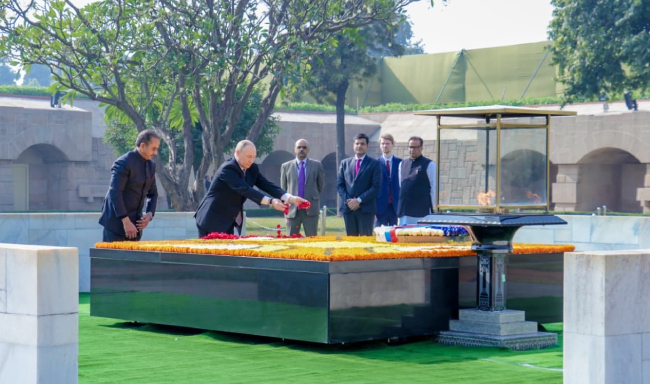
President of the Russian Federation, Vladimir Putin offers floral tributes to Mahatma Gandhi at Rajghat, in New Delhi today.
India-Russia Partnership Strengthened Amid Global Scrutiny
USD 100bn Trade Target; National Currencies Take Focus
Kudankulam, Corridors, and Joint Manufacture Shape Ties

New Delhi: The 23rd India–Russia Annual Summit ended today in New Delhi with language that mixed ritual cordiality and targeted technical commitments, and with both leaders openly advertising continuity while quietly setting practical parameters for deeper economic and technological entanglement. Vladimir Putin thanked India for an “exceptionally warm and cordial welcome” and emphasised a personal working rapport with Prime Minister Narendra Modi; Modi reciprocated with a greeting — “Namaskar! Dobryy den!” — and framed the visit as one of historic milestones.
The immediate public product of the two days was a joint statement and a package of memoranda of understanding and agreements covering migration, health, maritime training for polar waters, customs cooperation, fertilisers, media collaboration, academic ties and a Programme for the Development of Strategic Areas of India–Russia Economic Cooperation until 2030.
Beyond the signing ceremonies, the summit was notable for the prominence both sides gave to three tactical objectives: insulating trade through national currency settlements and interoperable payment systems, deepening energy and civil nuclear cooperation, and reorienting defence ties toward co‑development and local manufacture.
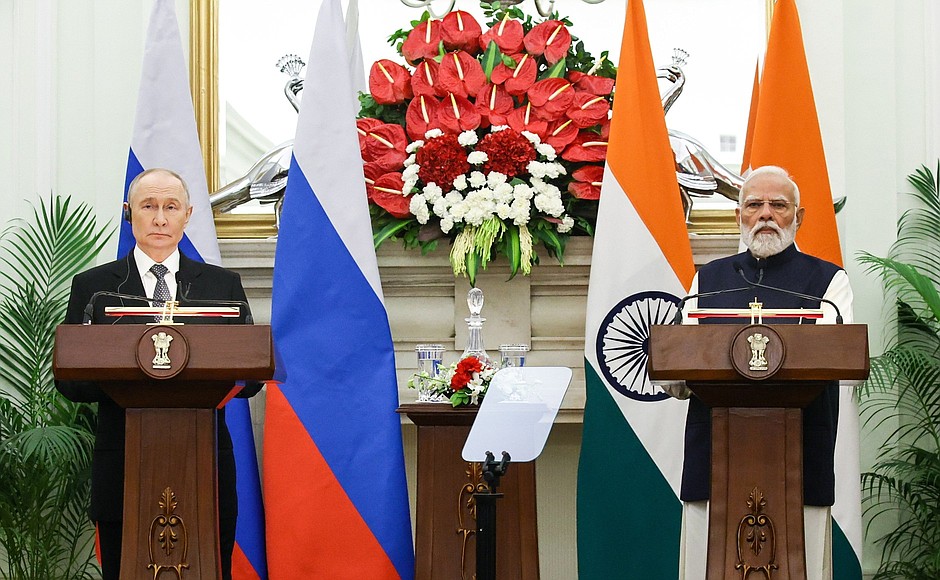
Putin’s press remarks opened with a personal tone — “Mr Prime Minister, dear friend… My sincere thanks … for the exceptionally warm and cordial welcome extended to the Russian delegation.” He said the talks were “constructive and friendly” and described how the delegations “conducted a thorough and comprehensive review of the entire spectrum of Russian‑Indian cooperation.” Putin cited a recent 12 per cent rise in bilateral trade to about USD 64–65 billion and asserted, “we believe there is clear potential to increase this volume to US$100 billion.” He laid out a roadmap via a “joint Programme for the Development of Russian‑Indian Economic Cooperation until 2030” and urged regulatory and institutional measures “to remove barriers to the flows of goods and capital, implement joint industrial projects, and deepen our collaboration in technology and investment.”
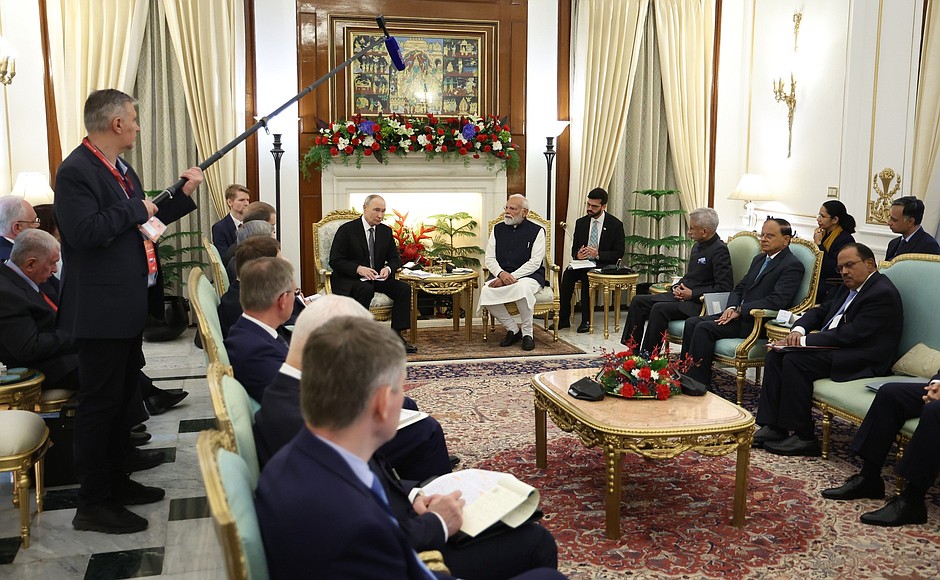
A key operational feature of the summit outcomes was the shift toward bilateral ruble–rupee settlements, which represents both a tactical and strategic adjustment in financial architecture. Putin framed this shift as settled: “their share in business deals has already reached 96 per cent”, and he noted that “major joint projects receive their funding in Russian rubles.” This mechanism enables exporters from each side to receive payment in domestic currency, reducing reliance on US dollars or euros and mitigating exposure to Western sanctions. Trade is channelled through designated banks and, where necessary, central bank accounts, potentially using interoperable digital currency platforms to facilitate conversions.
Also read: Putin in Delhi: Modi Defies West
For India, this ensures predictable continuity in energy and fertiliser imports, while Russia secures a major market insulated from external pressure. The approach also reduces currency conversion risks, supports bilateral industrial projects, and signals to the global market that the two countries can maintain trade flows independently of traditional Western-dominated financial systems. Operationally, while ruble deals reduce FX volatility, they require robust banking and regulatory coordination, careful management of liquidity, and mechanisms to address pricing or exchange-rate fluctuations.
Modi, for his part, described Indo‑Russian friendship as “a time-tested one that has greatly benefitted our people.” He underscored that the two leaders had “agreed on an Economic Cooperation Program until 2030,” which would help make bilateral trade “more diversified, balanced, and sustainable.” He listed connectivity projects such as the International North‑South Transport Corridor, the Northern Sea Route and the Chennai–Vladivostok corridor, and promised collaboration on “training of India’s seafarers for operations in polar waters.” He emphasised energy security and critical minerals as priorities, and flagged manpower mobility as a growth lever: “Manpower mobility will not only connect our people but also create new strength and new opportunities for both countries.” As an immediate people‑to‑people gesture, he announced that Russian nationals would be granted a 30‑day e‑Tourist Visa on a gratis basis and a 30‑day Group Tourist Visa on a gratis basis.
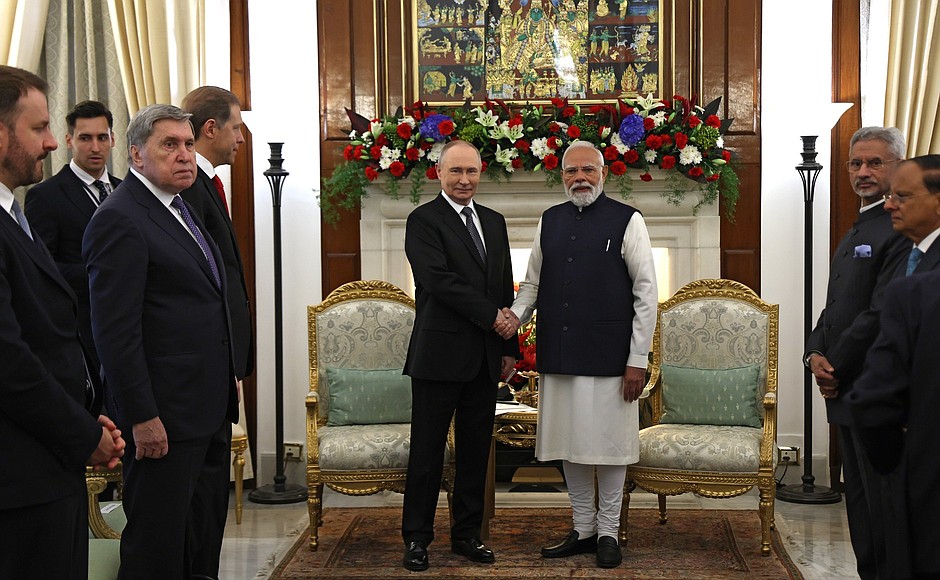
“I would note that the Prime Minister and I have established a close working and personal rapport. We have met at the Shanghai Cooperation Organisation summit in September, we maintain regular contact by telephone and personally oversee the development of our strategic cooperation across all key areas, as well as the progress of major bilateral projects,” Putin said.
On the nuclear front, the summit reaffirmed that cooperation would deepen: Putin highlighted the ongoing construction at the Kudankulam Nuclear Power Plant (KKNPP) — “Two out of six reactors have been connected to the power grid, while the other four are in the engineering and construction stages” — and floated future cooperation in small modular reactors, floating nuclear power plants and non‑energy uses. The joint text committed to “accelerate technical and commercial discussions on the VVER [VVER stands for “Vodo-Vodyanoi Energetichesky Reaktor” in Russian, which translates to “Water-Water Power Reactor” in English. It is a type of pressurized water reactor (PWR) used for generating electricity in nuclear power plants.]of the Russian design” while enabling localisation of equipment and fuel assembly manufacture in India.
On defence and military‑technical cooperation, the statement signalled a shift: rather than simply more imports, the emphasis is on joint research and development, co‑production and lifecycle support, aligning with New Delhi’s “Make in India” ambitions. The 22nd Session of the India‑Russia Intergovernmental Commission on Military & Military-Technical Cooperation (IRIGC‑M&MTC) was formally welcomed, and the partnership was described as re‑oriented toward joint development and manufacturing for Indian Armed Forces needs and even subsequent exports to “mutually friendly third countries.”
Financial architecture changes were highlighted as well: the summit underscored the use of national‑currency settlements, and agreed to work toward interoperability of national payment systems, financial messaging systems and central bank digital‑currency platforms, with Russian finance entities reportedly already using rupees earned from exports. The declared USD 100 billion trade goal by 2030 was tethered to practical measures — reduction of tariff and non‑tariff barriers, logistics optimisation, insurance and re‑insurance solutions — though no binding timeline beyond 2030 was provided.
Connectivity and logistics got geopolitical framing, too. Putin invoked projects such as a North‑South corridor via Russia and Belarus to the Indian Ocean, and the development of a Trans‑Arctic Transport Corridor and the Northern Sea Route as “ample opportunities for expanding bilateral trade.” Modi reiterated logistics and regulatory readiness, implicitly warning that infrastructure without stable regimes would not yield intended gains.
Soft‑power and people‑to‑people tracks got formal sign‑offs: labour‑mobility agreements, cooperation on health and food safety standards, multiple memoranda on broadcasting cooperation between Indian public broadcaster Prasar Bharati and a cluster of Russian media organisations, academic cooperation between Indian and Russian universities, cultural exchange projects, and visa liberalisation for Russian tourists. Putin said that the Russian RT channel will begin broadcasting to India “today,” aligning with his remarks that Russia remains committed to sharing information about its domestic developments, irrespective of outside pressures. Modi’s symbolic gift of the Bhagavad Gita translated into Russian complemented the practical visa liberalisation — an attempt to sustain people‑level ties alongside high‑level deals.
The full framework of deliverables and the language used suggest that the summit was configured to withstand scrutiny from third countries while advancing areas insulated from sanctions risk. Modi called labour mobility an instrument to “create new strength and new opportunities for both countries,” while Putin stressed that “many of these documents are aimed at expanding our economic partnership” and “we will work on this matter” in response to India’s list of concerns. The Indian side highlighted free e-visas and skilling linkages. The Russian side highlighted uninterrupted energy supplies and nuclear reactor cooperation. Neither leader publicly referenced defence procurement by name, although Putin pointed to fifty years of military-technical collaboration and Modi referenced “shipbuilding” and “Make in India” in the same paragraph.
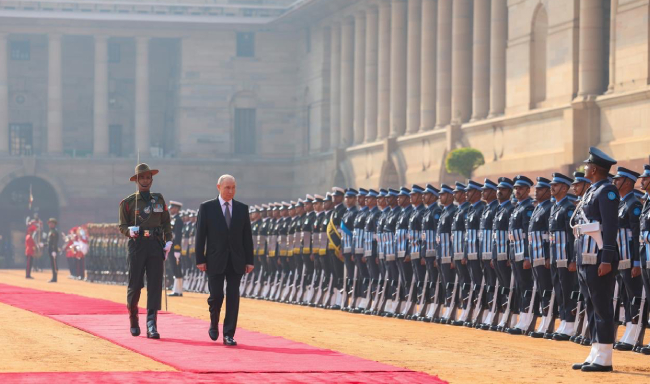
The summit closed with both leaders refraining from public controversy. Putin framed the partnership as a contribution to “a more just and democratic multipolar world order,” while Modi reiterated India’s avowed commitment to strategic autonomy and peacebuilding, including a willingness to “contribute” to efforts for a peaceful resolution in Ukraine. The joint statement reiterated cooperation in multilateral fora and Russia’s affirmation of support for India’s permanent membership of a reformed and expanded United Nations Security Council. No contentious operational commitments or quantified defence purchases were disclosed in the communiqués, reflecting deliberate opacity on matters deemed sensitive by both capitals.
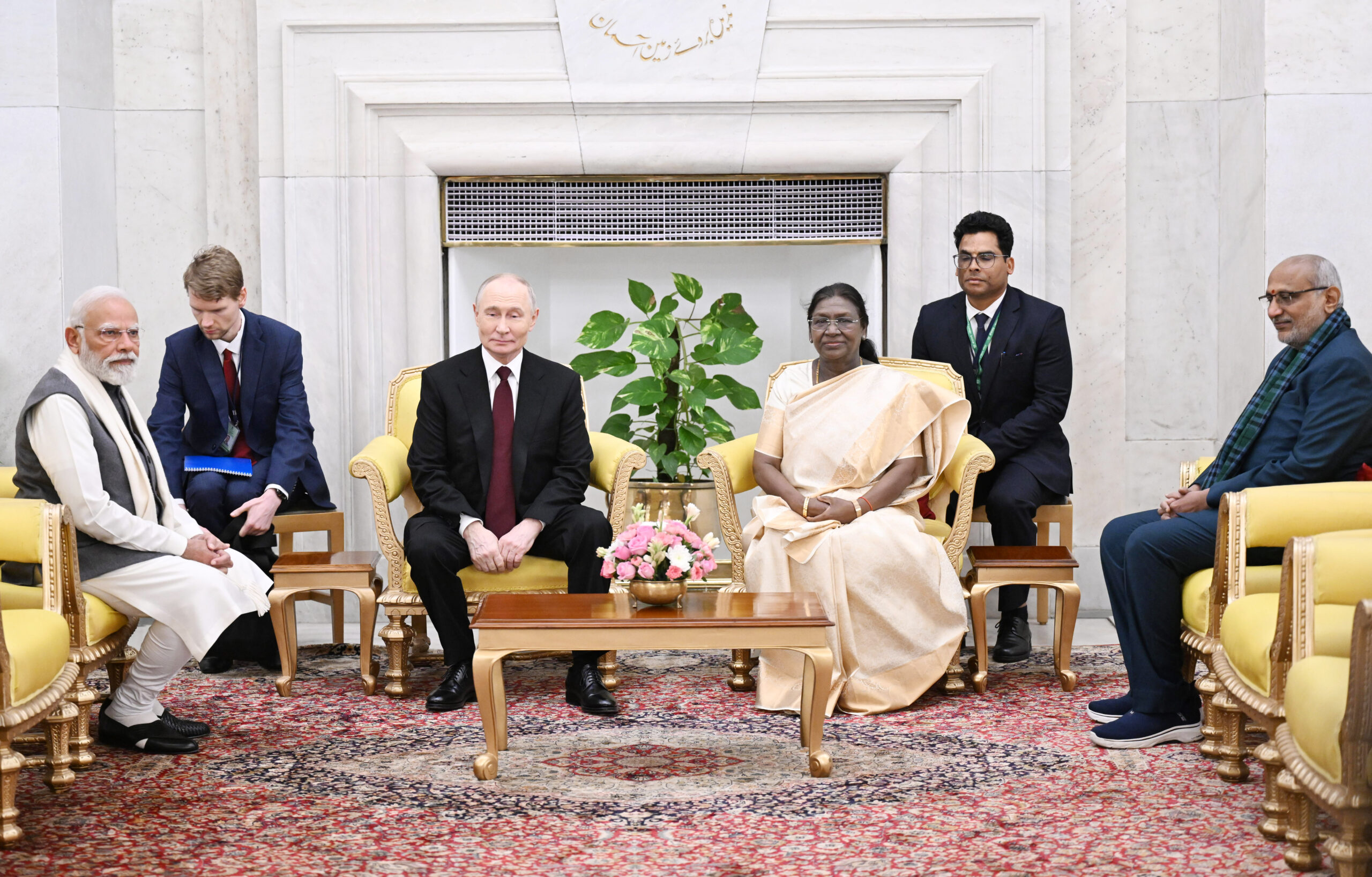
The President of India, Droupadi Murmu, who today hosted a banquet in Putin’s honour, said that the Joint Statement of the 23rd India-Russia Annual Summit reflects the special nature of the ties between the two nations and provides a comprehensive framework for further deepening the bilateral ties.
Taken together, the public record from the summit conveys an unmistakable pattern. The two governments have chosen incremental institutionalisation over headline deals: currency-based settlements, interoperable financial rails, energy and nuclear collaboration with embedded localisation clauses, and a defence relationship retooled toward co-development. The rhetoric of continuity was punctuated by explicit, operational commitments intended to deepen economic interdependence while preserving political flexibility. How those commitments translate into measurable outcomes — contract values, project timelines, localisation percentages and the composition of bilateral trade — will determine whether the summit’s language represents merely managerial maintenance of a historical partnership or a durable strategic re-anchoring.
Analyst commentary reported in a range of outlets emphasised the diplomatic tightrope India is walking: the visit was widely read as New Delhi asserting an independent foreign policy while insulating itself from potential secondary impacts. Coverage cited that some Western commentators and think-tank analysts viewed the meeting as testing India’s balancing act between deepening ties with Russia and maintaining partnerships with the United States and European partners; Reuters and Atlantic Council commentary mentioned that Delhi would aim to secure energy and technology while avoiding overt alignment that would jeopardise other relationships.
Outside India and Russia, global media interpreted the summit as a demonstration that both capitals intend to preserve and modernise their decades‑old partnership, even under growing Western pressure. Reuters described the agreements as a move to “expand and diversify bilateral trade beyond traditional oil and defence sectors.” Al Jazeera summarised one of Putin’s key pledges as a commitment to “uninterrupted shipments” of fuel to India — a stark signal after years of sanctions on Russian energy exports. The Financial Times interpreted the summit as a push to deepen cooperation on trade, defence, critical minerals and energy, while acknowledging that India was balancing “civil nuclear cooperation over oil imports amid U.S. criticism over fuel purchases.” Analysts quoted by The Guardian and other outlets framed the meeting as a political signal: according to a senior analyst with the International Crisis Group, the summit “underscores New Delhi’s strategic tightrope walk between the West and the rest, chiefly Russia.” Observers described the summit as a demonstration that “neither side has any intention to dilute this relationship, and is ready to withstand any external pressure.”
Notably, despite wide coverage, there is no publicly available record as of this evening of major global heads of state or government (outside India or Russia) issuing a formal comment or statement endorsing or condemning the summit in reaction to its outcomes.
Domestic reaction reporting noted friction with some European diplomatic circles: Indian media and diplomatic reporting flagged a pushback from the Indian Ministry of External Affairs to op-eds by European envoys and emphasised that New Delhi sought to treat the visit as a sovereign bilateral engagement rather than an endorsement of Russian policy. That reporting underscored the sensitive diplomatic background to the visit and the Indian state’s insistence that ties with Russia are longstanding and not targeted at third countries.
The summit is formally closed, but the diplomatic language used on both sides implies further negotiations across the next 12 months in logistics, energy, payments, nuclear civil technology, labour mobility and media linkage. The text of the outcomes confirms that both governments now have documentary commitments to attempt implementation.
– global bihari bureau