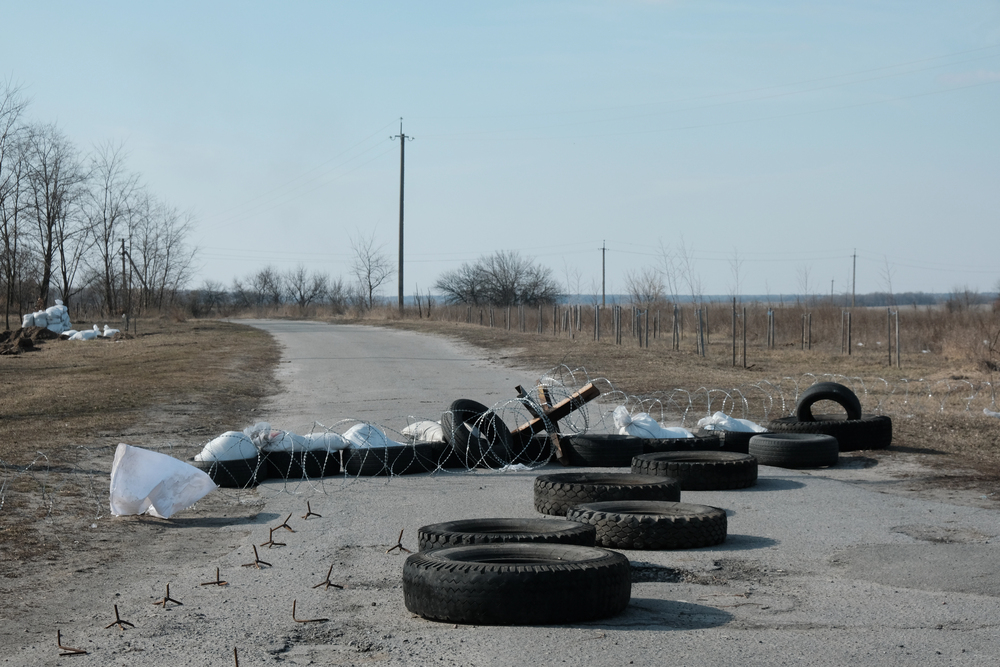
File photo of Hostroluchchya, Ukraine: 14 March 2022: Checkpoint near the village — Photo by Oles_Navrotskyi
War Leaves Ukraine’s Rural Heartland Starving
Kyiv: As the war in Ukraine continues, rural farmers and farming families face severe challenges in accessing their land due to landmines and a lack of financial resources for essential agricultural inputs. The Food and Agriculture Organization of the United Nations (FAO) has issued a stark warning that without immediate and sustained support, thousands of rural households risk being unable to plant or harvest on time, jeopardising national food security and rural livelihoods. The coming months are critical to ensure rural producers can sustain production through the winter and into the next season.
Addressing the needs of Ukraine’s rural communities requires more than emergency assistance; it demands a sustained, well-coordinated response to support agrifood systems. Across the country, rural households, many elderly or female-headed, rely heavily on agriculture for survival. These families are growing vegetables, tending to small livestock such as a single cow or a few chickens, and cultivating small plots of land, often under dangerous conditions, including shelling, unreliable electricity, and limited access to markets and supplies. Tasks once routine have become life-threatening in some regions due to the ongoing conflict.
Rein Paulsen, FAO’s Director of Emergencies and Resilience, recently visited Zaporizka oblast and underscored the urgency of the situation: “With the war still affecting millions, rural frontline communities remain among the most vulnerable and the least supported. These families want to provide for themselves and stay on their land. Emergency agricultural support is a highly effective way to enable them to do so.”
According to the Fourth Rapid Damage and Needs Assessment, conducted by the Government of Ukraine, the World Bank, the European Union, and the United Nations, Ukraine’s agriculture sector has suffered $83.9 billion in damages and losses, with an additional $1.6 billion in the irrigation sector. Rural households and small-scale farmers bear a significant portion of this burden, grappling with land contamination, labour shortages, rising input costs, and frequent power outages. Many lack basic tools, seeds, fertilisers, storage, and energy solutions needed to sustain production and protect their livelihoods.
Since 2022, FAO has provided critical support to over 250,000 rural families, distributing vegetable seeds, animal feed, day-old chicks, cash, and vouchers. Additionally, more than 15,000 farmers have received crop seeds, temporary storage solutions, and financial assistance. FAO has also collaborated with partners to survey mined lands, restore access to agricultural fields, and support national systems for monitoring and recovery.
Despite these efforts, the scale of need remains immense, and many rural families risk being left behind without further assistance. Paulsen emphasised the broader significance of this support: “Agriculture is a fabric of rural society. It’s not just a way to make a living—it’s a way of being. Vulnerable rural families are holding on. They need support not just to survive, but to thrive and rebuild.”
The FAO’s Emergency and Early Recovery Response Plan for 2025–2026 faces significant funding shortfalls, limiting its ability to fully address the crisis. With global funding constraints, FAO is calling on donors and partners to urgently redouble their support for Ukraine’s farming families, whose role in national food security, local economies, and long-term recovery is indispensable.
FAO stated today that it continues to work closely with national authorities and partners to deliver targeted assistance and strengthen Ukraine’s agri-food systems. The organisation is also intensifying advocacy efforts to ensure that the needs of rural communities remain visible and prioritised on the international agenda.
– global bihari bureau