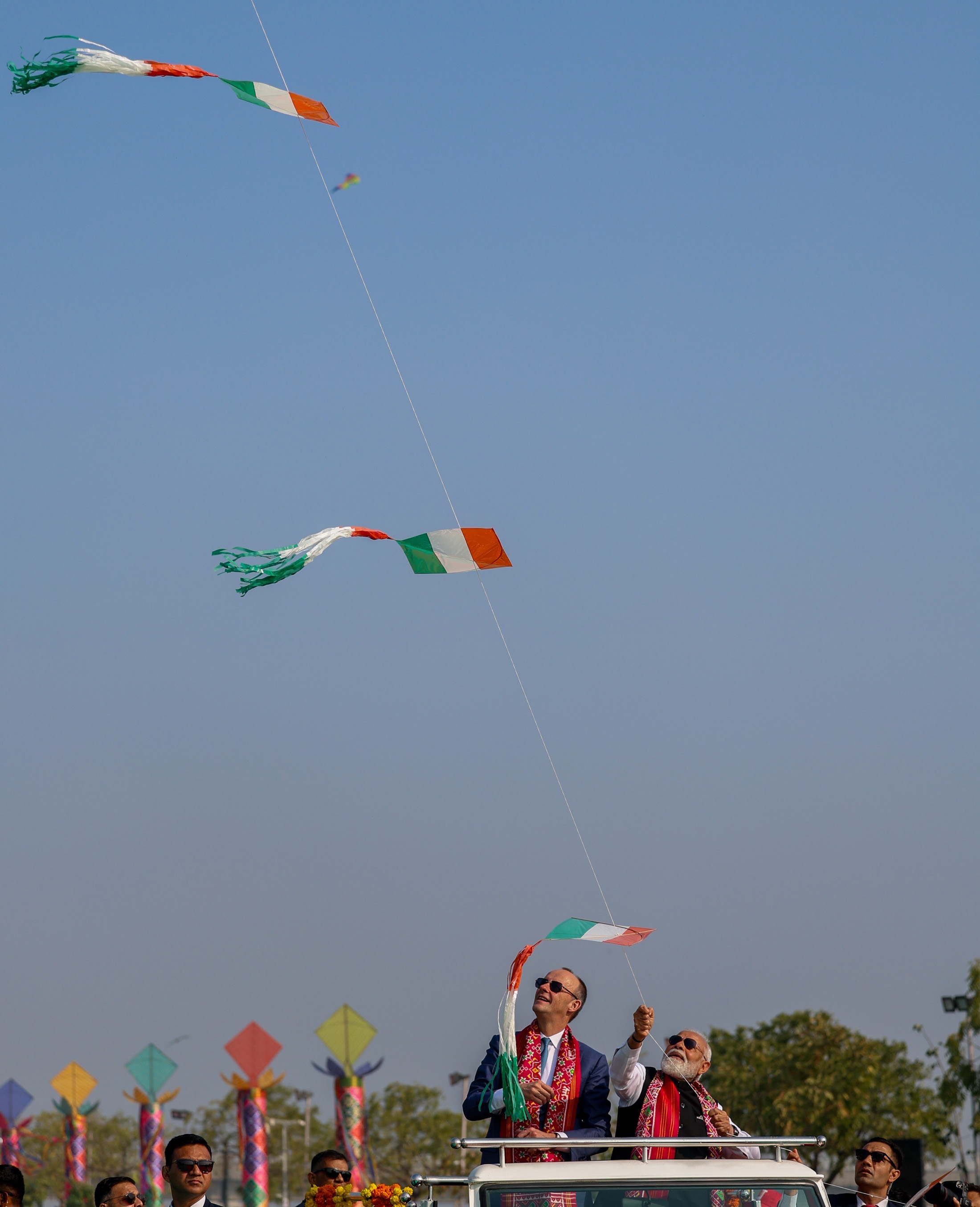
Prime Minister Narendra Modi and German Chancellor Friedrich Merz, fly kites at the International Kite Festival at the Sabarmati Riverfront at Ahmedabad, in Gujarat on January 12, 2026.
Merz’s First Asia Trip Boosts Indo-German Partnership
Germany-India Deepen Ties with Defence, Tech Deals
Ahmedabad/Bengaluru: Chancellor of the Federal Republic of Germany, Friedrich Merz, made India the first stop of his inaugural Asia visit since assuming office, signalling the growing strategic importance Berlin attributes to India within its Indo-Pacific policy. The visit, at the invitation of Prime Minister Narendra Modi, brought a high-level German delegation including 23 leading German Chief Executive Officers and industry leaders, and coincided with the 25th anniversary of the India-Germany Strategic Partnership and 75 years of diplomatic relations in 2026.
Prime Minister Modi welcomed Chancellor Merz in Ahmedabad, noting historical and philosophical links between the two countries, referencing figures such as Swami Vivekananda, Rabindranath Tagore, and Madame Bhikaiji Cama. Modi described the Chancellor’s choice of India as the first Asian destination as “a strong testament to the importance he places on relations with India,” reflecting trust in India as a partner in trade, technology, and global governance.
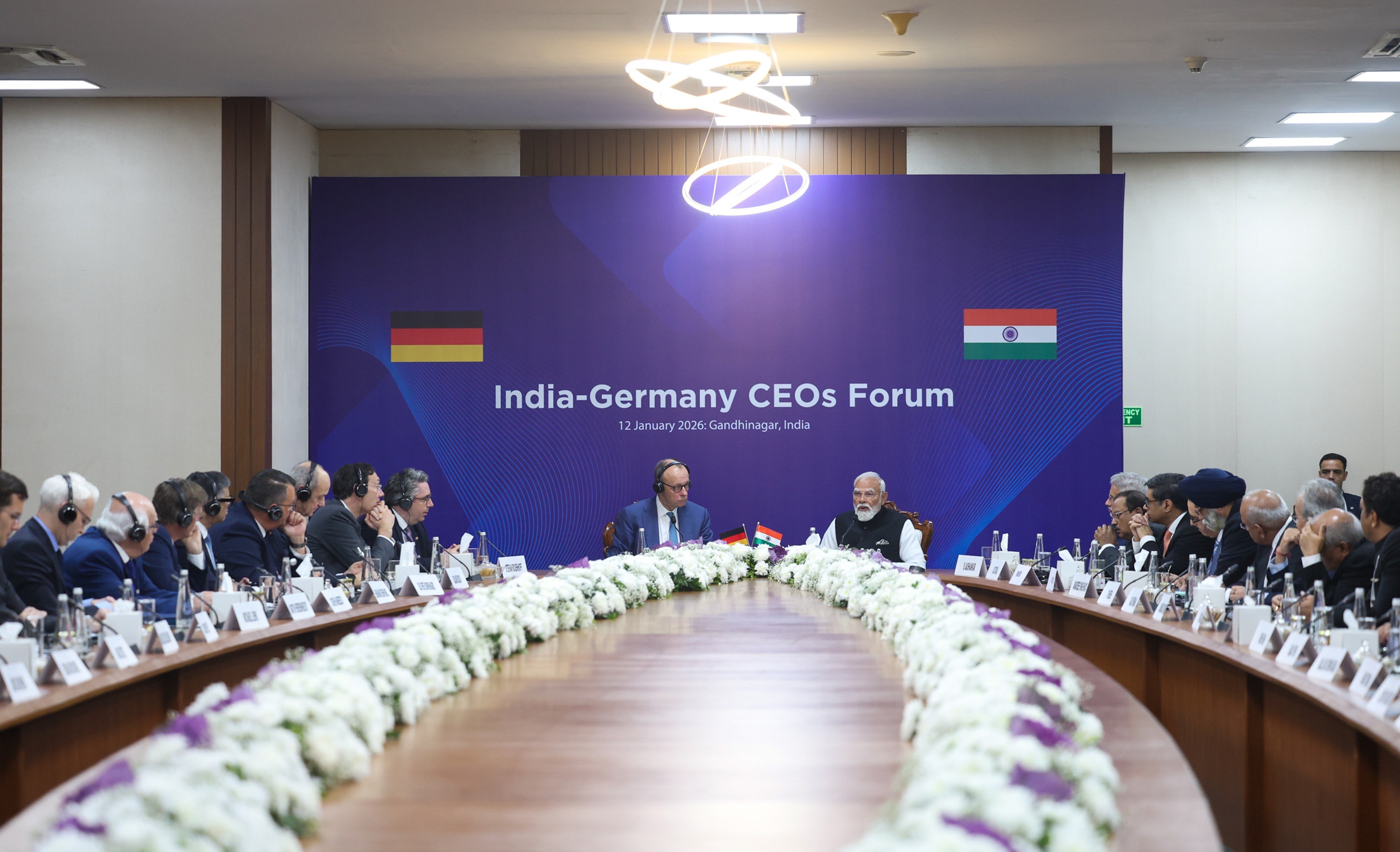
The visit combined ceremonial engagements with substantive policy discussions. The leaders paid tribute at Mahatma Gandhi’s statue at Sabarmati Ashram and participated in the Kite Festival before engaging with industry leaders at the India-Germany Chief Executive Officers Forum. Prime Minister Modi highlighted the bilateral trade of nearly USD 50 billion, the presence of over 2,000 German companies in India, and deepening collaboration in manufacturing, IT, automotive, energy, chemicals, and pharmaceuticals. He emphasised India’s skilled workforce and its potential to support German industry in critical and emerging sectors such as semiconductors, AI, biotech, and green energy.
In Ahmedabad on 12 January, Modi and Merz held restricted and delegation-level talks, reaffirming shared democratic values, commitment to a rules-based international order, and mutual respect underpinning the Strategic Partnership. Chancellor Merz stated that Germany’s engagement with India formed part of Berlin’s broader Asia recalibration, aimed at diversifying political and economic partnerships, strengthening strategic autonomy, and contributing to Indo-Pacific stability.
The visit produced 27 agreements and announcements: 19 MoUs and 8 additional commitments. Key areas included defence and security, trade and economy, critical and emerging technologies, renewable energy, green hydrogen, science and research, higher education, skills and mobility, cultural cooperation, and sport. Agreements covered the Joint Declaration of Intent on Defence Industrial Cooperation, the Indo-German Semiconductor Ecosystem Partnership, critical minerals collaboration, telecommunications cooperation, the All India Institute of Ayurveda–Charité University MoU, and a green ammonia offtake agreement between AM Green India and Uniper Global Commodities Germany. A bilateral Indo-Pacific consultation mechanism and Track 1.5 Foreign Policy and Security Dialogue were announced to institutionalise dialogue on regional security and maritime cooperation. Germany also committed to supporting the National Maritime Heritage Complex at Lothal, Gujarat, via the German Maritime Museum.
In defence and security, both leaders welcomed Germany’s participation in Indian naval exercises, including Exercise MILAN and the 9th Indian Ocean Naval Symposium Conclave of Chiefs, and deployment of a German Liaison Officer to the Information Fusion Centre–Indian Ocean Region. Discussions included cooperation on Eurodrone MALE UAVs, joint submarine development, counter-unmanned aerial systems, and facilitation of defence trade clearances. Modi acknowledged Germany’s efforts to simplify defence procedures and expressed confidence that co-development and co-production would strengthen long-term industrial collaboration. Both sides reaffirmed their commitment to combat terrorism and violent extremism in all its forms, in line with international law and the United Nations Charter.
Energy and climate cooperation was a key focus. Germany reaffirmed commitments under the Green and Sustainable Development Partnership, including funding and technical support for renewable energy, green hydrogen, urban mobility, climate-resilient infrastructure, and battery storage projects. While official sources confirm Germany’s prior commitment of EUR 10 billion through 2030, the visit reinforced ongoing bilateral collaboration and sectoral investment without specifying additional new allocations. Agreements included industrial collaboration, standards development, and technology transfer. Both leaders emphasised resilient and secure supply chains in semiconductors, critical minerals, and green technologies.
Science, research, and technology cooperation advanced with the extension of the Indo-German Science and Technology Centre, enhanced collaboration in bioeconomy, digital convergence, healthcare technologies, and battery innovation, and the establishment of Indo-German Centres of Excellence. The Indo-German Digital Dialogue Work Plan 2026–2027 was adopted to promote cooperation in internet governance, AI, Industry 4.0, and semiconductors. Cooperation between the Indian Space Research Organisation and the German Space Agency was also highlighted.
Education, mobility, and skills partnerships were strengthened through the Comprehensive Roadmap on Higher Education, a Joint Declaration of Intent on the Global Skills Partnership for healthcare professionals, and the establishment of a Centre of Excellence in Renewable Energy skilling. Germany announced visa-free transit for Indian passport holders, facilitating travel and deepening people-to-people ties. Cultural cooperation included joint initiatives in sport, maritime heritage, and the expansion of German language teaching in India.
Geopolitically, the visit occurred against the backdrop of Germany’s broader Asia recalibration, formalised in the 2020 Indo-Pacific Guidelines and the 2023 National Security Strategy. Berlin has sought to diversify engagement beyond China, responding to supply chain vulnerabilities exposed during the COVID-19 pandemic and the strategic consequences of the Ukraine conflict. India’s role as a major democratic economy, a net security provider in the Indian Ocean, and a bridge between the Global South and advanced economies was cited by the Ministry of External Affairs and the German Federal Foreign Office as central to this policy. Both leaders reiterated support for a free and open Indo-Pacific, adherence to the United Nations Convention on the Law of the Sea, and coordinated approaches to maritime security, connectivity, and regional stability.
Global challenges, including the Ukraine conflict, Gaza, climate change, and pandemic preparedness, were also discussed. Both sides reaffirmed support for diplomatic solutions, humanitarian principles, and coordinated multilateral action. Germany’s engagement with India was presented as complementary to European Union strategic interests, while India’s contributions to Global South cooperation—particularly in development projects in Ghana, Cameroon, and Malawi—aligned with Germany’s foreign policy objectives in sustainable development.
The visit concluded with engagements in Bengaluru focused on technology and innovation. Chancellor Merz emphasised innovation-driven collaboration, while both sides confirmed the next Inter-Governmental Consultations for later in 2026, signalling a shift from exploratory engagement to structured, long-term cooperation. Prime Minister Modi expressed confidence that the outcomes would give “new energy and clear direction” to the partnership, while Chancellor Merz underscored Germany’s commitment to expanding economic, technological, and strategic ties.
The visit reflects Germany’s transition from limited engagement to a sustained, institutionally anchored partnership with India. Analysts note that Germany’s first stop in Asia underscores recognition of India’s expanding role in global governance, regional stability, and supply chain diversification, positioning the bilateral partnership as a model for comprehensive multi-sectoral cooperation in the Indo-Pacific.
– global bihari bureau