Riyadh, Saudi Arabia
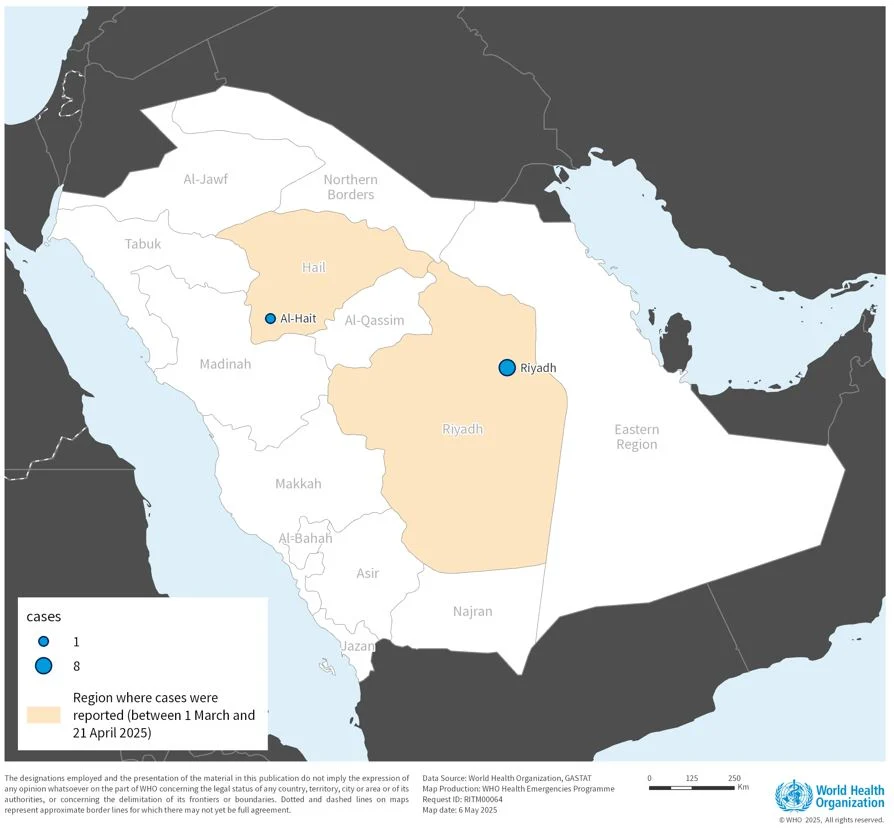
Riyadh/Geneva: Between March 1 and April 21, 2025, the Ministry of Health (MoH) in the Kingdom of Saudi Arabia (KSA) reported nine laboratory-confirmed cases of Middle East Respiratory Syndrome Coronavirus (MERS-CoV) infection, resulting in two deaths. The cases were geographically distributed, with eight in the Riyadh region and one in the Hail region. Among the infected individuals, five were male and four were female, the World Health Organization stated in Geneva today.
A significant cluster of seven cases was identified in Riyadh. This cluster involved six health and care workers who acquired the infection within a healthcare setting while caring for a single MERS-CoV patient. The identification of this cluster was a result of rigorous contact tracing and subsequent testing of all identified contacts. Notably, four of these six infected healthcare workers remained asymptomatic, while the remaining two exhibited only mild, nonspecific symptoms including myalgia, fatigue, nausea, and vomiting.
Of the nine reported cases, only one individual had a history of indirect contact with camels and was not part of the Riyadh hospital cluster. The remaining eight patients had no known history of direct or indirect contact with camels or camel products. Laboratory confirmation of all cases was conducted using real-time polymerase chain reaction (RT-PCR) between March 1 and April 16, 2025.
Despite this recent increase in cases, the WHO has assessed that the overall risk at both the global and regional levels remains moderate. The occurrence of these cases underscores the continued threat posed by MERS-CoV in countries where the virus circulates in dromedary camels, facilitating spillover into the human population.
Since the initial reporting of MERS-CoV in KSA in 2012, a total of 2627 laboratory-confirmed cases, including 946 associated deaths (Case Fatality Rate of 36%), have been reported to WHO from 27 countries across all six WHO regions. The vast majority of these cases (2218, or 84%) have been reported from KSA, including the nine recent cases. Since 2019, no human MERS-CoV infections have been reported from countries outside the Middle East.
In response to these cases, the Ministry of Health of KSA has implemented stringent infection prevention and control (IPC) measures within healthcare settings. These measures include regular training of health and care workers on IPC protocols, strict adherence to triage procedures, consistent use of personal protective equipment (PPE), and the implementation of isolation procedures for suspected and confirmed cases, along with prompt quarantine of contacts. Enhanced surveillance includes rigorous contact tracing and testing of high-risk contacts, including healthcare workers, and the ongoing inclusion of MERS-CoV in sentinel surveillance testing algorithms since 2023. Public health awareness campaigns are also underway to prevent human-to-human transmission, advising individuals with underlying chronic medical conditions to avoid close contact with animals, particularly dromedaries.
The WHO continues to emphasise the importance of strong surveillance for acute respiratory infections, including MERS-CoV, by all Member States. Delays in recognising early symptoms and implementing IPC measures in healthcare settings have been linked to previous outbreaks. Therefore, consistent application of standard and transmission-based precautions is crucial. These include ensuring adequate ventilation in patient care rooms, utilising single rooms with dedicated equipment, and the use of appropriate PPE. Early identification, case management, prompt isolation, and public health awareness are vital in preventing further human-to-human transmission.
MERS-CoV tends to cause more severe disease in individuals with underlying chronic medical conditions. Therefore, these individuals are particularly advised to avoid close contact with dromedaries and to observe general hygiene measures, including regular hand washing and avoiding consumption of raw camel milk or improperly cooked camel meat. Currently, WHO does not advise special screening at points of entry or recommend any travel or trade restrictions related to this event.
– global bihari bureau