 By Deepak Parvatiyar*
Himalayan Fury
18 Deaths in Bilaspur Landslide
Preventable Losses Demand Urgent Action
On October 7, 2025, at approximately 6:30 pm, a hillside in Himachal Pradesh’s Bilaspur district collapsed, engulfing a private bus in the remote Bhalughat area of Jhandutta under mud and boulders. The bus, carrying 30–35 passengers from Rohtak, Haryana, to Ghumarwin, vanished ~40 km from Bilaspur city. By October 8, at least 15 lives were lost (initial reports; later updated to 18), with others trapped. National Disaster Response Force, police, and fire services rescued three survivors, including two children, now in hospitals. Chief Minister Sukhvinder Singh Sukhu pledged relentless operations: “Rescue is on a war footing.”
Prime Minister Narendra Modi offered ₹2 lakh ex gratia for the bereaved and ₹50,000 for the injured. Union Home Minister Amit Shah noted the National Disaster Response Force’s efforts, and President Droupadi Murmu called it “heart-wrenching.” Deputy Chief Minister Mukesh Agnihotri faced a site destabilised by heavy rain—12.7 mm on October 7, above normal—worsened by climate shifts and human encroachment.
Himachal Pradesh’s 2025 monsoon toll is grim: 386 rain-related deaths (448 total, including accidents, by September 22), 218 from landslides, flash floods, and cloudbursts, with ~₹4,842 crore in damages. Mandi, Kullu, Solan, and Shimla report ~148 major landslides, ~98 flash floods, and ~47 cloudbursts since June 20 (provisional), shattering ~6,025 houses, blocking ~352 roads, and disrupting ~68 transformers. Authorities warn of rising tolls into November, as climate-driven deluges expose unregulated construction risks.
Uttarakhand’s scars run deeper still, its 2025 monsoon—the fiercest in four years—claiming ~263 lives across ~2,105 incidents (synthesis from state reports; ~951 in August). A cloudburst on August 5 in Dharali village, Uttarkashi, unleashed floods that erased homes, initially confirmed as killing five and leaving over 100 missing (including 28 tourists from Kerala). The state revised the figures to one death by August 12 and leaving ~66 missing. Late August and September deluges in Dehradun added 17 deaths and 13 disappearances. The State Disaster Response Force (SDRF) and Indian Army, wielding Mi-17 helicopters and C-130J transports, battled ~421% excess rainfall over 2 days during the August 5-6 cloudburst. Prime Minister Modi’s September visit signalled urgency, but experts point to ~15 western disturbances by August—potentially linked to Arctic warming per recent studies (Weather and Climate Dynamics, 2025)—compounded by potential Glacial Lake Outburst Flood (GLOF) risks.
In Jammu and Kashmir, an August 14 cloudburst in Chositi village, Kishtwar, obliterated the Machail Mata pilgrimage route, with the death toll rising from ~60 (August 15) to ~64 (August 18), injuring over 300, and leaving ~36-80 missing (provisional). Flash floods razed 10 houses, temples, and offices, stranding 200 pilgrims. Further strikes in Ramban, Reasi, and beyond on August 30 claimed 22 lives, including many children. Chief Minister Omar Abdullah reached the site as the NDRF dynamited boulders and the Army airlifted aid. A ₹209 crore central fund injection via the State Disaster Response Fund (SDRF) pales against the wreckage. Kathua’s August 17 cloudbursts added seven deaths.
West Bengal’s Darjeeling district, the tea-clad jewel of the sub-Himalayas, buckled under October 5’s onslaught—estimated ~300 millimetres [mm] of rain in 12 hours, birthing landslides that killed 23, including seven children, in Mirik Basti and Sukhiapokhri, snapping the Dudhia Iron Bridge. Initial reports estimate ~500 homes, ~67 roads, and ~5 bridges damaged (provisional), displacing 340 and stranding thousands of tourists. Chief Minister Banerjee, visiting on October 6, promised Bailey Bridge rebuilds, as three NDRF teams from Siliguri and Alipurduar searched for six missing amid red alerts. Governor C.V. Ananda Bose, cutting short a southern tour, now leads relief efforts.
This relentless monsoon, claiming hundreds of lives, injuring thousands, and uprooting tens of thousands, is no mere seasonal anomaly but a clarion of climate change’s escalating fury, compounded by human-induced vulnerabilities—and a marked escalation from 2023 and 2024’s devastating seasons.
Also read: Cloudbursts Crush Himalayas, Expose Fragile Future
In 2023, Himalayan states faced ~703 heavy rainfall events (synthesis from media/studies), with Himachal Pradesh alone recording ~428 deaths (300+ from July floods) and ₹9,500-12,000 crore in damages—equivalent to five years’ losses in one season. Uttarakhand saw ~1,800 landslides and 82 deaths, part of North India’s 1,200+ fatalities, while Jammu and Kashmir lost ~72 to floods and slides, and Darjeeling endured recurrent slides with hundreds affected.
In 2024, ~505 heavy rainfall events (La Niña recovery) caused 358 deaths in Himachal, ₹1,360 crore in damages from 101 cloudbursts, flash floods, and landslides. Uttarakhand logged ~1,000 landslides, killing ~100 and leaving 28 missing, while Jammu and Kashmir saw dozens dead.
By contrast, 2025’s record 765 heavy rain events in Himalayan states (up ~9% from 2023, ~51% from 2024, IMD analytical estimate as of September 24 ) drove Himachal’s 386 rain-related deaths (total 448, September 22 SDMA), ₹4,842 crore in damages, and Uttarakhand’s incidents soaring to ~2,105, with 263 deaths—a 163% jump from 2023. Jammu and Kashmir’s 2025 toll (68 in Kishtwar plus 22 elsewhere) exceeds 2023’s ~72, while Darjeeling’s 23 deaths and ~500 homes lost mark a sharp rise. The triennium shows a ~20% annual rise in hydro-meteorological deaths, fueled by ~17 western disturbances (up from 13-14) and intensified Bay of Bengal Low-Pressure Systems (LPSs).
To illustrate this escalating devastation, the following compact table captures key monsoon-related disaster metrics across 2023-2025, spotlighting the deadly interplay of natural forces and human recklessness:
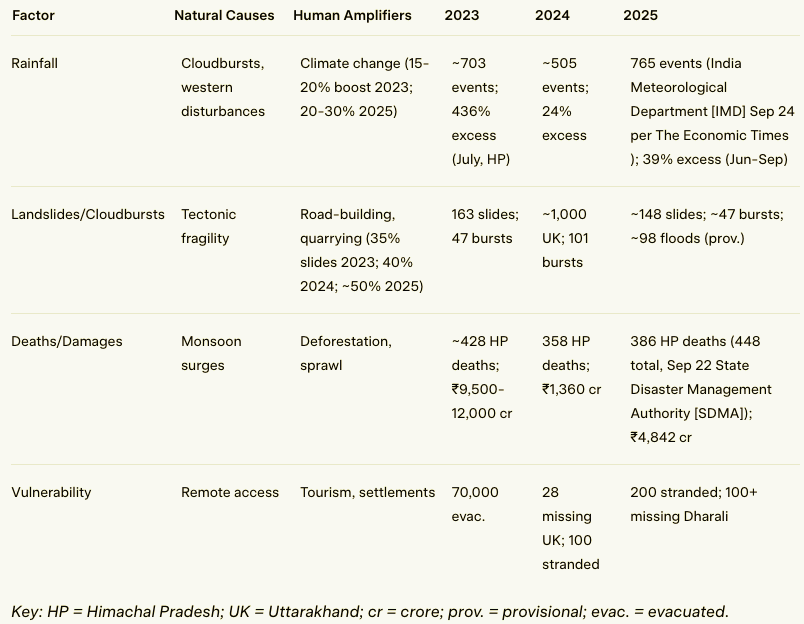
These Low-Pressure Systems, cyclonic circulations over the warm Bay of Bengal, drive 40-57% of monsoon rainfall, supercharged by a ~1 degree Celsius sea surface temperature anomaly, boosting moisture by ~14% and extremes by 20-30% (model estimates). This fueled Uttarkashi’s ~421% excess rainfall (August 5-6, local gauge) and Himachal’s 39% statewide surplus (June-September), the highest in 29 years. A warming atmosphere, holding 7% more moisture per degree Celsius, has intensified rainfall by 20-30% since the 1950s, with cloudbursts rising from ~47 in 2023 to ~47 by mid-2025 (provisional; trend suggests increase) and major landslides from ~163 in 2023 to ~148 by September 2025 (provisional; full-year likely higher).
Human recklessness amplifies these natural risks into hybrid disasters. A 2025 Catena study found road-cutting doubled slide density on Himachal’s National Highway-5 (NH-5), with ~50% of 2025 events tied to infrastructure (up from 40% in 2024, 35% in 2023). Uttarakhand’s Dharali flood was worsened by tourism sprawl, with 55-65% of incidents linked to altered hydrology (Springer 2025 ). Kishtwar’s devastation saw human-driven triggers rise to ~50%. Darjeeling’s losses trace to hill-cutting, with urban sprawl’s impact growing from 20% forest loss (2023) to 25% (2025, provisional). The United Nations Office for Disaster Risk Reduction (UNDRR) estimates 40-50% of losses are preventable (Global Assessment Report [GAR] 2025 ).
India’s disaster response, under the 2005 National Disaster Management Act, aligns partially with the Sendai Framework for Disaster Risk Reduction (2015-2030). The National Disaster Management Authority has ~168 seismic observatories and ~₹10,000 crore in state allocations. Landslide Hazard Zonation maps and estimated ~40 Doppler radars aid response, with the National Disaster Response Force’s 16 battalions and Kerala’s Artificial Intelligence slide prediction showing progress.
Yet, only 67% of national disaster risk reduction strategies meet Sendai’s 80% global average. Coordination falters across 28 states, and urban sprawl outpaces eco-restoration.
Earlier 2025 events, like Mandi’s September landslides (three deaths), exposed delayed warnings, echoing 2024’s Kedarnath delays (60% alert failures) and 2023’s post-July siloes (50,000 displaced without timely aid).
Sendai’s proactive tools—community micro-insurance (Philippines covers 30% at-risk households), AI-driven zonation (China), and eco-restoration (Ethiopia’s 4 billion trees)—are underused, with India reforesting limited high-risk slopes. India’s G20 Disaster Risk Reduction Working Group (launched 2023) and $6 billion mitigation funding (2021-2025) advance Sendai, but implementation lags, with hydro-meteorological deaths rising ~20% yearly.
Globally, the Sendai Framework’s seven targets—reducing mortality, affected populations, economic losses, infrastructure damage, and boosting strategies, cooperation, and early warnings—drive 136 countries’ plans, yielding 300-1,200% returns (e.g., Bangladesh’s flood apps, 80% coverage; Colombia’s slope-stabilising trees).
The UNDRR’s 2025 GAR urges $2.3 trillion annually for resilience. The International Consortium on Landslides’ Kyoto Commitment 2020 pushes data-sharing, underutilised by India despite 2023 Bay of Bengal Initiative for Multi-Sectoral Technical and Economic Cooperation (BIMSTEC) pledges. The United States’ Federal Emergency Management Agency (FEMA) Ready.gov and Spain’s Red Cross Urban Climate Resilience Programme cut fatalities 25% via integrated alerts. India’s 67% strategy coverage—lagging Japan’s 100%—underscores a critical gap.
The 2025 monsoon, with 765 deluges and 386 rain-driven deaths in Himachal alone, is a grim testament to a region unravelling under climate fury and human folly.
Up to 50% of losses are preventable, yet unchecked quarrying and sprawl persist. India must fortify early-warning systems to rival Bangladesh’s, harness AI like China’s, and reforest slopes to Ethiopia’s scale. Without bold reform, the Himalaya’s next slide will not merely scar the earth—it will shatter a legacy, leaving only grief where reverence could have prevailed.
*Senior journalist