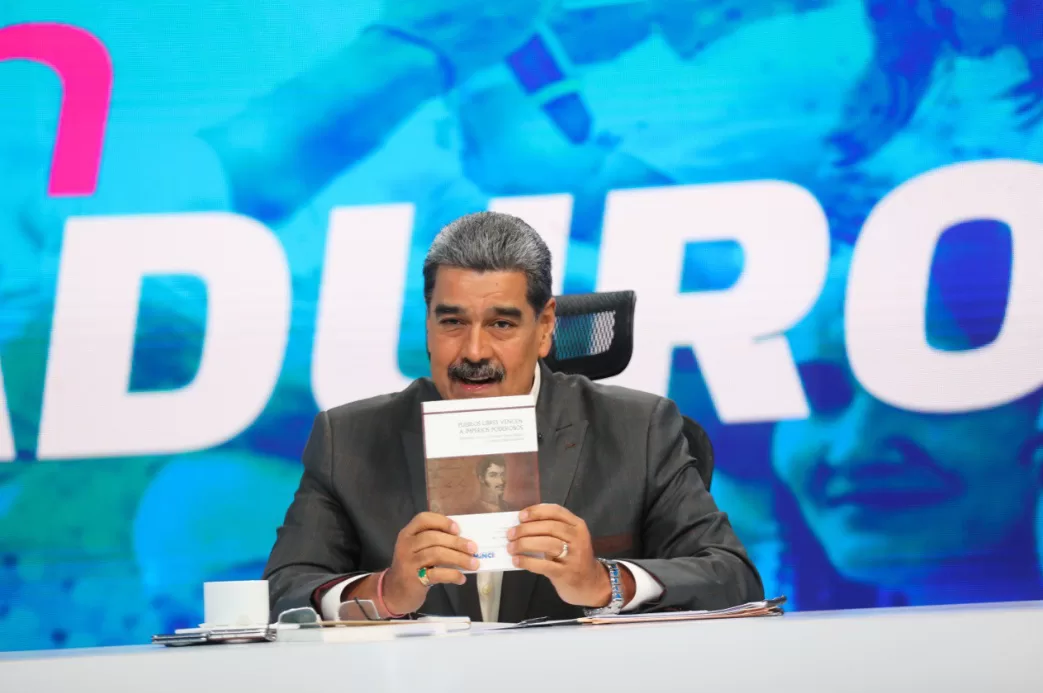
Nicolás Maduro Moros. Photo: Cortesía
Venezuela Braces for U.S. Anti-Drug Operation
Caracas/Washington: Tensions between the United States (U.S.) and Venezuela have escalated as U.S. warships approach Venezuela’s Caribbean coast, prompting President Nicolás Maduro Moros to mobilise millions of militia members to defend against what he calls an “imperialist” threat.
The administration of President Donald Trump deployed eight naval vessels, including three Aegis-class guided-missile destroyers—USS Gravely, USS Jason Dunham, and USS Sampson—and an amphibious squadron with USS San Antonio, USS Iwo Jima, and USS Fort Lauderdale, carrying approximately 4,500 Marines and sailors, starting August 19, 2025.
A guided-missile cruiser, USS Erie, and a nuclear-powered fast-attack submarine, USS Newport News, are expected to join by early September 2025, though their arrival remains unconfirmed, alongside P-8 Poseidon maritime patrol aircraft. The operation, set to span months in international waters, targets drug cartels like Venezuela’s Cartel de los Soles, designated a terrorist organisation by the U.S. Department of the Treasury in February 2025.
White House Press Secretary Karoline Leavitt emphasised Trump’s intent on August 19, 2025, stating, “President Trump has been very clear and consistent. He’s prepared to use every element of American power to stop drugs from flooding into our country.” The mission’s scope, whether surveillance or potential strikes, remains unclear, with a U.S. official noting the warships could support unspecified targeted actions.
Venezuela has responded with military and civilian mobilisation. Maduro announced the deployment of 4.5 million militia members on August 19, 2025, to protect national sovereignty, a figure analyst Carolina Jiménez Sandoval, president of the Washington Office on Latin America (WOLA), deems exaggerated, estimating 343,000 in 2020, many untrained, given Venezuela’s 28 million population. On August 26, 2025, 15,000 troops were sent to the Colombia-Venezuela border in Zulia and Tachira states for anti-narcotics operations, reportedly dismantling shipyards used for “narco subs,” though these claims lack independent verification.
Defence Minister Vladimir Padrino López announced naval patrols with warships and drones along the Caribbean coast on August 27, 2025, and a 30-day drone operation ban was imposed. Venezuela petitioned the United Nations (UN) to demand the U.S. halt its activities, with Foreign Minister Yván Gil citing the nuclear submarine as a violation of regional disarmament agreements. Maduro, in a televised address on August 17, 2025, vowed, “No empire will touch the sacred soil of Venezuela,” dismissing U.S. pressure as “the outlandish, bizarre threat of a declining empire.”
The U.S. operation aligns with intensified pressure on Maduro, indicted in a New York federal court in 2020 for narco-terrorism and cocaine trafficking. The reward for his arrest, initially $15 million, rose to $25 million under the administration of President Joe Biden and doubled to $50 million on August 7, 2025, under Trump. A $25 million bounty is also offered for Interior Minister Diosdado Cabello.
The U.S. accuses Maduro of leading the Cartel de los Soles, linked to Venezuela’s Tren de Aragua and Mexico’s Sinaloa Cartel, both designated terrorist organisations, though a National Intelligence Council memo notes no court-tested evidence supports these claims. Gil rejected the accusations as defamatory, noting Venezuela seized 53 tons of drugs in 2025.
U.S. Secretary of State Marco Rubio, speaking at a cabinet meeting on August 27, 2025, called the Maduro regime a “criminal enterprise” threatening U.S. national security, stating, “For the first time in modern history, we are truly on the offensive against organized cartels that are pumping poison—deadly poison—into our cities.” Rubio also referenced threats to U.S. oil interests in Guyana, saying, “The Maduro regime is not a government. It is a criminal enterprise that has taken control of national territory, threatening U.S. oil companies operating lawfully in Guyana.” He expressed scepticism about invasion, stating on August 1, 2024, per NBC 6 South Florida, “I don’t know of anyone who is advocating for that seriously within American policy circles.”
During the new edition of the programme “Con Maduro Más”, Maduro stated on August 26 that the “Miami mafia”, in the United States (USA), has all its power in Washington, DC. “The Miami mafia, which hates Venezuela, which hates Latin America, and which would like to be like the colonial mafia of the continent, linked to all corruption and drug trafficking, has power in Washington,” he declared. Likewise, he analysed the role of Marco Rubio, US Secretary of State, within the colonialist plans of that country.
The conflict traces back to Trump’s first term (2017–2021), when the U.S. imposed sanctions and an oil embargo, declaring Maduro’s government illegitimate. In 2019, the U.S. recognised opposition leader Juan Guaidó as interim president, severing diplomatic ties. The 2020 indictment escalated tensions, followed by the February 2025 terrorist designation of regional cartels. The disputed July 2024 election, where Maduro claimed a third term amid fraud allegations, led to U.S. asset seizures worth $700 million and renewed regime change rhetoric. Trump, in an August 2024 statement, called Venezuela a threat, saying, “I know it very well, and Venezuela is right now being run by a dictator,” blaming Maduro for drugs and criminals entering the U.S.
Public sentiment in Venezuela is mixed. Thousands, including civil servants and retirees like 78-year-old Omaira Hernandez, who said, “I know that because of my age I’m not going to carry a rifle, but I’m willing to help,” joined militia enlistment drives in Caracas, spurred by Maduro’s call to defend the “sacred soil,” as broadcast by state media Telesur. Others, like 52-year-old driver Pedro Martínez in Valencia, express scepticism, stating, “I sincerely don’t believe the American government will do anything. They make their announcements, but nothing happens.” The satirical website El Chigüire Bipolar mocked recurring invasion predictions from 2014 to 2024. Fears of repression linger, with the 2024 election crackdown killing 24 and leading to 2,000 arrests.
Venezuelan opposition leaders are divided. María Corina Machado, in hiding, supports the U.S. buildup, stating on Fox News on August 24, 2025, “This is the right approach to confront the criminal enterprise that has taken over Venezuela.” Edmundo González Urrutia, the exiled 2024 election candidate, urged the military to recognise him as commander-in-chief, saying in August 2025, per Cable News Network (CNN), “Put an end to the leadership” of Maduro, implying support for external pressure. Henrique Capriles rejected force, telling Al Jazeera, “I reject any act of force against Venezuela. The sanctity of our national sovereignty must be respected.” Magalli Meda, a Machado ally, expressed confidence in a transition, stating on Fox News on August 19, 2025, “In Venezuela, there is a solid leadership ready to assume the transition and rebuild the country from its institutions.”
The buildup could lead to significant consequences, though a full U.S. invasion is deemed unlikely due to Venezuela’s military and economic weaknesses. A U.S. official’s suggestion that warships could support targeted actions raises the possibility of naval confrontations or strikes, risking miscalculation and regional destabilisation. Colombian President Gustavo Petro warned that a U.S. attack could mirror Syria’s collapse, increasing migration and impacting Colombia’s state oil company, Ecopetrol. Brazil’s Vice President Hamilton Mourão stated Brazil would not allow U.S. troops to cross its borders unless attacked, reflecting regional caution. The deployment may embolden Venezuela’s opposition but alienate moderates like Capriles, deepening internal divisions. It could strain relations with allies like Guyana, which supports the U.S. but faces Venezuela’s accusations over the Essequibo dispute. Regionally, it risks polarising South America, with the Bolivarian Alliance for the Peoples of Our America–Peoples’ Trade Treaty (ALBA-TCP) nations like Cuba backing Maduro, while others align with the U.S. Brazil’s push for diplomacy via the Lima Group could be undermined. Disruptions to Venezuela’s oil trade, with its 303 billion barrels of reserves, could impact global markets and creditors, including China, which has invested $67 billion. Analyst Luz Mely Reyes suggested Trump may be pressuring Maduro to negotiate an exit or asserting dominance over Mexico and Colombia.
International reactions underscore the stakes. Venezuela’s UN mission denounced the deployment as a “serious threat to regional peace,” demanding guarantees against nuclear weapon use. The ALBA-TCP bloc, in an August 22, 2025, summit, condemned U.S. actions as illegal, with Cuban President Miguel Díaz-Canel stating, “Cuba firmly denounces this new demonstration of imperial force and makes a call to condemn this irrational attack by the Trump Administration.” The European Union (EU) has urged diplomacy, expressing concern about militarisation escalating tensions, though no direct statement addresses the 2025 buildup. China’s Foreign Ministry spokesperson Mao Ning, on August 21, 2025, said, “China opposes any move that violates the purposes and principles of the UN Charter and a country’s sovereignty and security.” Mexico’s President Claudia Sheinbaum rejected intervention, citing constitutional prohibitions.
Critics question the U.S. strategy. Former U.S. Ambassador Jimmy Story called it incoherent, noting Chevron’s operations in Venezuela. Drug policy expert Diego Garcia-Devis highlighted the lack of evidence for fentanyl production in Venezuela, a cocaine transit hub. Constitutional law expert Bruce Fein argues that entering Venezuelan waters without congressional approval violates the War Powers Resolution of 1973. The lack of court-tested evidence for Cartel de los Soles’ activities raises questions about U.S. motives, potentially tied to regime change.
– global bihari bureau