
Minakshi Temple, Madurai
Madurai Global Tag, Jewar Road Project Approved
New Delhi: The Union Cabinet today approved the declaration of Madurai Airport as an international airport, a move expected to strengthen connectivity and accelerate economic activity in the southern parts of the state while expanding India’s network of global aviation gateways.
Located in the historic temple city of Madurai in Tamil Nadu, the airport is among the oldest aviation facilities in the state and has long served as an important aviation hub for the region. Over the years, it has functioned as a key entry point to southern Tamil Nadu, facilitating travel for tourists, pilgrims and business visitors alike. The Cabinet’s decision to formally accord international status reflects both the city’s cultural prominence and the growing demand for improved air connectivity in the region.
With the inclusion of Madurai, India’s network of airports capable of handling international traffic expands further. Civil aviation records indicate that the country has around 36 designated international airports, and the addition of Madurai effectively raises the number to about 37. These airports form the backbone of India’s global aviation connectivity and are spread across major metropolitan centres as well as key regional hubs and tourist destinations.
Among the most prominent cities served by international airports are New Delhi, Mumbai, Bengaluru, Hyderabad, Chennai and Kolkata, which host some of the country’s busiest international gateways. Major international aviation hubs in these cities include Indira Gandhi International Airport, Chhatrapati Shivaji Maharaj International Airport, Kempegowda International Airport, Rajiv Gandhi International Airport, Chennai International Airport and Netaji Subhas Chandra Bose International Airport.
International air connectivity in India also extends to several important regional, commercial and pilgrimage centres such as Ahmedabad, Kochi, Thiruvananthapuram, Goa, Varanasi, Amritsar, Lucknow, Jaipur, Tiruchirappalli, Coimbatore and Guwahati. With Madurai joining this list, Tamil Nadu further strengthens its aviation footprint, complementing existing international gateways in Chennai, Tiruchirappalli and Coimbatore.
Government officials indicated that the upgrade is expected to significantly enhance regional connectivity, particularly by enabling direct international flight operations and improving links with overseas destinations. Such connectivity is considered crucial for expanding tourism flows, especially given Madurai’s standing as a major religious and cultural centre that attracts pilgrims from across India and abroad.
Beyond tourism and pilgrimage, the decision is also expected to stimulate trade and broader economic activity in southern Tamil Nadu. Improved air links could help integrate the region more closely with international markets, facilitating business travel, cargo movement and investment opportunities. Policymakers view the move as part of a broader effort to support regional economic development through improved infrastructure and connectivity.
The government noted that Madurai’s historical and cultural significance, combined with its potential to draw international pilgrims and business visitors, makes it well-suited for expanded aviation services. By granting international status to the airport, authorities aim to leverage this potential to support tourism growth and create wider economic benefits for the surrounding region.
The decision also reflects the rapid expansion of India’s civil aviation sector, which has been driven by rising passenger demand and a push for stronger regional connectivity. Authorities have outlined plans to significantly expand the country’s airport infrastructure in the coming decades, with the number of operational airports expected to grow substantially as India works toward becoming one of the world’s largest aviation markets.
In a related decision reflecting the government’s broader focus on strengthening aviation-linked infrastructure, the Cabinet Committee on Economic Affairs also approved the revised cost estimate for a major road connectivity project linking the upcoming Noida International Airport with the Delhi–Mumbai Expressway. The committee, chaired by Prime Minister Narendra Modi, cleared a revised total capital cost of ₹3,630.77 crore for the construction of a greenfield connectivity corridor from the Delhi–Faridabad–Ballabhgarh–Sohna spur of the expressway to the Jewar airport under the Hybrid Annuity Mode model across the states of Uttar Pradesh and Haryana.
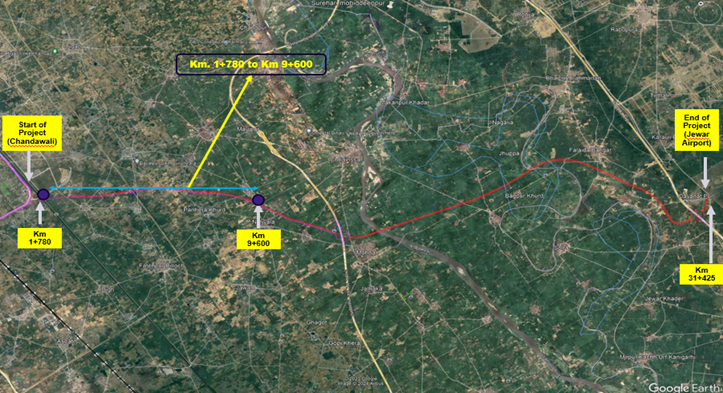
The planned 31.42-kilometre corridor is designed to provide direct and high-speed access to the airport from key parts of the National Capital Region, including South Delhi, Faridabad and Gurugram. Officials say the project is expected to promote economic growth and improve logistics efficiency across the NCR by creating faster and more seamless connectivity to the new aviation hub.
The corridor will intersect with major transport arteries such as the Eastern Peripheral Expressway, the Yamuna Expressway and the Dedicated Freight Corridor, thereby facilitating multimodal transport integration. According to the government, the proposed elevated corridor is intended not merely as a structural improvement but as a strategic infrastructure intervention aimed at catalysing urban transformation, enhancing regional connectivity and strengthening national logistics efficiency.
About 11 kilometres of the project will be constructed as an elevated highway, forming a crucial segment of the greenfield link between the DND–Ballabhgarh bypass and the Jewar airport while connecting it to the Delhi–Mumbai Expressway. The route will pass through areas identified for high-density urban development and future infrastructure expansion under the Faridabad Master Plan 2031. The additional cost associated with the elevated section has been estimated at ₹689.24 crore, of which the Government of Haryana has agreed to bear ₹450 crore.
Together, the decisions underscore the government’s broader strategy of combining airport expansion with supporting infrastructure to enhance connectivity, boost trade and tourism, and support long-term regional economic development. The decision on Madurai strengthens India’s international aviation network in the south, while the Jewar connectivity project aims to ensure that the country’s newest major airport hub in the National Capital Region is supported by efficient road links capable of handling future traffic and logistics demand.
– global bihari bureau