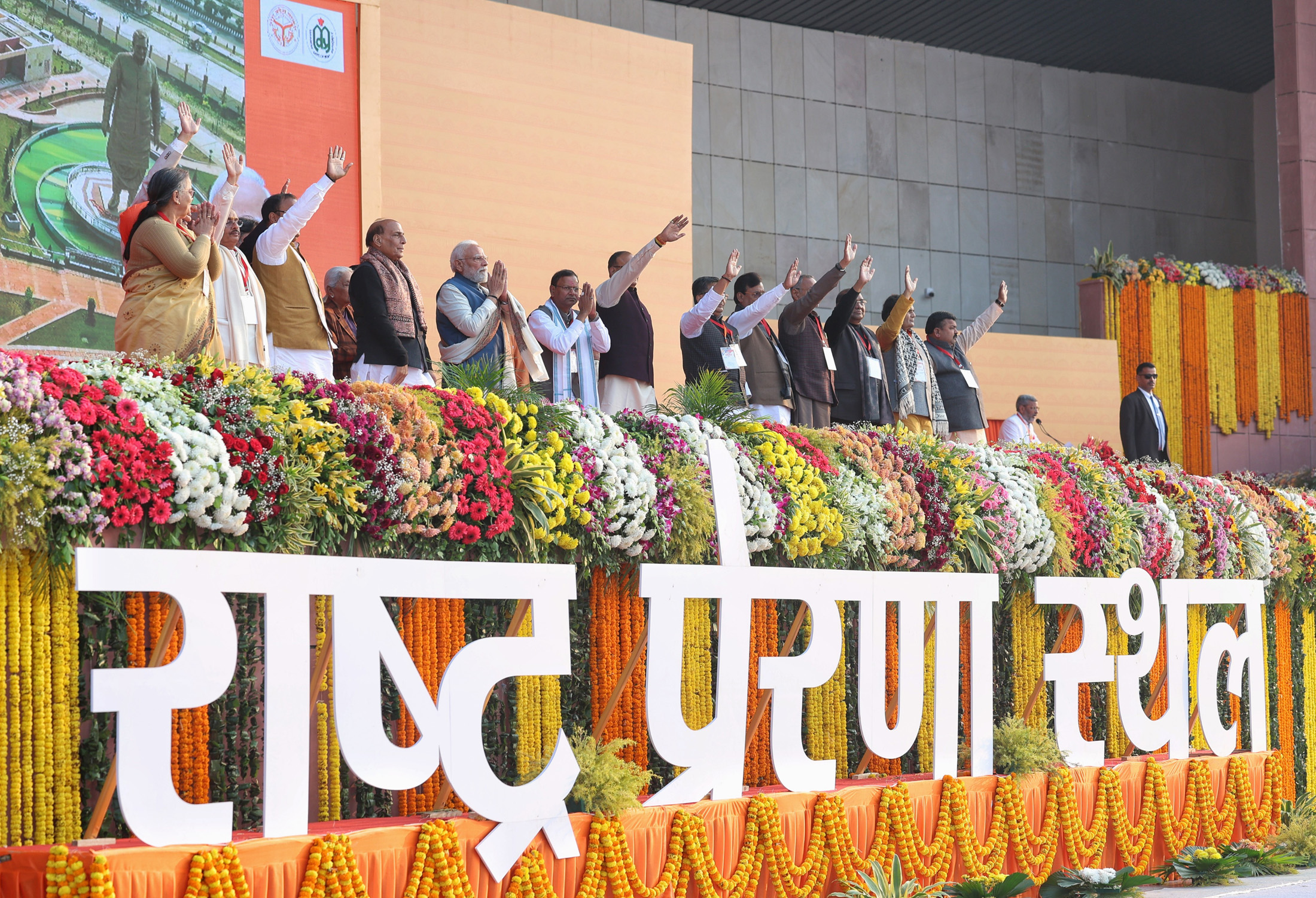
Prime Minister at the inauguration of the Rashtra Prerna Sthal at Lucknow, in Uttar Pradesh on December 25, 2025.
Monday Musing: Lucknow’s New Iconic Site
 By Onkareshwar Pandey*
Rashtra Prerna Sthal: Grand Homage or Selective Legacy?
India Urgently Needs a National Monument Policy
The inauguration of the Rashtra Prerna Sthal in Lucknow on December 25, 2025, by Prime Minister Narendra Modi—coinciding with the 101st birth anniversary of Atal Bihari Vajpayee—marks more than the unveiling of a new memorial. It represents the latest and perhaps most grandiose escalation in India’s intensifying contests over collective memory, often termed “memory wars.” This vast complex, spanning 65 acres along the Gomti river embankment and built at a reported cost of ₹230 crore (earlier estimates cited ₹320 crore), honours Atal Bihari Vajpayee, Deendayal Upadhyaya, and Shyama Prasad Mukherjee through towering 65-foot bronze statues (each weighing around 42 tonnes), a lotus-shaped two-storey museum spanning nearly 98,000 square feet with five galleries, immersive digital exhibits, and 12 interpretation walls, a 3,000-seat amphitheatre, meditation and yoga centres, a musical block, helipads, and a massive rally ground capable of hosting over two lakh people. Yet this ambitious project raises a fundamental question: does it genuinely serve as a site of national inspiration, or has it become a monumental platform for partisan legacy-building?

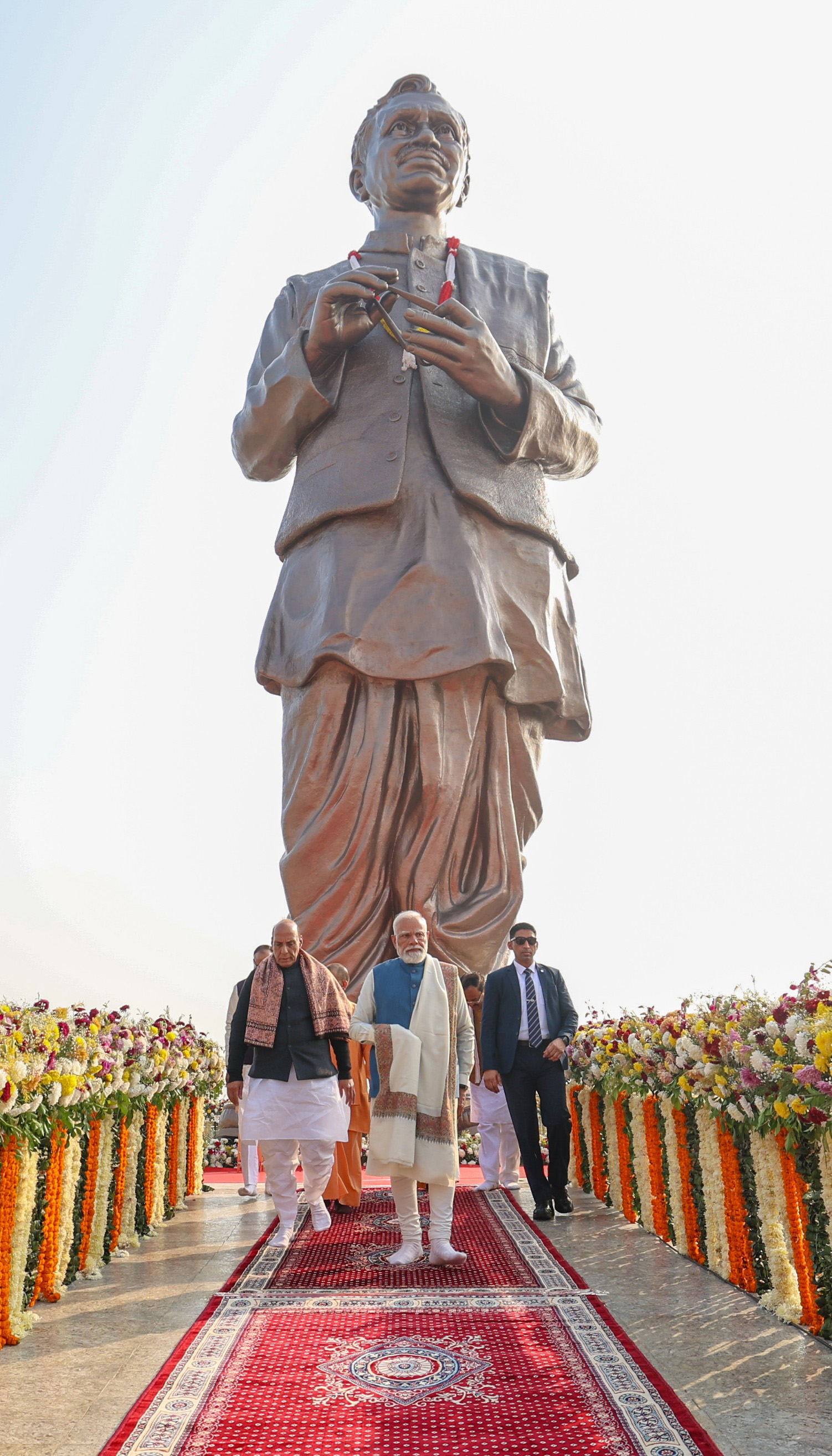
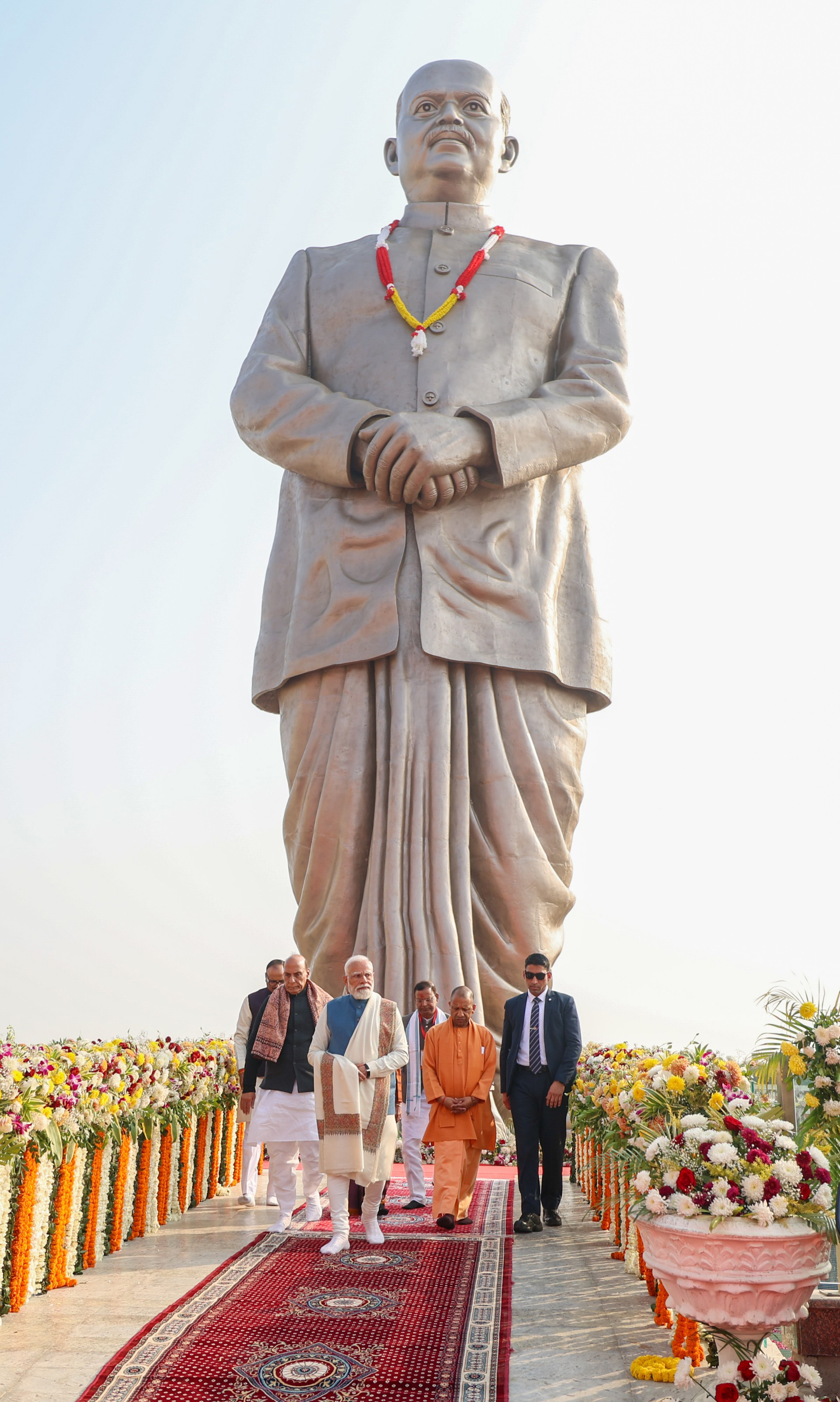
The very nomenclature “Rashtra Prerna Sthal” (National Inspiration Site) imposes an expectation of inclusivity that the complex conspicuously fails to meet. By enshrining a specific ideological trinity—Vajpayee, Upadhyaya, Mukherjee—it ties itself firmly to one political party’s lineage. This prompts a critical inquiry: if this is truly a national site, where is the representation of leadership spanning India’s diverse regions, from east to west and north to south?
A genuine national inspiration site would weave a tapestry of the country’s varied political and social thought. Where is Dr B.R. Ambedkar, the chief architect of the Constitution and a titan of social justice? Where is Narayana Guru, the radical social reformer from Kerala? Where are figures like C. Rajagopalachari, a stalwart of the freedom movement and the last Governor-General? The list of glaring omissions extends to former Prime Ministers and Presidents: Dr. Rajendra Prasad, India’s first President and Chairman of the Constituent Assembly; Lal Bahadur Shastri, who galvanized the nation with the Green Revolution and the slogan “Jai Jawan Jai Kisan”; Indira Gandhi, under whose leadership Bangladesh was liberated; P.V. Narasimha Rao, the pragmatic architect of India’s economic renewal; or even Chaudhary Charan Singh, V.P. Singh, I.K. Gujral, and H.D. Deve Gowda. Their absence is not an oversight but a deliberate statement, risking the reduction of the site from a “Rashtra Prerna Sthal” to something more aptly called a “BJP Prerna Sthal.” True national inspiration demands geographical and ideological pluralism. By offering a curated, homogenous narrative, the memorial alienates vast segments of the country’s cultural and political landscape, betraying the vision of a unified national heritage.
The financial magnitude of this project signals a dramatic shift from the austere ethos of earlier national memorials, fueling debate on fiscal priorities amid challenges like inflation, unemployment, and agrarian distress. Consider the profound simplicity of past tributes: Mahatma Gandhi’s Rajghat, built between 1948 and 1951, cost approximately ₹10 lakh at the time—an amount equivalent to roughly ₹10-12 crore today when adjusted for inflation. Shantivan for Jawaharlal Nehru and Shakti Sthal for Indira Gandhi similarly embodied solemn restraint, serving as spaces for quiet reflection rather than architectural spectacle in a young republic. The substantial expenditure here—not just a figure but a symbol—marks a paradigm change, where homage increasingly relies on overwhelming scale and state resources rather than the enduring strength of ideas and legacy. This evolution from modest remembrance to grand, sponsored magnificence defines the new politics of memory.
This pattern of reshaping historical narratives is not confined to Lucknow. It echoes in Delhi with the rebranding of the Nehru Memorial Museum & Library (NMML) into the Prime Ministers’ Museum (PMML). Far beyond administrative renaming, this subsumed Jawaharlal Nehru’s distinct legacy—as a central figure in the anti-colonial struggle and architect of modern institutions—into a generalised collective. A more inclusive alternative would have been constructing separate, dedicated museums for subsequent Prime Ministers, preserving each legacy’s unique space and context. Instead, the change diluted a formidable historical footprint. More strikingly, the inclusion of a gallery for a sitting Prime Minister in this state institution violates a longstanding democratic norm separating contemporary projection from historical memorialization, blurring the line between honouring the past and crafting it in the present—between state tribute and political branding.
The selectivity extends beyond mere inclusion to the very model of commemoration, creating a discriminatory two-tier system. Leaders aligned with the ruling ideology receive lavish, centrally funded, and aggressively projected tributes. The treatment of former Prime Minister Dr Manmohan Singh, however, reveals a different standard. His last rites were conducted at a common public cremation ground, a departure from the tradition of designated spaces for former Prime Ministers. Subsequently, the government announced the allocation of land to a private trust for his memorial, shifting the onus of funding and execution away from the state. This stands in stark contrast to the direct government machinery and treasury deployed for other leaders. The message is disquietingly clear: the state’s responsibility to commemorate its former leaders is now contingent on ideological alignment. Those outside a particular fold are relegated to a “trust model,” while those within it are elevated through “national projects.” This politicises the sacred duty of national remembrance, making it a reward for political conformity rather than a tribute to service.
An added irony emerges in the potential disconnect between the enshrined icons’ principles and contemporary rhetoric. Deendayal Upadhyaya’s ‘Antyodaya’ (upliftment of the last person) and ‘Integral Humanism’ emphasised social harmony and inclusivity, while Shyama Prasad Mukherjee championed strong federalism and debated central authority. Amid present-day discourse leaning toward majoritarian assertion and greater centralisation, the homage at these grand sites can seem ritualistic—a veneration of symbols detached from the diligent enactment of their core philosophies. The memorial risks becoming a repository for ideas honoured in display but unevenly pursued in practice.
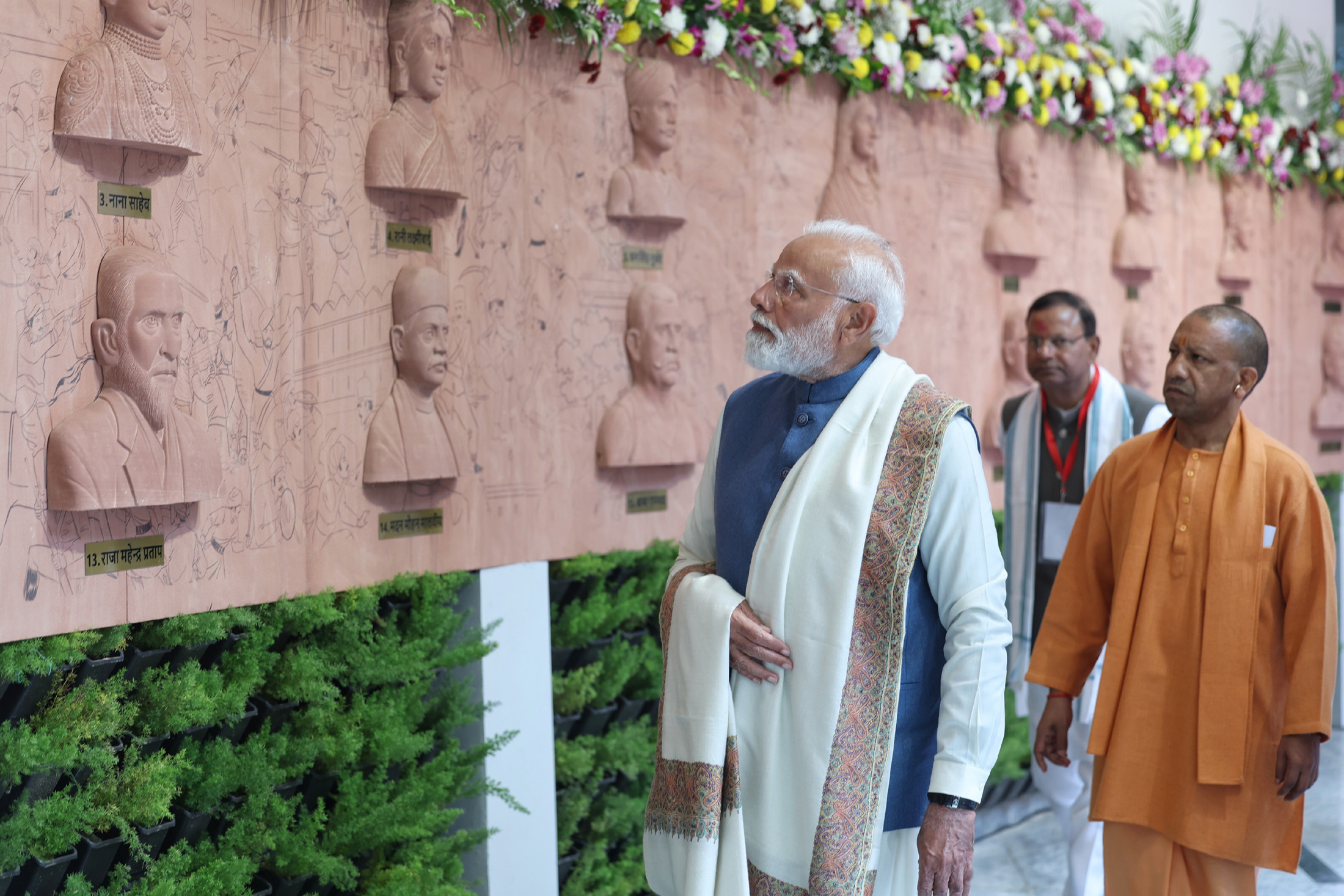
To resolve this deepening crisis of selective memory, India urgently needs a National Monument Policy, which does not yet exist as a unified framework for modern political memorials. Formulated by a broad-based, multi-party committee with statutory backing—perhaps drawing from models like the U.S. Presidential Libraries Act—it should establish transparent, non-partisan criteria for selecting honorees, impose stringent financial norms capping costs in line with public welfare ethics, and mandate diverse geographical, social, and ideological representation to reflect India’s composite genius. Transparent processes and institutional oversight are essential to restore faith, ensuring monuments foster unity and reflective learning rather than division or propaganda. True national inspiration arises from the full spectrum of a nation’s journey—its triumphs, debates, and plural voices—not a curated partisan rendition.
Until robust institutions shield collective memory from the tides of electoral politics, even the grandest and costliest memorials will stand less as symbols of shared heritage and more as fortresses in a contested present.
*Onkareshwar Pandey is a Delhi-based senior journalist and political analyst.