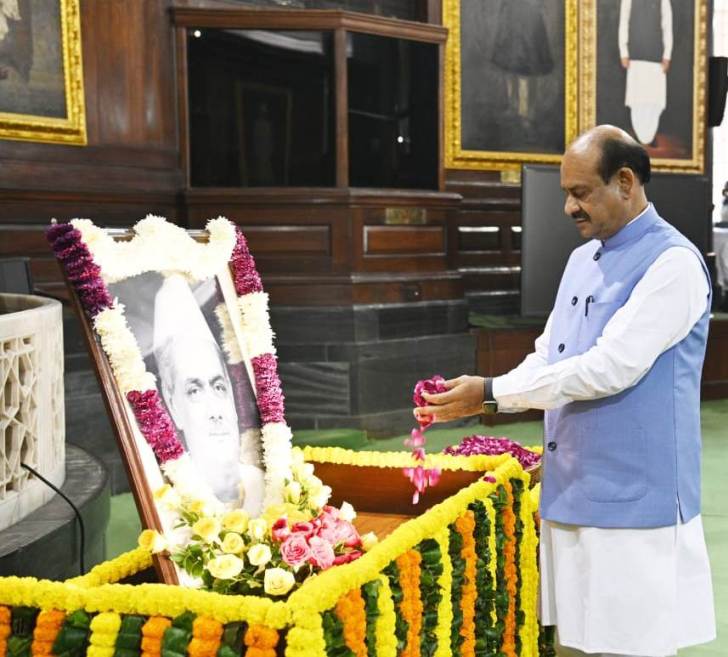
File photo of Lok Sabha Speaker Om Birla paying floral tributes at the portrait of former Lok Sabha Speaker, G.V. Mavalankar, on his birth anniversary on November 27, 2022
Debate over Speaker Reflects Deeper Constitutional Tensions
Removal Motion Spotlights Speaker’s Role, Powers and Rules
New Delhi: Freedom of speech in Parliament operates within the framework of constitutional provisions and the rules governing legislative procedure, Om Birla told members of the Lok Sabha, responding to issues raised during a debate on a motion seeking his removal from office. Emphasising that the rules of the House apply equally to all members, the Speaker said participation in debates must follow procedures adopted by the House itself.
The remarks came after the Lok Sabha concluded an extended discussion lasting roughly a dozen hours over two days following a resolution moved by Congress MP Mohammad Jawed seeking the Speaker’s removal under provisions of the Constitution of India. The motion, supported by more than a hundred opposition members, was debated in the House before being defeated in a vote, allowing Birla to continue in office.
The debate was notable both for its duration and for the constitutional questions raised by members across the political spectrum regarding the functioning of the Speaker’s office and the conduct of parliamentary proceedings.
During the discussion, several opposition members said the office of the Speaker occupies a critical position in India’s parliamentary democracy because it is responsible for ensuring that debates are conducted in accordance with established rules while allowing different political viewpoints to be expressed in the House. Some members argued that the presiding officer must maintain strict neutrality so that both the government and the opposition can participate fully in legislative discussions.
In their speeches, opposition MPs referred to Article 105 of the Constitution, which guarantees freedom of speech in Parliament, and said members must be able to raise issues of public importance and express their views during debates. Some speakers also raised concerns during the discussion about the conduct of proceedings and the opportunities available to members to intervene during debates.
Among the points mentioned by some opposition members were claims that their interventions had not always been recognised by the Chair or that microphones were not active when they attempted to speak. These concerns were raised during the debate as part of the arguments supporting the motion.
Members from the treasury benches rejected those assertions during the discussion and defended the functioning of the Speaker’s office. They said parliamentary proceedings are governed by established rules and conventions and that the presiding officer has the responsibility of ensuring that debates proceed in an orderly manner and that legislative business can be completed.
Responding to the issues raised during the debate, Birla told the House that while freedom of speech in Parliament is constitutionally guaranteed, it is exercised within the framework of rules adopted by the House. Those rules, he said, apply equally to the Leader of the House, the Leader of the Opposition, ministers and all other members.
“No Hon’ble Member in this House possesses any privilege to speak outside the framework of these rules,” the Speaker said while explaining the procedures governing debates.
Birla also addressed the question of microphones in the chamber. He said the presiding officer does not operate the microphone system directly and that microphones are activated through the recognition system used by the Chair, meaning that a member’s microphone becomes active only when the member has been formally permitted to speak under the rules of the House.
The Speaker further said that the office he occupies represents an institutional responsibility entrusted to him by the House. According to him, the Chair symbolises the democratic traditions of Parliament and the dignity of the legislature as an institution built over decades by successive presiding officers.
He noted that when the notice of the motion seeking his removal was introduced earlier in the session he did not preside over the proceedings while the House considered the matter, allowing the debate to proceed independently under the procedures governing such motions. The discussion that followed, he said, provided members from different political parties with the opportunity to present their views.
The episode has also drawn wider attention to the constitutional provisions governing the position of the Speaker in India’s parliamentary system.
Under Article 93 of the Constitution, the Lok Sabha elects a Speaker from among its members to preside over its proceedings. Article 94 provides that the Speaker may be removed through a resolution passed by a majority of the House. These provisions establish the Speaker as the principal presiding authority of the Lok Sabha.
In practice, the responsibilities of the office extend beyond presiding over debates. The Speaker is responsible for maintaining order in the chamber, recognising members who wish to speak, interpreting the Rules of Procedure and Conduct of Business, and ensuring that legislative work proceeds according to established parliamentary practices.
Because of these responsibilities, the position occupies a central place in parliamentary functioning. In a legislature where the government typically commands a numerical majority, opposition parties rely on procedural rules and parliamentary conventions to raise issues, question government policies and participate in legislative scrutiny.
Members participating in the debate therefore referred not only to the specific motion before the House but also to broader issues relating to the functioning of Parliament and the relationship between rules, debate and dissent.
Opposition speakers argued that effective legislative oversight requires adequate opportunities for dissenting voices to participate in discussions and raise questions concerning public policy and governance.
Members from the ruling benches responded that adherence to parliamentary rules is necessary to ensure that debates remain orderly and that legislative work can proceed without disruption.
In his remarks after the debate, Birla also referred to participation by members during discussions in recent Lok Sabhas. Citing parliamentary records, he said speaking time during debates is normally allocated in proportion to the strength of parties in the House. According to the Speaker, in several debates opposition members had received speaking time that exceeded their numerical allocation, as the Chair had extended discussions to allow more members to participate.
The Speaker said the Chair has also sought to ensure that representatives of smaller parties, single-member parties and independent members are given opportunities to participate in debates, in addition to members from larger parties. He added that women members and first-time MPs had also been encouraged to take part in discussions during his tenure.
Birla also referred to disruptions during parliamentary proceedings, including slogan-shouting, displaying placards, tearing papers and entering the Well of the House, and said such practices can interrupt legislative work and affect the functioning of the House.
While disagreement and vigorous debate are natural features of parliamentary democracy, he said the House must function within the framework of rules and conventions that govern its proceedings.
The Speaker recalled that conferences of presiding officers and parliamentary leaders held in 1997 and 2001 had emphasised the need to avoid such disruptions in legislative chambers. Those meetings, attended by leaders from multiple political parties, had recommended adherence to parliamentary decorum in order to ensure the effective functioning of legislatures.
Beyond the immediate political controversy, the debate also highlighted the broader institutional authority associated with the Speaker’s office in India’s parliamentary system.
The Speaker’s decisions determine the interpretation and application of parliamentary procedure, including the admission of motions, the recognition of members who wish to speak and the conduct of debates in the House.
Another significant authority vested in the office arises under Article 110 of the Constitution, which empowers the Speaker to certify whether a proposed law qualifies as a Money Bill. When legislation is certified as a Money Bill, the Rajya Sabha may only make recommendations and cannot amend the bill, while the Lok Sabha retains the final authority.
The Speaker also exercises an adjudicatory role under the anti-defection provisions of the Constitution’s Tenth Schedule. Under these provisions, the Speaker determines whether a legislator has violated party discipline in a manner that could lead to disqualification from membership of the House.
Because these responsibilities combine procedural authority with institutional influence, constitutional scholars often describe the Speaker as a central guardian of parliamentary functioning.
In many parliamentary systems derived from the Westminster tradition, the Speaker is expected to exercise these powers in a manner that commands the confidence of both the government and the opposition. In India, the Speaker is elected from among members of the House and does not formally resign from their political party after election, a structural feature that places particular importance on conventions of impartial conduct once the office is assumed.
The debate on the motion seeking Birla’s removal was therefore among the relatively rare occasions in recent decades when the functioning of the Speaker’s office was discussed at length in the Lok Sabha itself.
Although the motion was not adopted, the discussion highlighted the constitutional provisions, procedural rules and parliamentary conventions that shape the functioning of India’s national legislature.
For many observers of parliamentary practice, the episode illustrated the delicate balance inherent in the Speaker’s role: the responsibility to enforce rules and maintain order in the House while ensuring that the diversity of political viewpoints represented in Parliament can find expression through debate.
In that sense, the discussion served not only as a political confrontation but also as a reminder of the institutional framework that underpins parliamentary democracy in India and the importance of maintaining confidence in the rules and conventions that govern its functioning.
– global bihari bureau