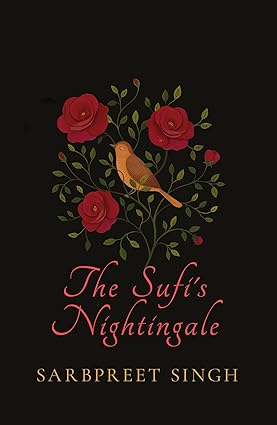
Literary Speaking: The Sufi’s Nightingale
 By Ranjit Monga*
An Ode to Madho Lal Hussain:
‘My love, your sweet face, dwells in my heart night and day’
‘Let me be your songbird, In your garden, let me stay’
So, how intense can love be? Can it lead two persons to become one or be known as one for eternity? Yes, if you are Madho Lal Hussain. They are two people united by love, and their story has endured for the past 500 years through poetry in the Sufi tradition, known as Kafis.
The poems or verses were written by Shah Hussain, a Sufi mystic based in Lahore (now in Pakistan), who expressed his love for Madho Lal in the 16th century, as vividly portrayed in the fictional book ‘The Sufi’s Nightingale’.

“I have remained true to the major events in their life, while reimagining the rest, giving an account of the lives of Hussain and Madho. Most importantly, it is an ode to Shah Hussain’s magnificent poetry. The book is very much animated by his beautiful kafis,” says the author, Sarbpreet Singh.
Speaking about the genesis of the book, Singh informs that initially he wanted to write a biography of the 16th-century Sufi mystic. “This came after I had been singing Hussain’s kafis for several years. I was intensely curious about the man who could write such magnificent poetry. But when I started researching, I discovered that the amount of biographical information was very tenuous. Then, there was a lot of lore that swirled around him, so there was not enough material to base a biography on. And, as I write both fiction and non-fiction, I decided that I would use whatever information I could gather as a framework and then fill the rest in with my imagination,” he says.
Based in Boston, United States, Singh is a celebrated author of many books on Sikh history. He is also a playwright, podcaster, commentator, and singer. Some of the books authored by him are The Camel Merchant of Philadelphia, Knight of the Restless Spirits, and The Story of the Sikhs 1469 to 1708. His latest book is ‘Cauldron, Sword and Victory’, which is a recounting of the history of the Sikhs in the 18th Century. His podcast, known as ‘Story of the Sikhs’, has listeners in 90 countries. He is also the founder of the Gurmat Sangeet project, a non-profit dedicated to preserving Sikh sacred music.
Sarbpreet Singh was also aware of the fact that there are multiple opinions about the exact nature of the relationship between Hussain and Madho. “If you read some of the older scholars, they completely dismiss the notion that Hussain and Madho were lovers. And you know, they point to the fact that some authors have suggested that Shah’s Kafis, some of them at least, were love poems written to Madho, and they debunked that claim fairly legitimately, in my opinion, by pointing to the broader tradition of devotional poetry from the Indian subcontinent. Whether it’s the Sufi context, whether it’s the Bhakti context, whether it’s the Guru Granth Sahib, and other, faith based poetry from the Indian sub-continent, the divine is often addressed in very romantic terms, so the expression of love is not for an individual, but it’s for the divine,” Singh points out. “There are other scholars, modern scholars, who very strongly reject the notion that Hussain and Madho were not lovers,” he informs.
Singh, who grew up in Gangtok, in Sikkim, himself is indifferent to the exact nature of the love between Shah Hussain and Madho. “I will go as far as to say that I am a little disappointed by the almost sort of salacious interest that a lot of people take in the exact nature of the relationship. Isn’t it enough to know that they loved each other intensely? So intensely that they lie buried in the same mausoleum on the outskirts of Lahore, so intensely that Madho succeeded Shah Hussain in the Sufi order and over time their very identities have merged,” he elaborates.
“I think, given the good response that the book has received, I am pretty happy with how I address their relationship. The reason I keep it a mystery is that it is a mystery. You know, we do not have historical records that tell us what the relationship was. And I am very content leaving this mystery intact,” he explains.
Since Hussain was a Sufi mystic, Singh enlightens readers about various Sufi concepts, including malamati. “Several faith traditions recognise that our ego is often the root cause of a lot of our suffering. Sufi practice emphasises the subduing or the control of one’s ego. And one of the most difficult paths in Sufi practice is the path of malamati. The term malamati means blame. So, what the malamatis do to suppress their ego, they wilfully indulge in actions that are designed to invite the contempt and abuse of the world. The abuse is a mechanism for them to control their ego. The path of malamati is an extremely difficult one,” he explains.
Singh admits that there is no specific historical record that states that Hussain was a malamati. “If you look at his poetry and if you immerse yourself in his poetry and try to understand it, you find this strain of malamat constantly. It is a recurring theme, and certainly, there is a lot of consensus among scholars who have studied Shah Hussain that he was a malamati,” he clarifies.
Elaborating on the storyline, Singh describes how a young boy, handsome and arrogant, is accosted by an older fakir. He does not know what he wants from him. He initially completely rebuffs Hussain. And then he enters his circle and becomes his disciple. Then he becomes Hussain’s most beloved disciple and also becomes his successor in the Sufi order. The story is told through the eyes of Maqbool, also known as Maqboola, a disciple who becomes jealous of Madho. Singh presents the story skilfully, immersing the reader in a bygone era.
After Madho becomes a disciple, he is constantly ridiculed by his former friends. His masculinity feels threatened because his friends insinuate that he is Hussain’s lover. That causes him to leave and become a soldier. He travels to various regions of the subcontinent, as indicated by historical records.
Singh has adapted the book for the stage and has already conducted some shows in Boston. He is presently scouting for partners to bring it to the stage in India. He announced plans for a film adaptation, directed by his daughter, who is an established filmmaker. “We are both committed to bringing ‘The Sufi’s Nightingale‘ to the screen, and are currently collaborating with a talented young screenwriter on the script,” he states.
To listen to the full episode, click below:
On Spotify:
*Senior journalist