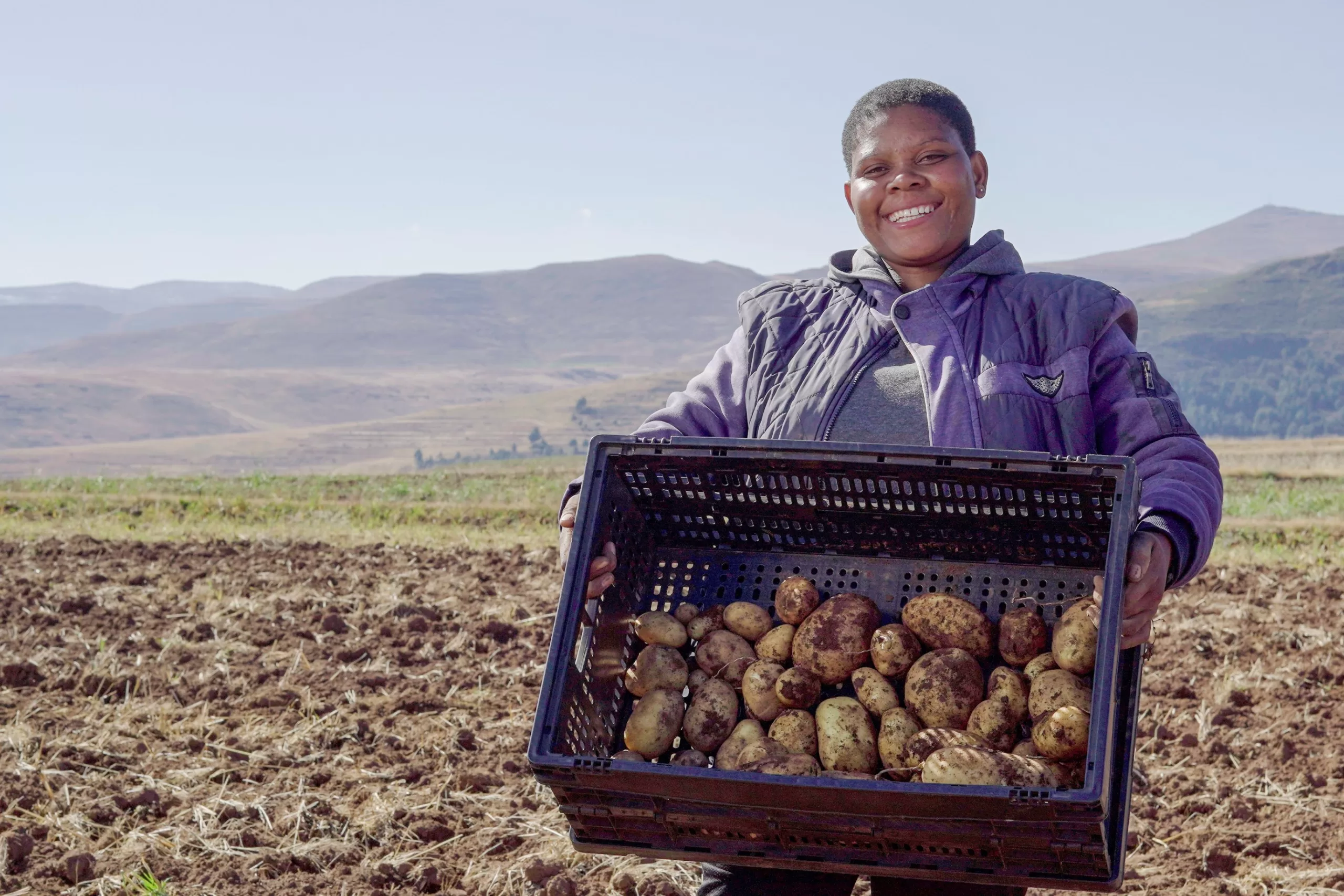
The potato is now a symbol of national transformation. Lesotho chose the potato as its priority product and joined FAO’s One Country One Priority Product (OCOP) initiative in 2022. ©FAO/ Carl Houston McMillan
Potato Power Drives Lesotho’s Food Security
In the mountainous terrain of Lesotho’s Maseru District, where craggy peaks and rolling highland plateaus define the landscape, Mabitsoane Diholo, a 53-year-old farmer and mother of seven, works diligently on her farm. The potato, once a modest crop grown to feed her family, has become the cornerstone of her livelihood. “This potato has built my house. It has educated my children,” she says. “I used to grow potatoes just to eat at home and feed my children. Now, it is my livelihood.”
The potato’s significance extends beyond Mabitsoane’s farm, symbolising a national transformation in Lesotho. In 2022, the country joined the One Country One Priority Product (OCOP) initiative, launched by the Food and Agriculture Organization of the United Nations (FAO), selecting the potato as its priority crop. This initiative has supported 750 farmers, including Mabitsoane, who is a lead farmer and active member of the Potato Lesotho Association. Beyond farming, she runs a roadside eatery and mentors others in her community.
Previously, Mabitsoane sold surplus potatoes by the roadside. Still, with seeds and fertilisers provided through the OCOP initiative, her yields have increased, enabling her to supply the Maluti Fresh Produce Market in Maseru. The initiative’s focus on connecting farmers to local markets has stabilised and boosted their incomes. “I get paid twice a week. This has changed our lives,” Mabitsoane says. “Before, we sold by the roadside and got cheated. Now, people come back again and again because they know my potatoes are good.”
Thabo Khalema, manager of Maluti Fresh Produce Market, underscores its importance to Lesotho’s horticulture industry. “This market is pivotal,” he says. “It gives local farmers a path to commercial farming, with fair pricing, transparency, and real income. They’re no longer just producers—they’re entrepreneurs.”
Nthimo Mokitinyane, FAO’s OCOP Focal Point in Lesotho, explains that while potatoes were already widely grown, coordination was lacking. “Now, with better seeds, improved practices, and market access, farmers are moving from subsistence to commercial farming,” he says. Pilot areas have seen productivity increases of up to 20 per cent, and farmers are now making data-driven decisions. “It’s no longer guesswork—it’s business,” Mokitinyane notes.
Women, who comprise over 60 per cent of OCOP-supported farmers, are driving this shift. “They are the first to show up, to try new practices, and to share knowledge,” Mokitinyane says. Mabitsoane echoes this, stating, “I’m not working for myself only. I’m working to uplift my fellow women. This project is giving us the power to take care of our families.”
Maleuta Mahao, a 27-year-old farmer who began two years ago, embodies this empowerment. Starting with 25 kilograms of seed, she recently harvested over 300 kilograms of potatoes. “I used to think farming was just digging,” she says. “Now I know it’s business—about profit, planning, and feeding the nation.” The OCOP initiative helped her gain confidence, and she now inspires others in her village. “People ask me, ‘How did you do it?’ I tell them: ‘start small, work hard, and keep going’.”
His Majesty King Letsie III, an FAO Special Goodwill Ambassador for Nutrition, highlights the potato’s potential. “Women have been at the forefront of agricultural production for decades,” he says. “If we unlock the commercial potential of the potato, it can empower rural women and attract young people struggling to find jobs.” He emphasises the need for investment and markets to ensure farmers can sell their produce and reinvest.
Lesotho’s high-altitude climate is ideal for potato farming, making it a cornerstone of the country’s food security and economic resilience strategy. Kutloelo Kothoelo Molapo, Project Coordinator of the Potato Lesotho Association, says OCOP has transformed farmers’ mindsets. “Our members used to be subsistence growers,” she says. “Now they’re talking about contracts, quality standards, and profit margins.” The Association ensures farmers meet market demands, delivering clean, sorted potatoes free of rot.
Minister of Agriculture, Food Security, and Nutrition, Thabo Mofosi, describes OCOP as a game-changer. “We used to rely heavily on imports,” he says. “Now, with this initiative, we’re building local capacity to produce more.” The program supports the entire value chain—production, processing, transport, and markets—creating jobs, income, and dignity.
Maleuta dreams of supplying potatoes nationwide. “I want to grow for the whole country—not just for my village,” she says. For Mabitsoane, farming has funded her daughter’s university education. “She wants to be like me,” she says proudly. “A businesswoman.”
King Letsie III envisions a future where children in farming communities grow up healthy, nourished by locally produced food. “My biggest hope is that they grow as healthy citizens, enabling them to be productive adults,” he says.
The OCOP initiative strengthens the potato’s value chain, from seeds to sales, transforming it into a catalyst for women’s empowerment, youth employment, and rural resilience. On World Food Day, October 16, food heroes like Lesotho’s potato farmers are celebrated for their role in building sustainable agrifood systems. Their efforts, alongside global calls to respect food, reduce waste, and curb unnecessary consumption, are shaping a more resilient future.
Source: The FAO News and Media Office, Rome
– global bihari bureau