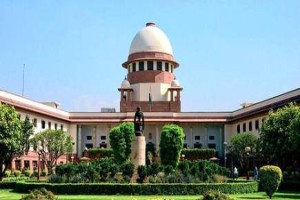
Supreme Court of India
Calls Grow for Stronger Legal Safeguards for Aravalli Range
New Delhi: The Supreme Court’s recent framework for defining and regulating the Aravalli hills has come under renewed scrutiny, with a detailed plea urging the court to take suo motu cognisance of the potential ecological consequences of height- and slope-based demarcation of one of the world’s oldest mountain systems.
The concerns have been raised in the wake of a recent Supreme Court order that accepted a uniform definition of the Aravalli Hills and the Aravalli Range for regulatory purposes, relying substantially on elevation-based criteria, including a 100-metre height threshold and proximity norms. While the court also directed a freeze on new mining leases and called for the preparation of a comprehensive management plan for sustainable mining, critics argue that the definitional framework itself risks excluding ecologically critical but lower-lying features of the Aravalli landscape.
In a representation addressed to the Chief Justice of India, environmentalist and water conservationist Rajendra Singh has warned that defining the Aravalli through parameters such as hill height, slope and contour could fragment a continuous ecological system into thousands of isolated hillocks. According to the plea, such fragmentation could leave large portions of the Aravalli—estimated at over 90 per cent—outside the ambit of effective protection and vulnerable to mining and development activity.
The representation places particular emphasis on the Delhi–Haryana border, stating that no hillocks meet the 100-metre criterion in this belt. It cautions that the application of such thresholds could effectively open even previously protected stretches of the Aravalli to mining and construction, weakening natural ecological barriers and increasing the risk of desertification, including the possible eastward advance of the Thar desert towards the National Capital Region.
At the core of the plea is the argument that the Aravalli is not a collection of discrete hills but an ancient and interconnected ecosystem shaped over millions of years by geomorphology, monsoon winds, groundwater reserves, traditional water-harvesting systems, forests, vegetation, wildlife and biodiversity. Reducing this complex natural system to technical or economic benchmarks, the letter contends, undermines its integrity, continuity and ecological resilience.
Invoking constitutional duties and environmental doctrines such as the Public Trust Doctrine and intergenerational equity, the representation argues that environmental protection must enhance the quality of natural systems rather than diminish them. It asserts that the Aravalli should be understood through its natural, cultural and geomorphological foundations and through the core principles of Indian knowledge systems, rather than through development-oriented classifications.
The plea further states that the ecological fallout of applying criteria such as 100-metre and 50-metre height thresholds and slope-based classifications can be scientifically demonstrated. It suggests that independent agencies could map the potential adverse impacts using existing Survey of India data and place such findings before the court to assess the implications for groundwater recharge, biodiversity and regional climate stability.
The representation also recalls that the Supreme Court has, on multiple occasions in earlier judgments, acknowledged the geographical and environmental significance of the Aravalli range, including its role as a natural barrier against desertification and its importance for water security across northern India. Against the backdrop of climate change, rising air pollution and increasing stress on water resources, the plea argues that any mining or development activity that causes harm to the Aravalli ecosystem must be rejected outright.
Beyond legal and ecological arguments, the letter points to growing public awareness and concern over the future of the Aravalli, describing the spread of environmental consciousness as a warning signal from nature itself. It states that the destruction of the Aravalli would amount to an irreversible loss for which there can be no compensation or remediation.
The representation also places the issue in a historical judicial context. It recalls that in 1994, acting on a petition filed by Singh, a Supreme Court bench headed by then Chief Justice M.N. Venkatachaliah ordered the closure of 478 mines in Sariska and subsequently halted mining across large parts of the Aravalli range. The plea argues that a similar level of judicial vigilance is once again required to prevent irreversible ecological damage.
Drawing broader historical parallels, the letter cites the decline of ancient civilisations such as the Indus Valley civilisation, including Mohenjo-daro and Dholavira, attributing their collapse to the loss of water resources. It warns that continued ecological neglect could have long-term civilisational consequences.
The concerns raised come amid a wider public and expert debate over the Supreme Court’s recent Aravalli framework. While government authorities have stated that the new approach aims to improve enforceability, curb illegal mining and introduce scientific planning through conservation and sustainable mining zones, critics maintain that elevation-based definitions risk excluding low but ecologically vital ridges and corridors that are integral to the Aravalli system.
The matter now stands at the intersection of constitutional environmental doctrine, ecological science, regulatory policy and public interest litigation, with the plea urging the Supreme Court to exercise its constitutional authority to ensure comprehensive and enduring protection of the Aravalli ecosystem in the interests of present and future generations.
– global bihari bureau