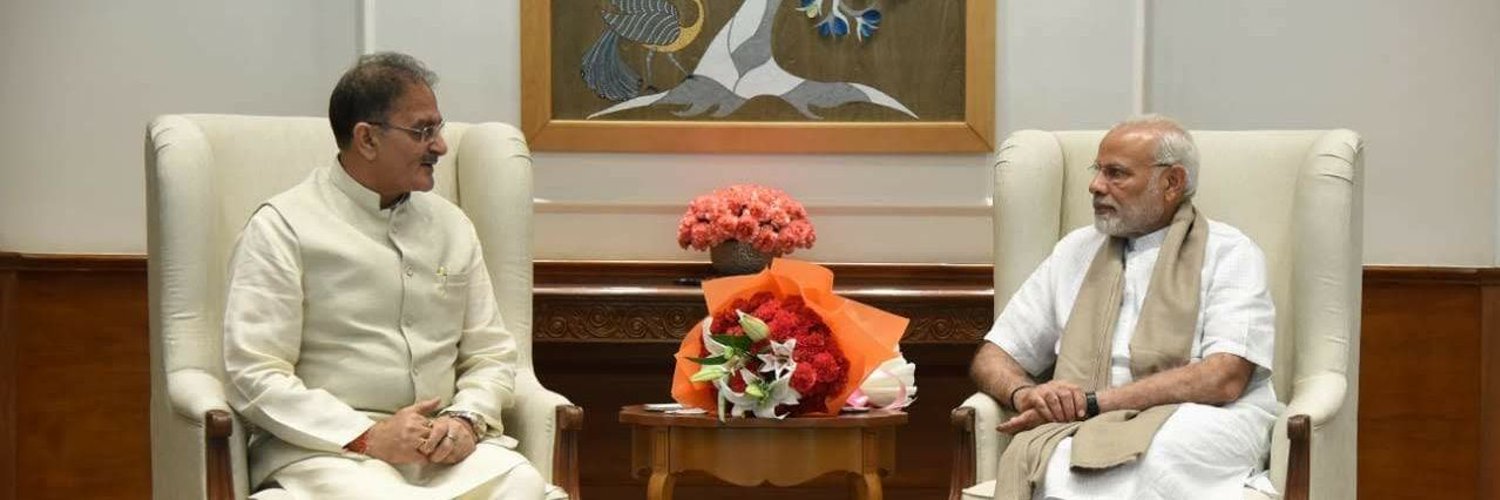
Kavinder Gupta with Prime Minister Narendra Modi
 By Onkareshwar Pandey*
Kavinder Gupta Named Ladakh LG, Sinha Stays in J&K, New Governors for Haryana, Goa
New Delhi: President Droupadi Murmu has appointed senior Bharatiya Janata Party (BJP) leader Kavinder Gupta as the new Lieutenant Governor (LG) of Ladakh, a region of immense strategic importance due to its tense border with China, while retaining Manoj Sinha as LG of Jammu & Kashmir despite scrutiny following a recent terror attack in Pahalgam. Announced today, the reshuffle also includes new Governors for Haryana and Goa, reflecting the central government’s focus on addressing governance needs in critical Union Territories with security challenges and in states with distinct political landscapes.
Kavinder Gupta, a senior BJP leader and former Deputy Chief Minister of Jammu & Kashmir, replaces Brigadier (Retd.) Dr. B.D. Mishra, whose resignation was accepted by the President as Ladakh’s LG. Established as a separate Union Territory without a legislature in August 2019, Ladakh remains a critical region due to ongoing border tensions with China, including the 2020 Galwan Valley clash and continued standoffs near Pangong Tso Lake. With no elected assembly, the Lieutenant Governor holds absolute administrative power, making Gupta’s appointment crucial for both governance and national security. His political background has prompted discussion on whether this shift from a military figure like Mishra will impact the region’s security dynamics.
In Jammu & Kashmir, Manoj Sinha continues as Lieutenant Governor despite criticism following the recent Pahalgam terror attack, which exposed gaps in security preparedness. In a recent interview, Sinha accepted the complete failure of security in the Pahalgam attack and took full responsibility. This decision has led to questions: Is the Centre satisfied with Sinha’s handling of militancy? Why no reshuffle in J&K when Ladakh sees a change? Will the focus on Ladakh divert attention from J&K’s escalating violence?
Ladakh, with a population of about 2.9 lakh per the 2011 Census—likely higher now due to increased military presence—comprises Leh and Kargil, districts with distinct cultural and political demands. Leh seeks more autonomy, while Kargil has protested Ladakh’s separation from Jammu & Kashmir. Gupta faces strategic challenges ahead: With China’s repeated PLA incursions, will the new LG adopt a harder stance or focus on diplomatic engagement? Can Gupta balance local unrest, as Leh and Kargil have differing demands? How will he advance infrastructure, with the government pushing roads and tunnels for military mobility, while civilians demand better connectivity and jobs?
In Haryana, Prof. Ashim Kumar Ghosh, an academician with a background in public policy, has been appointed Governor. Observers note his lack of direct political experience may affect his ability to navigate Haryana’s often-volatile politics. In Goa, former Civil Aviation Minister Pusapati Ashok Gajapathi Raju, a seasoned politician from Andhra Pradesh, takes over as Governor, bringing his experience to a state known for its vibrant political environment.
The new appointments reflect the Centre’s attempt to strengthen governance in key regions, but challenges remain, especially in Ladakh, where security, development, and political representation issues intersect. With a political figure like Kavinder Gupta at the helm, the focus may shift to dialogue, but China’s unpredictability looms large. Meanwhile, the retention of Manoj Sinha in J&K suggests continuity in strategy, even as terrorism resurges. In Haryana and Goa, the new Governors will address their own political and developmental priorities. These leadership changes will influence India’s administrative and security framework moving forward.
*Senior journalist