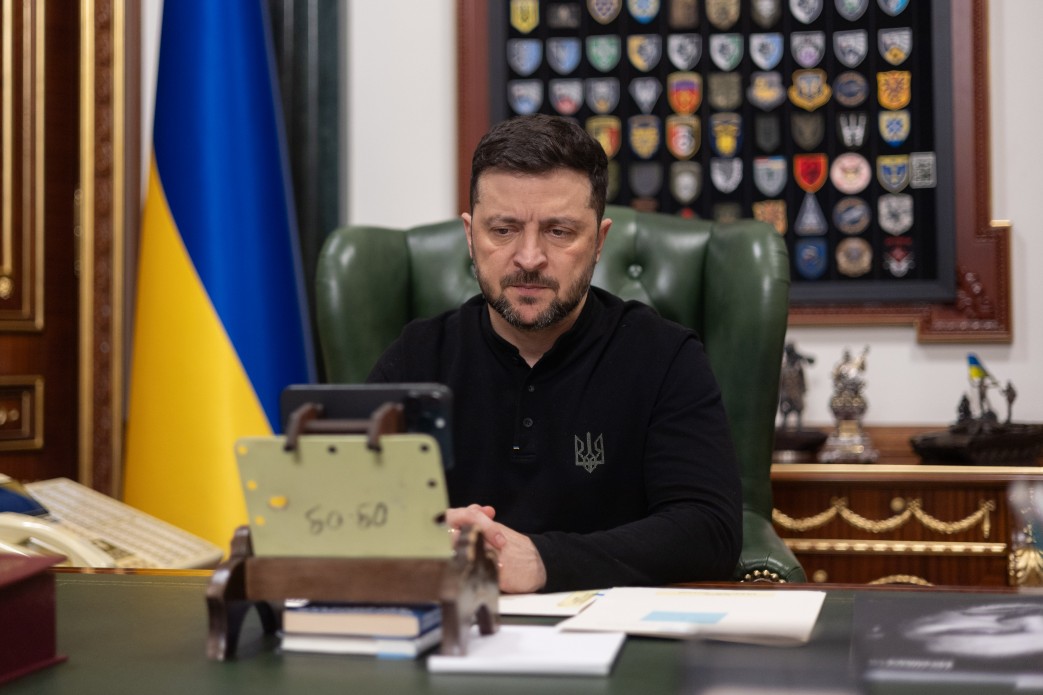
Presidet Volodymyr Zelenskyy of Ukraine addressing his countrymen today.
Diplomacy Accelerates as War Deepens on the Ground
Kyiv: Winter nights in Kyiv carry a quiet tension that can only be understood in full after months of repeated attacks. Sirens hum faintly beneath freshly fallen snow, generators cough in narrow courtyards, and apartment buildings sit in near silence, the residents waiting for the next impact. On the night of 29 November, more than 360,000 households remained without power, as temperatures hovered just below freezing, and at least five funerals were being prepared across Kyiv and surrounding regions. Over this backdrop of civilian vulnerability, President Volodymyr Zelenskyy recorded an address to the nation, speaking over an unstable power grid, while also signalling the country’s strategic intent to an international audience.
“Work is still underway after last night’s Russian missile and drone strike,” Zelenskyy said. “It was a large-scale attack; the energy sector was the primary target. Russia is not changing its tactics here and continues trying to inflict exactly this kind of pain on Ukraine ahead of winter. What matters is that we are countering it. What matters is that there are interceptions. Nineteen missiles were shot down, including ballistic ones. Almost 560 drones were also neutralised, including nearly three hundred ‘shaheds.’ Unfortunately, not everything was shot down, and working towards stronger air defence is priority number one. This task is extremely difficult and extremely costly for Ukraine and for our partners. No country could handle this alone. But we are securing air defence missiles for Ukraine and steadily expanding our fleet of air defence systems of various types. We are preparing for next week’s work with our partners – including to ensure a higher quality of our air defence, and we are very much counting on our partners’ support.”
In parallel with managing the immediate consequences of the attacks, Zelenskyy highlighted Kyiv’s diplomatic efforts. He reported that the Ukrainian delegation, led by Rustem Umerov, Member of Parliament, and Kyrylo Budanov, Chief of the Main Intelligence Directorate, had already arrived in the United States to continue talks based on Geneva-derived points. He noted that other officials—including Dmytro Kuleba, Minister of Foreign Affairs of Ukraine, and Sergii Kyslytsya, Permanent Representative of Ukraine to the United Nations—were part of a broader consultative team. “The dialogue based on the Geneva points will continue. Diplomacy remains active. The American side is demonstrating a constructive approach, and in the coming days, it is feasible to flesh out the steps to determine how to bring the war to a dignified end. The Ukrainian delegation has the necessary directives, and I expect the guys to work in accordance with clear Ukrainian priorities,” he said.
Zelenskyy described domestic resilience efforts as well, mentioning meetings with Prime Minister Denys Shmyhal, Deputy Prime Minister and Minister of Digital Transformation Mykhailo Fedorov, and Pavlo Palisa, focusing on internal governance and the nation’s capacity to support negotiation processes. He also spoke with Speaker of the Verkhovna Rada Ruslan Stefanchuk and Prime Minister Yuliia Svyrydenko, urging the parliament to maintain full functionality. In his remarks on governance, he confirmed that a candidate for Minister of Justice had been identified and that a strong head of the Ministry of Energy of Ukraine would be determined jointly by parliament and the Prime Minister.
Sanctions policy remained a central pillar of Ukraine’s strategy. Zelenskyy stated, “We will introduce new sanctions decisions – building on our partners’ pressure on Russia for this war – and our sanctions, which we will effectively implement jointly with our partners, so that the world exerts pressure on the aggressor in exactly the way needed to weaken Russia’s ability to wage war. The decrees will be issued tomorrow. Our sanctions proposals will be forwarded to all major partner jurisdictions.”
The attacks themselves were significant in scale. Over 48 hours, Russian forces launched 36–38 missiles and nearly 600 drones, of which 19 missiles and approximately 558–560 drones were intercepted. Casualties as of midday 30 November stood at at least five killed and 33 wounded, including three children. Damage to power infrastructure left hundreds of thousands in blackout conditions, though restoration efforts had returned electricity to roughly 360,000–410,000 households by midday.
International diplomatic manoeuvres added layers of complexity. The Abu Dhabi track involved U.S. officials, including Jake Sullivan, National Security Advisor, and Derek Driscoll, Special Advisor, engaging with Russian counterparts while Ukrainian representatives observed but did not lead the agenda. At the same time, the Florida talks with Umerov and Budanov, meeting Senator Marco Rubio and investor Jared Kushner, were reported to focus on operationalising the 19-point framework. Zelenskyy underscored that this framework, revised from the original 28 points, retained national sovereignty, reparations, accountability, and prioritised the return of prisoners of war and abducted children, while removing provisions for territorial concessions, amnesty, and NATO/neutrality status.
European partners, including British Labour Party Leader Keir Starmer, French President Emmanuel Macron, and European Commission President Ursula von der Leyen, stressed the importance of transparency and enforcement. They called for the full publication of the framework to ensure that obligations could not be sidestepped. Analysts also noted that energy disruptions tied to the conflict were affecting European Union economic output, with short-term GDP impacts estimated at 0.5–2 per cent.
On the operational front, Ukraine continued to assert leverage. Targeted strikes on the Black Sea shadow fleet caused over $70 million in damage, hitting vessels that had been used to circumvent sanctions. Russian officials, including Foreign Minister Sergey Lavrov and Deputy Foreign Minister Sergei Ryabkov, monitored developments closely but offered no commitments, signalling a strategy of testing Ukraine’s resolve while continuing limited operations in areas such as Pokrovsk. Zelenskyy closed his address with a reaffirmation of resolve: “Thank you to everyone who is helping! Thank you to all who are defending Ukraine. Glory to Ukraine!” The address reflected a dual approach, balancing immediate civilian defence, strategic military deterrence, and ongoing diplomatic engagement, highlighting Ukraine’s intention to combine survival with a measured path toward negotiation and international accountability.
– global bihari bureau