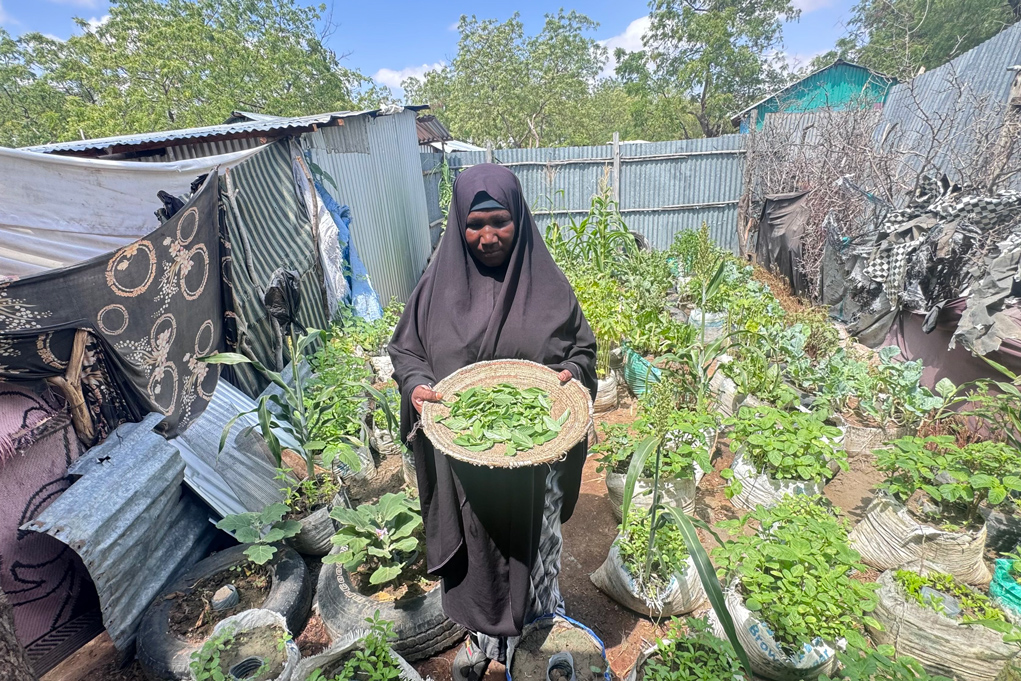
Mariam has lived in the Hagadera Refugee Camp in Dadaab, eastern Kenya, for the last 19 years. Her garden was part of the effort to make it feel like home, but more importantly it provides nutritious vegetables for her family of seven. ©FAO/Joseph Othieno
Mariam’s Garden of Quiet Courage
Where Spinach Grows in the Desert
In Hagadera Refugee Camp in Dadaab, eastern Kenya, the earth is the colour of dust. Corrugated metal shelters and canvas tents stretch across a flat, sunbaked landscape where the wind carries sand instead of seeds. Water is scarce, shade is precious, and survival often feels measured in rations rather than seasons.
Yet in one corner of the camp, green interrupts the monotony.
Mariam’s kitchen garden stands out like a quiet rebellion against the environment. Spinach leaves unfurl beside kale—locally known as Sukuma Wiki—while black nightshade, cowpeas, amaranth and jute mallow push through soil that was never meant to nurture vegetables. The garden is small, but its meaning is vast.
Mariam has lived in Hagadera for 19 years. She arrived at the age of 34 after fleeing political unrest in Somalia. What was meant to be temporary became permanent. The refugee camp, with its rows of shelters and shifting population, has been the only home she has known for nearly two decades.
Over time, she has learned to claim space in a place defined by displacement. Her kitchen garden is part of that claim. It feeds her family of seven, but it also feeds a deeper need—for dignity, stability and self-reliance.
“I wanted my children to have enough food and enough variety,” she says. “That is why I started.”
Her story unfolds within a larger initiative. Supporting kitchen gardens in Dadaab is part of the European Union-funded Refugee Settlement Project implemented by the Food and Agriculture Organization (FAO) of the United Nations in collaboration with other agencies of the United Nations. Through the project, 2,000 refugee and host community households were assisted in establishing gardens designed to improve nutrition and livelihoods.
Among those 2,000 households, Mariam’s plot has become exceptional.
With seeds provided by FAO, she grows spinach, kale, black nightshade, cowpeas, amaranth and jute mallow. The quantity and quality of her harvest surpass most others in the camp. Her garden has become a place of informal learning, where neighbours come to watch, ask questions and gather courage.
“This has become the norm; women come here to see and admire my kitchen,” Mariam says. “I also share the vegetables with some of them, although most are just normally mesmerized as they had never thought that such green kitchen gardens could exist in Dadaab. They have now mustered up the courage to go set up their gardens.”
In a settlement shaped by food aid and scarcity, the sight of fresh vegetables growing in sandy soil feels almost improbable. Yet it is also carefully planned.
Dadaab’s environment is unforgiving. The area is predominantly dry, with sandy soils and limited water resources. These conditions make conventional agriculture nearly impossible. For that reason, FAO provided training on how to grow crops under such constraints—using innovative kitchen garden techniques adapted to arid environments.
Mariam embraced the training but quickly realised that theory alone would not be enough. Practice demanded effort, persistence and creativity.
“After the training, I was informed that the vegetables require loam soil, which is fertile soil,” she recalls. “Here it is mostly sandy, and I had to use a donkey-pulled cart to get the soil from far, an hour-long journey.”
The image is striking: a refugee woman travelling for an hour across dry terrain to fetch fertile soil so that vegetables might grow where nothing else would. It was exhausting work, but Mariam believed in the outcome.
“But I knew it was going to yield well,” she adds, “and now here I am with the results you can see.”
Her green thumb is not entirely solitary. Regular visits from extension service providers support her work. These specialists monitor the progress of her crops and guide cultivation techniques, helping her respond to challenges such as pests, soil quality and water use.
Still, the discipline of daily care falls to Mariam. Water must be managed carefully. Plants must be protected from heat and wind. Each harvest is earned through routine and resolve.
For her family, the impact has been transformative. Mariam is now among the self-reliant refugees who no longer need food rations.
“These vegetables are better than what I used to get from the market,” she says. “They are fresh, and they have significantly reduced the amount I have to spend on buying.”
Her savings amount to about 45 United States dollars every month. In a refugee economy where cash is scarce and opportunities are limited, this is a meaningful sum. She uses the money to buy other essentials for her family—items that once felt beyond reach.
The garden has altered not just her diet but her sense of control over daily life. Instead of waiting for food distributions, she harvests what she has grown. Instead of depending entirely on markets, she feeds her household from her own soil.
Yet success has sharpened her ambition.
Her biggest constraint is space. The garden can only grow so much within the boundaries of her small plot. Mariam dreams of expanding it so she can grow enough vegetables not only for her family but also for sale in the market.
“I am sure my vegetables will be preferred to the ones that are brought from other areas,” she says, “since they will get to the market when they are still very fresh.”
It is a modest business vision, but in the context of a refugee camp, it represents a radical shift—from survival to enterprise.
The project that supported Mariam does not end with seeds and soil. Households trained in kitchen gardening also participate in cooking demonstrations designed to strengthen practical skills and improve nutrition. These sessions teach families how to prepare diverse, nutritious meals using locally available foods.
The idea is simple but powerful: growing food must go hand in hand with knowing how to use it well.
“It is great to see women like Mariam and many others taking up this food production technology,” says Elizabeth Kamau, project lead at the FAO. “It is very practical but most importantly impactful in terms of their nutrition and incomes.”
The initiative is far from complete. It aims to reach another 2,000 households and also promotes the rearing of backyard chickens as an additional source of food and income.
Iron deficiency and anaemia among women of reproductive age, along with poor dietary diversity among children under five, remain major concerns in Dadaab. These conditions weaken immunity, reduce energy levels and affect long-term development. By growing vegetables and keeping poultry, families gain access to fresh and affordable foods that help address these nutritional gaps.
In this way, Mariam’s garden becomes more than a personal success story. It is a model for what can happen when training, resources and determination meet.
Her experience also fits into a broader global narrative. This story is part of a series celebrating women farmers worldwide—from producers, fishers and pastoralists to traders, agricultural scientists and rural entrepreneurs.
The International Year of the Woman Farmer 2026 recognises the essential contributions women make to food security, economic prosperity, improved nutrition and livelihoods. It also acknowledges the burdens they carry: heavier workloads, precarious working conditions and unequal access to land, credit and resources.
The campaign calls for collective action and investment to empower women in all their diversity and to build a fairer, more inclusive and sustainable agrifood system for all.
In Hagadera Refugee Camp, those global ideas take local form in Mariam’s daily routine. Each morning, she checks her plants. Each week she shares knowledge with neighbours. Each month, she saves money that once vanished into food purchases.
Her garden does not erase the hardships of displacement. The camp remains crowded, resources remain limited, and uncertainty remains part of life. But within those limits, something steady has taken root.
In a place shaped by loss and waiting, Mariam cultivates continuity. Her vegetables grow where dust once ruled. Her children eat what she has planted. Other women watch and begin to imagine gardens of their own.
What stands out is not only the colour of green against the sand, but the quiet message beneath it: that even in the most fragile soil, care and knowledge can produce more than food. They can produce confidence, independence and hope.
In Dadaab, where the future often feels suspended, Mariam’s kitchen garden grows toward it—leaf by leaf, harvest by harvest, season by season.
Source: The FAO News And Media Office, Rome
– global bihari bureau