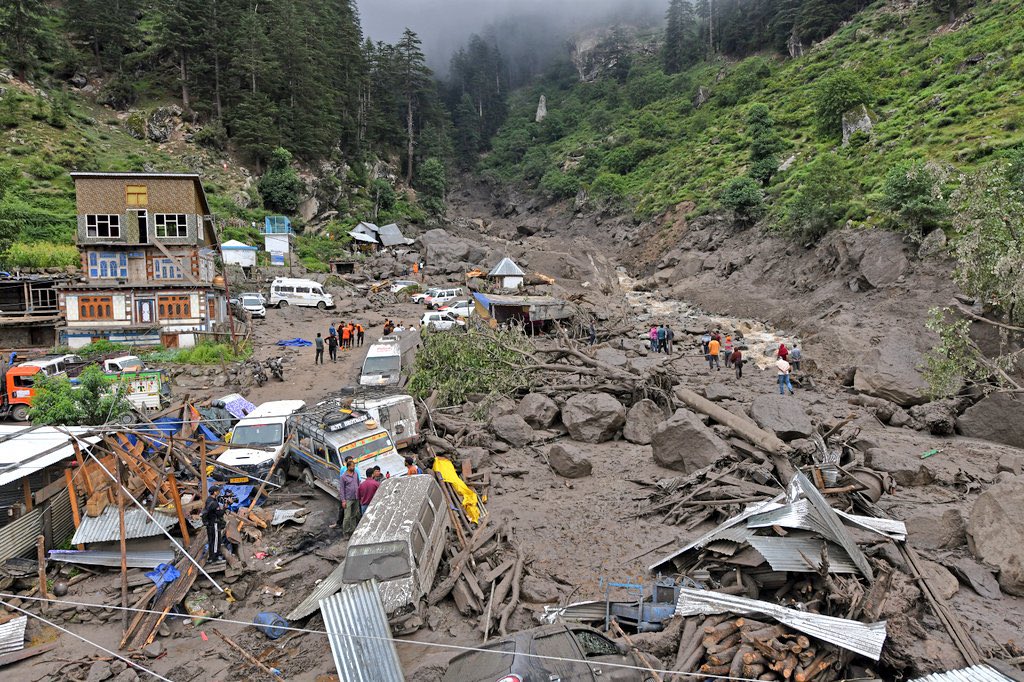
Destruction caused by the deadly cloudburst that struck the Ghati area of Jammu and Kashmir’s Kathua district today morning. Photo courtesy: @ArunabhHazarik1|X
Monsoon Fury: Floods Hit Several States includingBihar; Yamuna Rises in Delhi
Jammu: A cloudburst in Jammu and Kashmir’s Kathua district early this morning unleashed flash floods and landslides, killing at least seven people, including five children, and injuring four others in areas like Jodh Ghati and Janglote. The disaster damaged a railway track, the national highway, and a police station, with water flooding the Janglote industrial area and a Kendriya Vidyalaya campus. Rescue operations involving the Indian Army, National Disaster Response Force (NDRF), State Disaster Response Force (SDRF), and local volunteers are underway, using earth-movers and dog squads to search for survivors amid debris. The India Meteorological Department (IMD) defines a cloudburst as rainfall exceeding 100 milimeter in one hour, and its bulletin on August 17 noted intense convective activity contributing to the event, though technical confirmation of the cloudburst is pending.
Jammu and Kashmir Chief Minister Omar Abdullah expressed anguish over the tragedy, stating, “Deeply saddened by the tragic loss of lives & damage caused by landslides in several parts of Kathua, including Jodh Khad & Juthana, which claimed precious lives & left many injured. My heartfelt condolences to the bereaved families. I’ve instructed the administration to intensify relief, rescue & evacuation measures.” He announced ex gratia relief from the Chief Minister’s Relief Fund, supplementing SDRF support: Rs 2 lakh for each deceased, Rs 1 lakh for those severely injured, Rs 50,000 for minor injuries, Rs 1 lakh for fully damaged houses, Rs 50,000 for severely damaged houses, and Rs 25,000 for partially damaged structures. Lieutenant Governor Manoj Sinha, in a statement reported by PTI, expressed grief and said he briefed Union Home Minister Amit Shah on the situation, emphasising ongoing coordination with central authorities for relief efforts.
(Source: video from my close friend near ITI Road, Kathua)#cloudburst #kathuacloudburst #kathua pic.twitter.com/6KSNGo7kPE
— jatin.sol (@Jatin0G) August 17, 2025
Union Home Minister Amit Shah assured full Central Government support, stating, “Spoke with the Lieutenant Governor and Chief Minister of Jammu and Kashmir regarding the cloudburst in Kathua. Relief and rescue operations are being carried out by the local administration, and NDRF teams have also been rushed to the site. Assured every support from the Modi government.” Helicopter services have airlifted six injured individuals to hospitals in Pathankot, Punjab, as confirmed by Union Minister Jitendra Singh.
This follows a devastating cloudburst on August 14 in Chashoti village in Kishtwar district of Jammu and Kashmir, where flash floods killed at least 65 people, rescued over 100, and left 75 missing, halting the Machail Mata temple yatra. Chief Minister Abdullah visited Kishtwar, announcing identical ex-gratia relief and stating, “The government stands firmly with the affected families, ensuring swift restoration of infrastructure.” Rescue efforts continue with Army, NDRF, and SDRF teams.
In Uttarakhand, a cloudburst on August 5 in Dharali village, Uttarkashi district, triggered flash floods along the Kheer Ganga river, killing five and leaving dozens missing. Landslides blocked roads near Bartwari, Linchigad, and Gangrani, and a civil helipad was rendered non-functional. Over 150 people have been rescued by the Army, NDRF, SDRF, and volunteers. The IMD’s August 13 briefing forecasted heavy to very heavy rainfall over Uttarakhand, with isolated extremely heavy falls (≥210 mm) expected, prompting a red alert for Uttarkashi, Tehri, Rudraprayag, Chamoli, and Dehradun. Chief Minister Pushkar Singh Dhami conducted aerial surveys to coordinate relief. Since June 1, Uttarakhand has reported 21 deaths, nine missing, 134 houses damaged, and 50 roads blocked, including two national highways.
Himachal Pradesh has faced severe monsoon impacts since July, with 78 deaths reported across Mandi, Kullu, Shimla, and Lahaul-Spiti districts. Mandi alone recorded 14 cloudburst incidents and three flash floods, with 14 deaths and 30 missing. Over 325 roads, including National Highways 305 and 505, remain closed, with 179 in Mandi and 71 in Kullu. Bridges in Shimla and Lahaul-Spiti were washed away, isolating villages like Koot and Kyav, and a police post in Ganvi Ravine was destroyed. Agricultural losses in Karpat village reached ten bighas, with state losses estimated at Rs 572 crore, potentially rising to Rs 700 crore. The IMD’s August 17 forecast predicted heavy rainfall in Chamba, Kangra, and Mandi, issuing orange and yellow alerts through August 18.
The monsoon has triggered widespread flooding across India, affecting northern, eastern, and northeastern states, with over 300 deaths reported in recent weeks alongside neighbouring regions. Uttar Pradesh, Rajasthan, Punjab, Haryana, and Delhi-NCR face disruptions from flash floods and landslides, with the IMD’s August 17 briefing noting a fresh low-pressure area over the Bay of Bengal intensifying rainfall in Odisha, Andhra Pradesh, and Telangana. Rescue operations have evacuated thousands, but blocked roads and landslides have left communities stranded, with economic losses in the billions of rupees. The central government has pledged support, with Prime Minister Narendra Modi monitoring developments.
In Bihar, floods have severely impacted nearly 25 lakh people across 10 districts, including Buxar, Bhojpur, Patna, Vaishali, Samastipur, Munger, Begusarai, Katihar, Bhagalpur, and Khagaria, with at least 15 deaths reported. Swollen rivers like the Ganga and Kosi, fueled by upstream rainfall, have submerged villages, forcing residents to seek higher ground or use boats. Embankments face pressure, with fears of breaches, and drone footage shows vast inundated areas disrupting daily life, including cremations shifted to roadsides. The Bihar Water Resources Department reported releasing 6.87 lakh cusecs of water from Valmikinagar Barrage and 7.54 lakh cusecs from Kosi Birpur Barrage on August 17, exacerbating flood risks. Relief efforts include aid distribution in areas like Jawaniya village in Buxar, where local leaders are supporting around 500 families. The IMD’s August 13 bulletin warned of low to moderate flash flood risks in districts like West and East Champaran, Sitamarhi, and Muzaffarpur, predicting heavy rain through August 18.
In Delhi, the Yamuna River’s water level has risen to 205.21 meters at the Old Railway Bridge, breaching the warning mark of 204.5 meters and nearing the danger level of 205.33 meters. The Central Water Commission estimates it may reach 206.1 meters by August 19 due to upstream discharges from Haryana, as reported on July 17. Authorities have issued flood alerts, urging residents in low-lying areas to remain vigilant, with evacuation preparations underway amid traffic disruptions from recent heavy rains. The IMD’s August 17 forecast predicted light to moderate rain with thunderstorms in Delhi-National Capital Region (NCR) through August 18.
The IMD attributes these events to intense convective clouds and active monsoon systems, with its August 17 satellite imagery indicating strong vertical air movement conducive to cloudbursts. Experts link the increasing frequency of such disasters to climate change, melting glaciers, and unplanned construction in the Himalayan region, which has seen extreme weather on 822 days since 2022, claiming 2,863 lives across 13 states. Authorities continue to urge residents and tourists to avoid landslide-prone areas and stay indoors as rescue operations persist.
– global bihari bureau