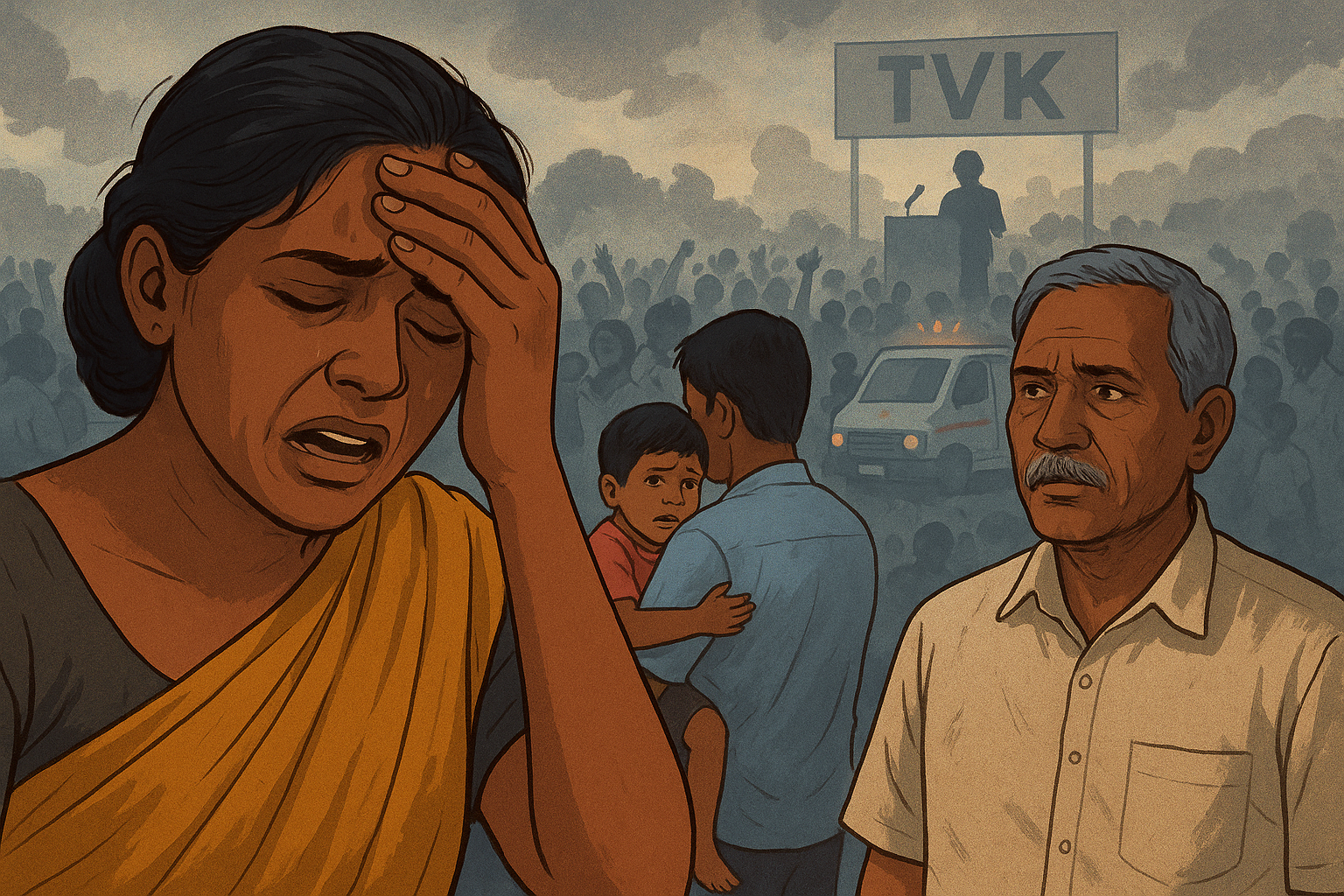
AI generated image
Political narratives and administrative lapses converge in Karur
Chennai/Karur: The catastrophic crowd crush at the Karur rally, claiming forty lives and leaving over eighty injured, has laid bare a tangled web of organisational failures, administrative shortcomings, and political manoeuvring. In response, the Tamil Nadu government appointed retired judge Aruna Jagadeesan to lead a judicial commission tasked with dissecting the permissions, crowd management protocols, and emergency response mechanisms that failed so tragically. Simultaneously, police have filed a First Information Report (FIR) against senior organisers of the Tamilaga Vettri Kazhagam (TVK), the rally’s organising body led by actor-politician Vijay, who was addressing the gathering. These parallel investigations—judicial and criminal—are far more than procedural exercises. They unfold against a raw backdrop of grieving families, traumatised survivors, and a public demanding clarity, justice, and systemic reform.
The tragedy’s roots lie in a cascade of failures that turned a political gathering into a deadly crush. The TVK insists it adhered to all permissions, pointing fingers at local authorities for failing to enforce crowd limits, deploy adequate police, or provide necessities like drinking water and shade. Eyewitnesses paint a grim picture: attendees trapped against poorly placed barricades, women and children overwhelmed by the surging crowd, and ambulances stalled in the chaos. As the crowd swelled and people began fainting from heat and overcrowding, Vijay paused his speech to toss water bottles to affected supporters, called for police assistance, and arranged for ambulances to reach those in distress. Survivors recount the suffocating terror of being pressed from all sides, with panic rippling through the dense gathering as confusion took hold. These accounts reveal a profound failure of planning and execution, from inadequate crowd control to the absence of accessible emergency services.
Also read: 31 Killed in Stampede During Vijay’s Rally in Karur
Amid the human toll, political actors have staked out their positions. The ruling Dravida Munnetra Kazhagam (DMK) has highlighted its response—₹1,000,000 (ten lakh rupees) in compensation for each deceased victim’s family, ministerial oversight of relief efforts, and the judicial commission—as proof of its commitment to accountability. Opposition parties, including the All India Anna Dravida Munnetra Kazhagam (AIADMK) and the Bharatiya Janata Party (BJP), counter with demands for a central investigation and judicial oversight, arguing that local authorities failed to protect attendees. The TVK, meanwhile, frames the tragedy as an administrative lapse, distancing itself from organisational blame. In the aftermath, Vijay expressed profound sorrow, stating he was “writhing in unbearable, indescribable pain and sorrow,” extended condolences to the families, prayed for the injured’s recovery, directed the provision of the best medical treatment, and announced plans to travel to Karur that night to meet the bereaved families and visit hospitalised survivors. These competing narratives unfold in the shadow of Karur’s overflowing hospitals and mourning families, where the human cost remains painfully visible.
Public outrage has spilt into action, with Karur’s traders shuttering their businesses in protest and social media amplifying haunting images of surging crowds and stranded ambulances. Civic groups are calling for independent oversight of relief disbursement and full transparency in the publication of inquiry findings, warning that selective disclosures could politicise grief and erode trust. Eyewitnesses consistently point to structural failures—bottlenecked exits, insufficient stewarding, and a lack of immediate medical contingencies—that directly fueled the fatalities and injuries. These lapses underscore the urgent need for accountability and reform.
At the heart of the pursuit of justice lies the meticulous handling of evidence. Permissions, police deployment rosters, steward assignments, ambulance and hospital logs, and forensic reports must be preserved under certified chain-of-custody protocols to ensure their integrity. Testimonies from stewards, police, medical personnel, and attendees must be carefully collected and cross-referenced to eliminate inconsistencies that could undermine legal and administrative outcomes. Video footage, audio recordings, drone imagery, and hospital admission timestamps will provide critical corroboration in pinpointing the proximate cause of the tragedy. Transparent management of these materials is vital to prevent political narratives from overshadowing the truth.
The political stakes are high, with each party’s messaging revealing clear incentives. The TVK’s emphasis on administrative failure seeks to deflect organisational liability. The DMK casts its actions—compensation, oversight, and the judicial commission—as procedurally robust and responsive. Opposition parties seize on governance lapses to push for central intervention. These competing strategies raise the risk that legal and administrative findings will be contested in the public arena, making rigorous documentation, cross-verification, and independent oversight essential to maintaining credibility.
The tragedy’s legal and policy ramifications extend far beyond the immediate crisis. The investigations may lead to criminal charges for negligence or culpable homicide, administrative sanctions for permission violations, and civil compensation claims. Interim court orders could reshape future political gatherings, mandate evidence preservation, or regulate relief disbursement, highlighting the interplay between political posturing and procedural rigour. More broadly, the incident exposes systemic flaws in managing mass political events: oversubscription beyond permitted capacity, delays in leader arrivals, bottlenecks in stage access, and inadequate steward and medical planning. These deficiencies demand enforceable protocols to govern permissions, crowd management, emergency response, and documentation.
The human and systemic stakes remain intertwined. Families of the deceased need verified relief and sustained medical support, while civic groups continue to press for independent verification and transparent inquiry outcomes. The success of the judicial commission and criminal investigation hinges on their ability to manage evidence, coordinate witness testimony, and uphold public transparency. Without rigorous fact-finding and impartial adjudication, political narratives may drown out factual responsibility, leaving the public without closure.
The Karur crowd crush is a tragedy of lives lost, bodies broken, and trust fractured. It is also a test of Tamil Nadu’s ability to respond, remediate, and prevent recurrence. As families mourn, survivors grapple with trauma, and civic actors demand accountability, the state must navigate this crisis with precision and integrity. Only through transparent, evidence-driven investigations and meaningful reforms can justice be served and future tragedies averted.
– global bihari bureau