Focus Now on Pendency, Big Cases?
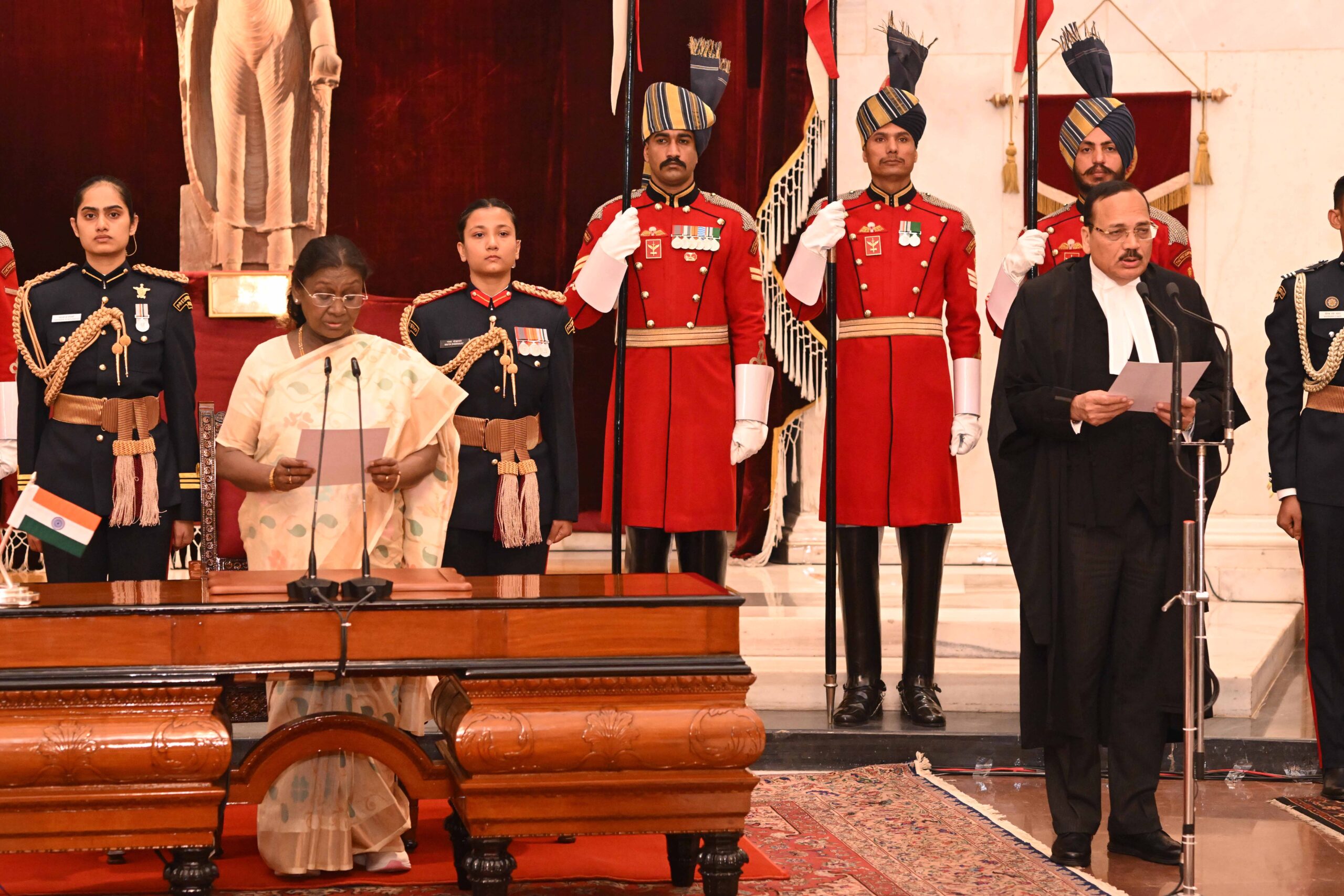
New Delhi: Justice Surya Kant was sworn in this morning as the 53rd Chief Justice of India in a solemn ceremony held at 10:00 hrs in the Ganatantra Mandap of Rashtrapati Bhavan. President Droupadi Murmu administered the oath of office and allegiance to the Constitution in Hindi, a departure from the recent pattern in Chief Justice of India swearing-ins, where the oath was typically taken in English.
In a gesture marking continuity of office and camaraderie, the retiring Chief Justice B.R. Gavai arrived in the official Chief Justice’s Mercedes-Benz and left in his personal car so that the vehicle was immediately available for the new Chief Justice on his way to the Supreme Court after the ceremony.
Present on the occasion were Vice-President C.P. Radhakrishnan, Prime Minister Narendra Modi, Union Law Minister Arjun Ram Meghwal, Haryana Chief Minister Nayab Singh Saini, Lok Sabha Speaker Om Birla, Defence Minister Rajnath Singh, Home Minister Amit Shah, several Union Ministers, former Vice-President Jagdeep Dhankhar, several sitting and retired judges of the Supreme Court of India, and Chief Justices and senior judges from the Supreme Courts of Bhutan, Kenya, Malaysia, Brazil, Mauritius, Nepal and Sri Lanka.

A customary group photograph was taken with the President, Vice-President, Prime Minister, the new Chief Justice, the retiring Chief Justice and the Law Minister.
Justice Surya Kant, who until yesterday was the senior-most puisne judge, succeeds Chief Justice Bhushan Ramkrishna Gavai, who attained the age of superannuation on November 23, 2025, after a tenure of slightly over six months. The appointment adheres strictly to the long-standing convention of elevating the senior-most judge of the Supreme Court as Chief Justice, a practice consistently followed by the Union Government since 1979.
Born on February 10, 1962, at Hisar in Haryana into a middle-class family, Justice Surya Kant graduated from Government Post Graduate College, Hisar in 1981 and obtained his Bachelor of Laws degree from Maharishi Dayanand University, Rohtak in 1984. He enrolled as an advocate the same year and began practice at the District Court, Hisar, before shifting to Chandigarh in 1985 to appear regularly before the Punjab and Haryana High Court, where he specialised in constitutional, service and civil matters. He represented a large number of universities, public sector banks, corporations, statutory boards and the High Court itself. On July 7, 2000, he created history by becoming, at the age of thirty-eight, the youngest Advocate General of Haryana. In March 2001, he was designated Senior Advocate and continued to hold the office of Advocate General until his elevation as a permanent judge of the Punjab and Haryana High Court on January 9, 2004.
As a High Court judge, he served two consecutive terms as a member of the Governing Body of the National Legal Services Authority from February 2007 to February 2011. In 2011, while still on the Bench, he stood First Class First in the Master of Laws examination conducted by the Directorate of Distance Education, Kurukshetra University. He assumed charge as Chief Justice of the High Court of Himachal Pradesh on October 5, 2018 and was elevated to the Supreme Court of India on May 24, 2019. He has since been associated with several committees of the Indian Law Institute, a deemed university functioning under the aegis of the Supreme Court, and was appointed Chairman of the Supreme Court Legal Services Committee with effect from November 12, 2024. He is due to demit office on attaining the age of sixty-five on February 9, 2027, giving him a tenure of fourteen months and sixteen days.
The new Chief Justice inherits a court that is functioning at its full sanctioned strength of thirty-four judges and has in recent months intensified efforts to reduce pendency through greater use of technology, live-streaming and regular constitution benches. Yet the docket remains heavy, with more than ninety thousand matters pending and several constitutionally significant cases awaiting final adjudication.
Among the most immediate and politically sensitive matters is the batch of petitions challenging the Election Commission of India’s Special Intensive Revision (SIR) of electoral rolls in Kerala. A bench headed by Justice Kant had, on November 21, issued notice returnable on November 26 on the State government’s plea to defer the exercise until after local body elections, citing risk of mass disenfranchisement among over 2.5 crore electors and administrative overload in a state with 1,200 local bodies and 23,612 wards. The Kerala State Election Commission has scheduled polls for December 9 and 11, with counting on December 13 and completion by December 18, while the SIR timeline mandates enumeration by Booth Level Officers to end on December 4 and draft rolls to be published on December 9, creating an irreconcilable clash. Petitions from the Communist Party of India (Marxist), Indian Union Muslim League and Kerala Pradesh Congress Committee have been clubbed with the state’s plea, arguing the revision lacks documented irregularities or constitutional exigency under Section 21 of the Representation of the People Act and could disenfranchise voters without individual verification. The outcome will have ramifications for voter-list purity exercises across the country, including ongoing challenges from Tamil Nadu and West Bengal, terming the SIR a “de facto” National Register of Citizens.
The validity of the sedition provision under Section 124A of the Indian Penal Code, kept in abeyance since May 2022 by a bench that included Justice Kant, awaits examination by a constitution bench. With the Union government yet to finalise its stand on re-examination of the law despite consultations reaching the final stage, thousands of criminal trials remain stalled, and the case is likely to be listed early in the new Chief Justice’s term. The 2022 order halted all fresh FIRs and proceedings under the colonial-era provision, which has seen over 13,000 cases registered between 2010 and 2023, often against journalists, activists and opposition figures for alleged incitement without violence. A definitive verdict could reshape free speech under Article 19(1)(a), building on the 1962 Kedar Nath Singh ruling that confined sedition to acts inciting violence or public disorder, and unblock stalled prosecutions while prompting potential repeal or amendment amid criticism of its vagueness and misuse.
Petitions seeking a clear enunciation of the extent of social media regulation under the Information Technology Rules, 2021 – arising from a controversy involving alleged derogatory remarks by comedian Ranveer Allahbadia on the show ‘India’s Got Latent’ – are also before a bench presided over by the new Chief Justice. The case will determine how far the State can go in requiring platforms to proactively remove content without violating Article 19(1)(a), echoing the 2015 Shreya Singhal judgment striking down Section 66A for its chilling effect. With over 900 million internet users generating vast data daily, a ruling could calibrate algorithmic moderation by global tech giants amid rising cyberbullying and misinformation, particularly post-2024 elections. Justice Kant’s prior observations on judicial independence from social media pressures and his August 2025 directive for the Centre to submit draft guidelines suggest a balanced approach favouring safeguards over blanket censorship.
The status of approximately forty thousand Rohingya Muslims in India and the interplay between the Foreigners Act, the Citizenship Amendment Act, 2019 and India’s obligations under customary international law on non-refoulement is another matter that a three-judge bench, including Justice Kan,t had agreed to examine in detail on July 31, 2025. No date has been fixed, but the case is expected to be taken up soon, following the court’s May 8 observation that Rohingyas, as non-citizens, lack Article 19(1)(e) rights to reside in India and must be treated as foreigners under the Foreigners Act, subject to deportation after due process. The bench dismissed interim pleas against deportations, including allegations of forced maritime pushbacks in May 2025, for lack of evidence, while affirming Article 21 protections against arbitrary detention. Petitioners cite the United Nations High Commissioner for Refugees (UNHCR) refugee cards for over 8,000 Rohingyas and risks of genocide in Myanmar, invoking non-refoulement as jus cogens, against the Centre’s national security concerns and non-signatory status to the 1951 Refugee Convention. This intersects with broader citizenship disputes, testing federal relations in border states like Jammu and Kashmir and Manipur amid fresh influxes.
Challenges to the Agnipath scheme for short-term recruitment into the armed forces, the lingering implementation issues concerning disclosure of electoral bond data, the mounting backlog of reserved judgments in High Courts (running into several lakhs), chronic vacancies in Information Commissions under the Right to Information Act, and a host of environmental and river-rejuvenation matters round out the immediate high-priority docket. On electoral bonds, follow-up petitions scrutinise the State Bank of India’s compliance in revealing over ₹16,000 crore in contributions from 2018 to 2024, amid quid pro quo allegations. The Agnipath validity, challenged since 2022 for breaching Article 14 equality in job security, awaits a larger bench. Delayed High Court judgments, highlighted in August 2025 by Justice Kant’s bench seeking nationwide data on over 4.5 lakh reserved verdicts, prompt calls for six-month disposal mandates. RTI vacancies exceed 50%, with quarterly compliance reports ordered. Environmental cases include oversight committees for the Rajasthan river restoration.
Justice Kant has repeatedly emphasised the need for three constitution benches to sit simultaneously, greater reliance on mediation and alternative dispute resolution, and rigorous monitoring of old matters to bring down pendency. With a relatively short tenure, the new Chief Justice is widely expected to accord priority to constituting larger benches for long-pending constitutional questions while simultaneously pushing administrative reforms to ensure speedier justice delivery at all levels of the judiciary.
– global bihari bureau