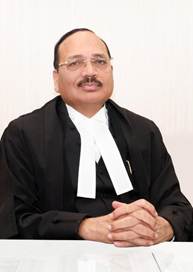
Justice Surya Kant
Justice Surya Kant to Succeed CJI Gavai on November 24, 2025
New Delhi: Justice Surya Kant, a serving judge of the Supreme Court of India, has been appointed as the 53rd Chief Justice of India. The President of India has signed the warrant of appointment, and the notification was issued by the Ministry of Law and Justice today. Justice Kant will take the oath of office on November 24, 2025, at Rashtrapati Bhavan, formally assuming charge from Chief Justice Bhushan Ramkrishna Gavai, whose tenure concludes a day earlier.
Under the current seniority convention, Justice Kant will serve as Chief Justice of India until February 9, 2027, when he reaches the age of 65. During this period, he is expected to oversee the completion of several key judicial digitisation projects initiated under his predecessors, including the expansion of e-filing, the integration of artificial intelligence tools for cause-list management, and the ongoing review of procedural efficiency across High Courts.
Justice Kant’s appointment as Chief Justice of India comes at a time when the Supreme Court’s docket stands at a record high, with over 80,000 pending cases. His tenure is expected to continue ongoing efforts to modernise judicial processes, improve case management, and strengthen coordination between the judiciary and legal aid institutions.
Born on 10 February 1962 in Petwar village of Hisar district in Haryana, Justice Surya Kant’s journey from rural beginnings to the highest judicial office in the country reflects a distinguished career spanning over four decades. After completing his Bachelor of Laws degree from Maharishi Dayanand University, Rohtak, in 1984, he began practising at the District Courts in Hisar. In 1985, he shifted to the Punjab and Haryana High Court in Chandigarh, specialising in constitutional, service, and civil matters.
A first-generation lawyer, Justice Surya Kant’s professional path—from a district court in Hisar to the Supreme Court’s leadership—illustrates an institutional journey marked by merit, scholarship, and administrative acumen. His elevation also continues a long line of Chief Justices drawn from diverse judicial and regional backgrounds, reinforcing the inclusive fabric of India’s higher judiciary.
His early practice focused on public law and service jurisprudence, where he appeared in several notable cases involving state administrative reforms and service disputes. On July 7, 2000, Justice Surya Kant became the youngest Advocate General of Haryana, a position he held until his elevation to the bench. He was designated as a Senior Advocate in March 2001, marking a key milestone in his professional ascent.
Justice Kant was appointed as a permanent Judge of the Punjab and Haryana High Court on 9 January 2004. As a High Court judge, he delivered several significant judgments concerning environmental regulation, transparency in public administration, and the rights of workers. He was part of benches that upheld the accountability of state authorities in land acquisition and municipal governance.
Between 2007 and 2011, he served on the Governing Body of the National Legal Services Authority (NALSA), where he contributed to improving legal aid delivery across rural and underprivileged sections of society. During this period, he also pursued higher studies, obtaining his Master’s degree in Law with a First Class First distinction in 2011.
Justice Kant was appointed Chief Justice of the Himachal Pradesh High Court on 5 October 2018. His tenure there was marked by administrative reforms aimed at reducing pendency, expanding e-filing systems, and increasing access to justice in remote hill districts. On 24 May 2019, he was elevated to the Supreme Court of India.
At the apex court, Justice Surya Kant has presided over a wide range of constitutional and civil cases. He has been part of benches addressing matters relating to freedom of speech, judicial oversight of administrative action, criminal procedure reforms, and environmental protection. Among his notable contributions was his role in the bench that kept the operation of the sedition law (Section 124A of the Indian Penal Code) in abeyance, pending a constitutional review. He also participated in rulings that expanded the interpretation of the right to a clean environment as an intrinsic part of the right to life under Article 21 of the Constitution.
He has been a member of several Supreme Court committees on judicial infrastructure and procedural reforms, where his inputs have supported the transition to digitised case management systems. His judicial philosophy, as reflected in his pronouncements, has balanced institutional integrity with a concern for procedural fairness and equal access to justice.
Justice Surya Kant has also contributed significantly to legal education and institutional strengthening. He has served on various committees of the Indian Law Institute, advocating for reforms in curriculum design, clinical legal training, and the integration of technology into legal research. Since 14 May 2025, he has been serving as the Executive Chairman of the National Legal Services Authority, where he has overseen initiatives to expand free legal aid and streamline alternative dispute resolution mechanisms.
His judgments in service law, environmental regulation, and social welfare schemes are frequently cited for their clarity and social sensitivity. In one series of rulings, he underscored the accountability of public authorities in cases concerning the misuse of power and the protection of local ecosystems. As Chief Justice of the Himachal Pradesh High Court, he introduced administrative circulars encouraging case disposal through pre-litigation mediation and e-courts.
– global bihari bureau