

Supreme Court of India
 By Dr Adish Aggarwala*
Unmask Those Behind the Judiciary Textbook Chapter
New Delhi: A thorough and transparent inquiry is imperative into the inclusion of a chapter on alleged “corruption in the judiciary” in the Class VIII school syllabus, as the circumstances strongly indicate that the move was not inadvertent but a calculated and motivated attempt to malign the judiciary and to engineer an artificial rift between the Executive and the Judiciary.
The chapter appeared in an NCERT Social Science textbook titled Exploring Society: India and Beyond (Part 2, First Edition) and referred to issues such as corruption in the judiciary, pendency of cases and shortage of judges. The manner in which these themes were presented went far beyond balanced academic discussion and carried sweeping and unsubstantiated allegations capable of undermining the dignity and credibility of the justice delivery system in the minds of impressionable students.
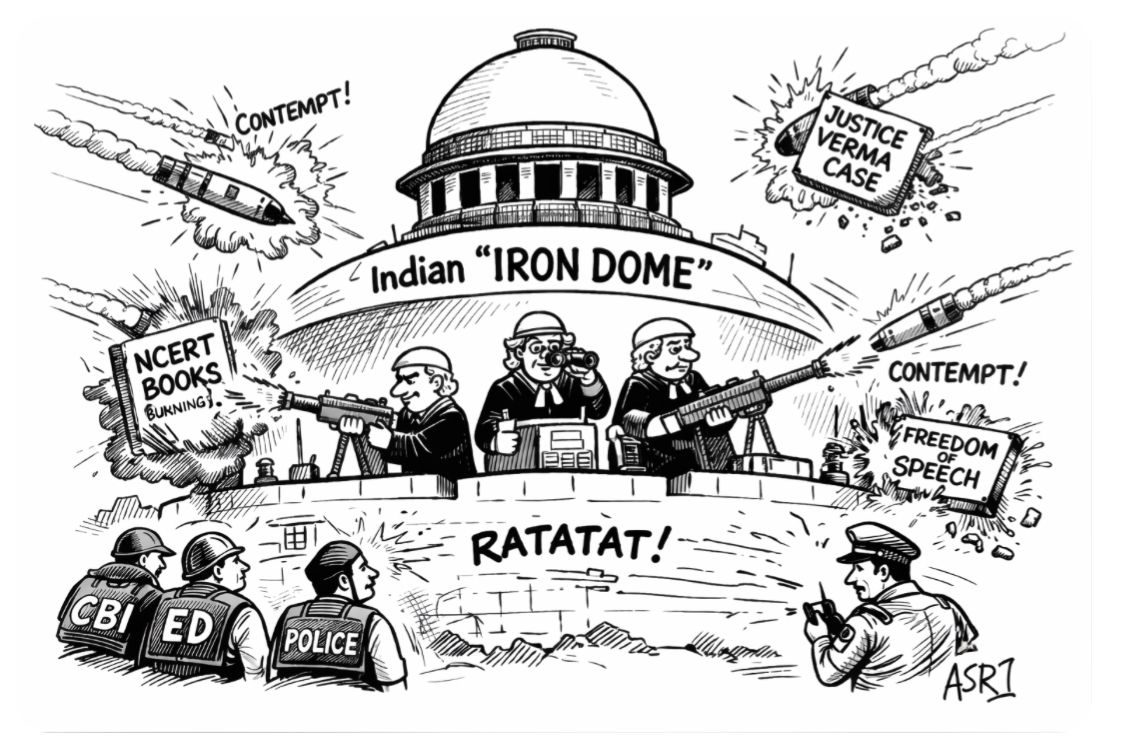
The gravity of the issue was acknowledged at the highest judicial level when the Supreme Court took suo motu cognisance and ordered an immediate ban on the textbook, directing the seizure of all physical and digital copies. A three-judge Bench issued show-cause notices to senior officials, including the Director of the National Council of Educational Research and Training, and sought records of meetings and approvals that led to the chapter’s inclusion. The Court observed that the contents could amount to an attempt to erode institutional authority and even attract contempt of court.
Following the Court’s intervention, NCERT halted the distribution of the textbook and admitted that inappropriate material had found its way into the chapter. It undertook to rewrite and revise the content. During the proceedings, the Solicitor General tendered an unconditional apology on behalf of the Union Government and NCERT and assured the Court that accountability would be fixed and corrective steps taken.
The unequivocal condemnation of the objectionable chapter by Prime Minister Narendra Modi has been welcomed as statesmanlike and consistent with the long-standing position of the Government of India in upholding the dignity, independence and constitutional role of the judiciary. The Prime Minister’s stand reinforces that the government has always held the judiciary in the highest esteem, and any attempt to suggest otherwise, particularly before schoolchildren, is deeply unfortunate and wholly unjustified.
While these developments address the immediate fallout, they do not answer the central and more disturbing question: how did a chapter carrying generalised and unsubstantiated allegations about the judiciary clear multiple layers of academic and administrative vetting? The pattern of approval suggests not a routine oversight but a systemic failure that warrants a full-scale inquiry into the process, the authorship and the decision-making chain behind the publication.
There is compelling reason to believe that the inclusion of this chapter was not inadvertent but a deliberate act by certain vested interests seeking to defame the judiciary and poison the harmonious relationship between the Executive and the Judiciary, the two vital pillars of India’s constitutional democracy. If such attempts are allowed to pass unchecked, they risk weakening public faith in the justice delivery system and destabilising the constitutional balance envisioned by the framers of the Constitution.
The danger of introducing such content at the school level is especially acute. When allegations of corruption are presented without evidence or context to young students, they implant suspicion and cynicism at an early stage of learning. This can cause long-term damage to institutional credibility and distort the understanding of democratic governance among future citizens.
A credible inquiry must therefore examine the precise circumstances under which the chapter was conceptualised and approved, identify the individuals or groups responsible for drafting and clearing it, and determine whether any political or ideological considerations influenced its inclusion. Their political affiliations, if any, must also be examined in the interest of transparency and accountability.
The legal fraternity remains united in safeguarding the dignity, independence and credibility of the judiciary and stands ready to cooperate fully with the government in any steps taken in this direction. Protecting the judiciary from motivated attacks is not merely a professional concern but a constitutional obligation owed to the nation.
This episode has exposed serious vulnerabilities in the curriculum approval process and underlines the urgent need for stricter scrutiny, transparency and institutional safeguards in the framing of school textbooks, particularly on subjects touching constitutional institutions. Educational material must enlighten students about democracy and the rule of law, not undermine confidence in the very institutions that sustain them.
Only a thorough and transparent inquiry, followed by structural reform of the vetting process, can restore public trust and ensure that school education does not become a vehicle for unverified allegations or ideological experimentation at the cost of institutional integrity.
*Dr Adish Aggarwala is a senior advocate and a former president of the Supreme Court Bar Association. This write-up is based on his letter to the Prime Minister written in his capacity as president of the All India Bar Association.




Only those who are mentally deranged can argue that stating an obvious fact like judiciary being corrupt is a deliberate effort to malign judiciary. Right from survey amoung ordinary citizens to the case of yeshwant varma prove that not only there is corruption in judiciary but also that they can indulge in it with impunity.