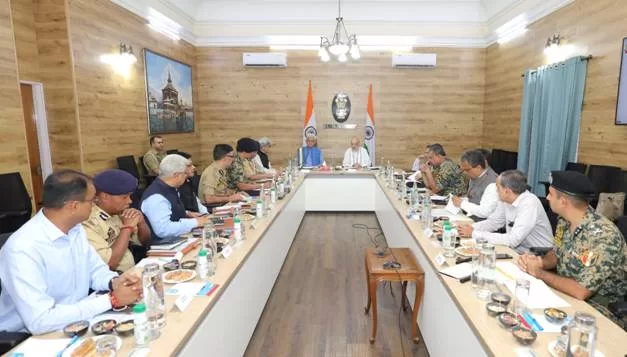
Amit Shah Instructs J&K Agencies to Boost Security, Relief
Jammu: Union Home Minister and Minister of Cooperation Amit Shah issued directives to bolster security and disaster response in Jammu and Kashmir during a high-level meeting in Jammu today. He instructed security agencies, including the Central Armed Police Forces (CAPFs), to intensify vigilance and coordination to eliminate terrorism, reinforcing the Central Government’s zero-tolerance policy. Addressing recent flash floods and landslides, he directed the India Meteorological Department (IMD) and National Disaster Management Authority (NDMA) to leverage data analytics and artificial intelligence to study cloudburst triggers and enhance early warning systems. He also emphasised a critical review of the Glacial Lake Outburst Flood (GLOF) Early Warning System to minimise casualties, aligning with a zero-casualty goal.
Accompanied by Lieutenant Governor Manoj Sinha, Chief Minister Omar Abdullah, Union Home Secretary, Director of the Intelligence Bureau, Chief Secretary and Director General of Police of Jammu and Kashmir, and heads of CAPFs, Shah reviewed the security landscape and flood relief operations. He commended the Union Territory administration and security agencies for ensuring the peaceful conduct of the Shri Amarnathji Yatra in 2025, with over 4.5 lakh pilgrims reported by local authorities to have participated without incident. Shah also praised the coordinated efforts of the National Disaster Response Force (NDRF), Army, Union Territory Disaster Response Force (UTDRF), Jammu and Kashmir Police, and CAPFs, which evacuated over 5,000 people and saved numerous lives during the floods.
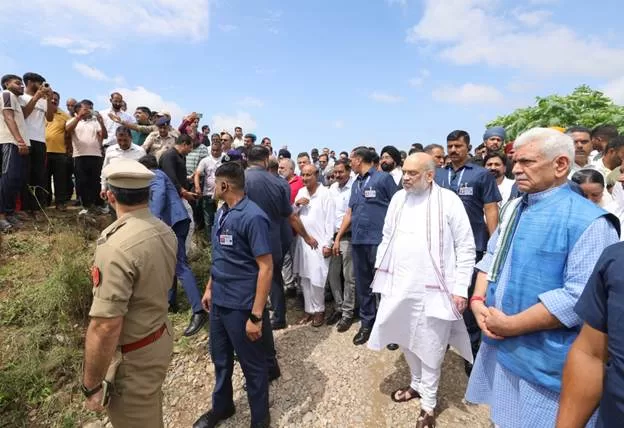
Shah visited flood-affected areas in the Jammu division, inspecting damages at the Tawi Bridge at Bikram Chowk, the Shiv Temple, and residential areas in Mangu Chak village, where he met displaced residents. Official reports indicate that heavy rainfall since late August triggered flash floods and landslides, damaging over 1,200 homes and critical infrastructure, including 15 major roads. Shah expressed condolences for at least 12 confirmed deaths, as per Union Territory government data, and assured comprehensive support. He noted that Modi had personally monitored the situation, enabling the rapid deployment of 17 NDRF teams, 23 Army columns, and Indian Air Force helicopters, which remain on standby.
The Central Government has allocated Rs. 209 crore from the State Disaster Response Fund (SDRF) to support relief efforts, with funds already disbursed for immediate aid. Shah directed advanced survey teams from the Ministry of Home Affairs to assess damages, estimating losses to infrastructure and private property at over Rs. 500 crore, according to preliminary Union Territory reports. He instructed the Food Corporation of India (FCI) to supply additional rations to affected areas, with a decision on offline delivery pending a connectivity assessment within 10 days. Shah also ordered the Health and Water Departments, supported by Army and CAPF medical units, to prioritise clean water and healthcare, noting that 85 per cent of electricity and water supplies have been restored.
To address systemic gaps, Shah stressed the need for accurate and accessible Early Warning Apps, citing inconsistencies in current systems that delayed evacuations in remote areas. Local officials reported that timely warnings from the IMD and Union Territory Disaster Management Authority reduced casualties, but challenges remain in reaching rural communities. Shah’s call for AI-driven analysis aims to address these gaps, with the NDMA tasked to collaborate with scientific institutions for cloudburst prediction models. He also directed a follow-up meeting within 48 hours to coordinate Central and Union Territory efforts, ensuring swift rehabilitation and reconstruction.
The Union Territory government has established 45 relief camps, providing food and medical care to over 10,000 displaced individuals, according to local administration updates. Road repairs have restored traffic on 80 per cent of affected routes, and temporary infrastructure restoration is ongoing. Shah assured that compensation for damaged private property, estimated to affect 3,000 households, would be expedited under SDRF guidelines. He reiterated the Central Government’s commitment to supporting Jammu and Kashmir, emphasising sustained relief and technical assistance to rebuild affected communities.
– global bihari bureau