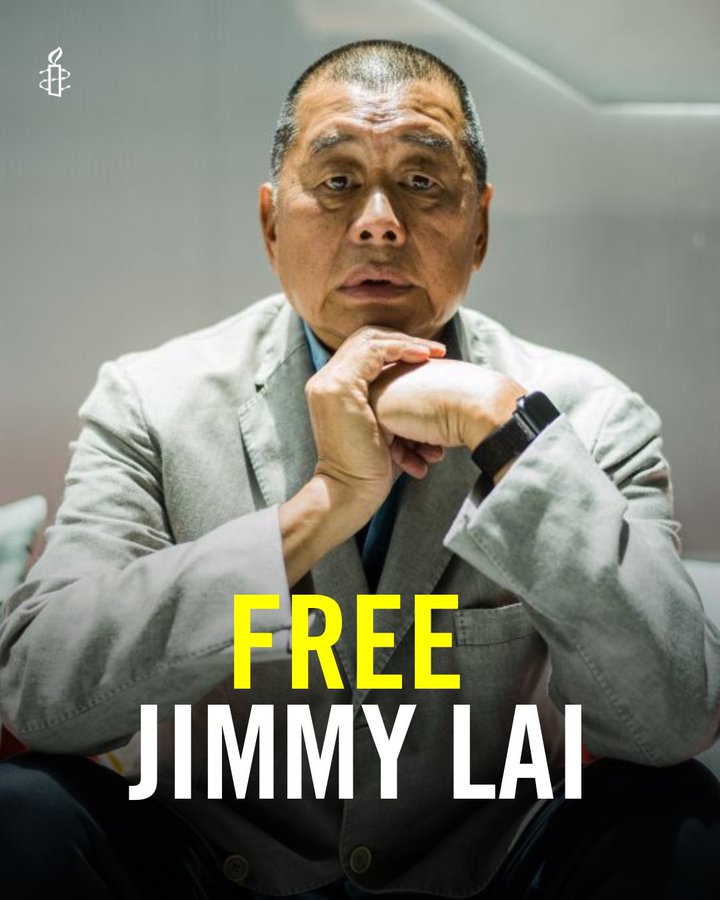
Jimmy Lai. Photo source: Amnesty UK @AmnestyUK|X
Hong Kong Verdict Sparks Diplomatic and Media Debate
Trump Condemns Lai Verdict, China Remains Unyielding
Washington/Beijing: It began with a statement that instantly reverberated across global capitals. United States President Donald Trump said he felt “badly” about the conviction of Jimmy Lai in Hong Kong and called for his release. The remarks, delivered at a high-profile briefing, were echoed by the United Kingdom and a host of international human rights organisations, including Amnesty International and Reporters Without Borders. Lai, the founder of the once-vibrant Apple Daily, had become a visible symbol of independent journalism and pro-democracy activism in the city.
For Trump and his supporters, Lai’s conviction is not merely a legal matter but a test of principles promised under the 1984 Sino-British Joint Declaration, which enshrined certain freedoms for Hong Kong after its return to China. The United States framed the case as a human rights issue, citing reports that Lai’s health had deteriorated sharply over more than 1,800 days of imprisonment and stressing the broader implications for civil liberties in Hong Kong. Secretary of State Marco Rubio reinforced this view, highlighting that Lai is part of a larger cohort facing legal consequences for defending freedom of expression. Rubio also underscored the humanitarian dimension, calling on Hong Kong authorities to release Lai on humanitarian grounds.
“The guilty verdict in Mr. Lai’s national security case reflects the enforcement of Beijing’s laws to silence those who seek to protect freedom of speech and other fundamental rights — rights that China pledged to uphold in the 1984 Sino-British Joint Declaration. Mr. Lai is not alone in facing punishment for defending these rights. Reports indicate that Mr. Lai’s health has severely deteriorated during more than 1,800 days in prison. We urge the authorities to bring this ordeal to an end as soon as possible and to release Mr. Lai on humanitarian grounds,” Rubio stated today.
Across the South China Sea, the response was markedly different. Foreign Ministry spokesperson Guo Jiakun addressed the matter in multiple press briefings between December 12 and December 16, 2025, emphasising that the case is an internal judicial matter of the Hong Kong Special Administrative Region. “Hong Kong upholds the rule of law. The Central Government firmly supports the Hong Kong SAR in safeguarding national security and punishing crimes that endanger national security in accordance with the law, and bringing criminals who endanger national security to justice,” Guo said, repeatedly framing foreign criticism as interference. He stressed that the judicial process was lawful, legitimate, and beyond reproach, warning other countries to refrain from meddling in Hong Kong’s internal affairs. Guo’s statements underscored the Chinese government’s consistent position: sovereignty and national security take precedence over external pressure or opinion.
Jimmy Lai’s personal and professional journey is inseparable from Hong Kong’s turbulent political landscape. A self-made entrepreneur and media tycoon, 78-year-old Lai first rose to public prominence during the 2019 anti-government protests, when he was arrested for participating in unauthorised assemblies. His subsequent legal challenges intensified after the National Security Law came into effect in June 2020, a sweeping legislation that criminalises acts of secession, subversion, terrorism, or collusion with foreign forces. Lai faced charges of colluding with foreign governments to promote sanctions against Hong Kong, endangering national security, and participating in protests.
Apple Daily, Lai’s flagship newspaper, came under intense pressure. Police raids, asset freezes, and the arrests of executives culminated in the paper’s closure in 2021, silencing one of the city’s most prominent independent voices. For readers and journalists, the closure represented more than the end of a publication; it was a stark indicator of the shrinking space for independent reporting in a city once lauded for its vibrant press. Reports indicate that Lai’s health deteriorated during prolonged detention, adding a human cost to the legal and political drama.
The legal proceedings themselves were emblematic of the challenges facing Hong Kong’s judiciary under the National Security Law. The rapid succession of arrests, bail denials, and overlapping charges raised questions internationally about the boundaries of due process in politically sensitive cases. Lai’s conviction serves as a lens through which analysts examine the practical limits of the “one country, two systems” principle: the framework that promised Hong Kong a high degree of autonomy while ensuring the central government’s ultimate authority over security and sovereignty.
Reporters Without Borders, an NGO, criticised “the short notice announcement” and also called the trial a “sham.” However, Guo Jiakun said that the fundamental premise of One Country, Two Systems is to safeguard the “sovereignty, security and development interests of our nation”.
Jimmy Lai’s Legal Journey
Aug 2019: Arrested for participation in anti-government protests.
June 2020: National Security Law comes into effect.
Aug 2020: Arrested on collusion and national security charges.
Dec 2020: Arrested for organising/protesting charges.
2021: Apple Daily closure after asset freeze and raids.
Dec 2025: Guilty verdict under National Security Law; international reactions surge.
Globally, the implications are significant. Lai’s case has become a diplomatic flashpoint, influencing discussions in Washington, London, and Brussels, as well as shaping the strategies of human rights organisations. For the United States and allied governments, the verdict signals an erosion of civil liberties and independent journalism in Hong Kong, prompting concerns about the broader trend of restricting dissent. For Beijing, the case represents the exercise of sovereign authority to enforce law and order, positioning dissent that is perceived as collusion with foreign powers as a potential threat to national stability. The reactions from Trump, Rubio, and Western human rights organisations underline the symbolic weight of the case in shaping international perceptions of Hong Kong and China.
Beyond diplomacy and law, the case has human and social dimensions. Lai’s colleagues, family, and supporters have spoken of the emotional toll and the chilling effect on independent journalism. Apple Daily’s closure removed a major platform for investigative reporting, and journalists now operate in an environment where legal definitions of national security intersect with editorial freedom. Lai’s case is thus a measure of both resilience and constraint: an individual facing an extraordinary legal and political pressure, and a society navigating a transformed landscape for media and civil society.
For readers following the arc of Hong Kong’s autonomy, the verdict is far from a closed chapter. The legal conclusion in Hong Kong does not end the international resonance of the case. Diplomatic engagement, advocacy for press freedom, and scrutiny of Hong Kong’s autonomy are likely to remain active fronts. Meanwhile, local journalists and civil society organisations continue to navigate heightened legal scrutiny and operational limitations, testing the boundaries of what remains permissible under the National Security Law.
As the dust settles on the courtroom proceedings, Jimmy Lai’s case stands as both a legal milestone and a symbol of global contention. It captures the tension between sovereignty, security, and freedom; between legal authority and humanitarian concerns; between local governance and international attention. For advocates of press freedom, policymakers, and residents of Hong Kong alike, the story is ongoing. It is a story that illuminates the fragile balance of law, politics, and human rights in a city whose freedoms were once considered a model under the “one country, two systems” promise—and whose trajectory now carries lessons and warnings for the wider world.
– global bihari bureau