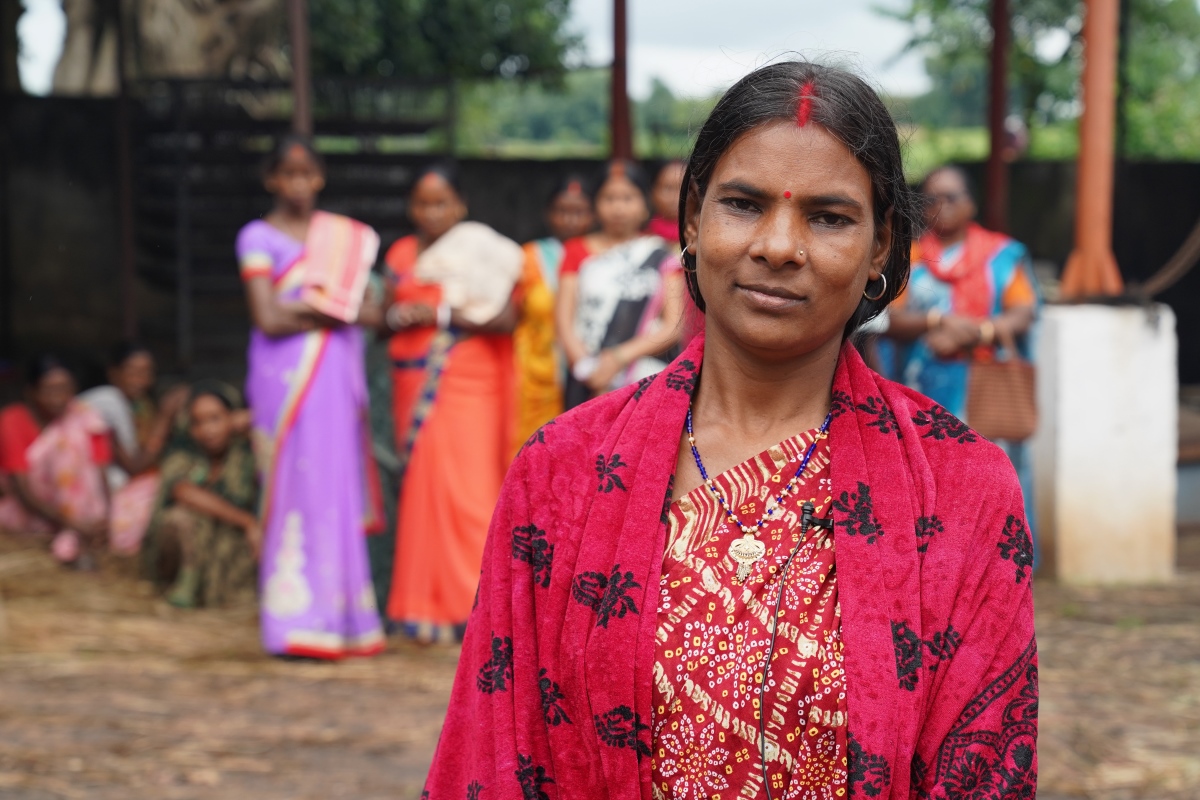
© FAO/ Nilavra Bhattacharjee
Ranchi: In the heart of Jharkhand, where ancient forests hum with life and the earth brims with untapped riches, a quiet revolution is taking shape. This is a land of stark contrasts—lush soils teeming with minerals sit alongside fields scorched by unpredictable droughts and capricious monsoons. Yet, amidst these challenges, vibrant communities are weaving a story of grit, unity, and transformation. Picture narrow paths winding through remote hamlets, where women balance baskets of vegetables or bundles of firewood on their heads, coaxing a living from fragmented plots with weathered tools. Their lives, once anchored to subsistence, are now reaching for something bolder.
In Gumla district, a small community hub pulses with energy. Inside, women of all ages cradle toddlers or lean in close, their producer group meeting crackling with ideas. Outside, rows of plump brinjals, hearty pulses, and ripe tomatoes stretch under the sun, a vivid testament to their labour. These crops, carefully nurtured, are destined for the vibrant feasts of the Sohrai harvest festival, a celebration of bounty in October and November. But this gathering is about more than the harvest—it’s a forge for a future where these women stand taller, their voices stronger, their dreams within reach.
Across Jharkhand, 200,000 households are rewriting their stories through the Jharkhand Opportunities for Harnessing Rural Growth (JOHAR) programme, a lifeline fueled by the Government of Jharkhand’s Department of Rural Development, the Jharkhand State Livelihood Promotion Society (JSLPS), and bolstered by the World Bank and the Food and Agriculture Organization (FAO). JOHAR has ignited a shift from survivalist paddy farming to high-value crops like fruits and vegetables, alongside thriving livestock ventures. Over 150,000 households have seen incomes soar by more than 35 per cent, a leap that means school fees paid, meals secured, and futures brightened.
In just four years, JOHAR’s 21 women-led Farmer Producer Organisations (FPOs), representing 4,000 producer groups, have churned out a staggering USD 21 million in business turnover. These women negotiate savvy deals, snapping up inputs at bargain prices and selling their harvests to FPOs on terms that outshine open markets. The ripple effect is profound—children in classrooms, homes steadier, and communities buzzing with possibility.
Take Asha Devi, now the spirited Chair of Kanke’s producer group. Once tethered to traditional farming, she grew just enough to feed her family, with no surplus to sell. Marriage came early, and her world was small. But JOHAR changed the script. Joining the Kanke producer group, Asha found strength in numbers, pooling resources to conquer the limits of scattered plots and outdated tools. With JOHAR’s backing, her group embraced modern techniques and high-value crops, tapping into affordable equipment from app-based Custom Hiring Centres and quality seeds from Agri-marts. A digital app now guides their crop planning, while a call centre offers expert advice on pests, markets, and financing. Asha’s leadership didn’t stop there—she and women from Bero and Mandar districts founded the Sarhul Ajeevika Farmer Producer Company Limited, a cooperative uniting 14,000 women with a financial stake in their collective success. “We know profit margins, market demands, and how to negotiate,” Asha beams. “Our children call us entrepreneurs—that’s our greatest reward.”
Sarhul’s growth is nothing short of electric. From a modest USD 2,300 in 2019, it skyrocketed to USD 290,000 by 2023, with projections hitting USD 405,000 today—a 180 per cent surge. CEO Sanjeev Kumar credits this to a relentless focus on women-led businesses and sharp market monitoring. K. Srinivasan, Secretary of Jharkhand’s Rural Development Department, calls JOHAR’s integrated approach a game-changer, lifting tribal and landless women into modern agriculture and thriving markets.
At Patratu’s bustling Agri-mart, manager Deepak Kumar proudly displays earthworm manure and clever pest traps like pheromone and lemongrass sprays, serving farmers across blocks. JOHAR’s 550 soilless seedling centres and poly-house nurseries, run by women entrepreneurs, churn out robust seedlings, while solar-powered irrigation and tricycle-mounted pumps bring water to parched fields. Over 60,000 households now farm smarter, thanks to these innovations.
In Kanke’s tribal village of Malsiring, Dharmi Devi’s story mirrors Asha’s. Once forced to abandon school due to poverty, Dharmi now co-directs Sarhul and leads her Village Council. Starting with 30 hens from JOHAR, her producer group turned a USD 110 profit, spurring her to scale up to 100 hens and double her earnings. Across Jharkhand, 65,000 households have seen incomes multiply 84-fold through livestock support, with Dharmi’s poultry venture part of a network producing three million eggs annually—five per cent of the state’s supply.
Near Ranchi, the Divyansh Agro Poultry Hatchery hums with life, its incubators cradling eggs that become chicks for farmers like Dharmi. CEO Vikash Kumar Choudhary scaled from 10,000 to 100,000 chicks weekly, driven by JOHAR’s training and market connections. His solar-powered hatchery machine empowers rural women to hatch chicks at home, sparking their own entrepreneurial journeys.
In Bero’s forested hills, a lemongrass distillation facility thrums with purpose, its citrusy scent wafting as 250 tribal women transform 70 acres of barren land into a USD 350,000 oil business. Mithila Devi, a producer group member, marvels at the shift: “We didn’t know lemongrass could bring profit, even in dry seasons. Now, I’m lifting other women out of poverty.” Nearby, in Raidih, women cultivate lac, a resin prized for cosmetics, turning forest resources into climate-resilient income through JOHAR’s market savvy.
The journeys of Asha, Dharmi, and Mithila weave a tapestry of triumph, proving that when women are armed with skills, resources, and opportunity, they don’t just survive—they reshape their world. JOHAR’s legacy, backed by JSLPS, FAO, and the World Bank, is a blueprint for agrifood transformation, sowing seeds of prosperity that will bloom for generations.
Source: The FAO News And Media Office, Rome
– global bihari bureau