Jerusalem: A violent terrorist attack struck Ramot Junction in Jerusalem today, claiming the lives of six individuals and injuring between 10 and 21 others. The incident, which occurred around 10:13 a.m. local time at a crowded bus stop on Yigal Street, involved two Palestinian gunmen from the occupied West Bank who opened fire using improvised “Carlo” submachine guns before being neutralised by security forces and an armed civilian.
— Israel ישראל (@Israel) September 8, 2025
Israeli police confirmed that the attackers arrived by car and targeted a bus station near the entrance to the Ramot neighbourhood, an area annexed by Israel following the 1967 war. Among the deceased was Yaakov Pinto, a recent immigrant from Spain, alongside a 50-year-old man, a woman in her 50s, and three men in their 30s, including a rabbi. Reports indicate at least one pregnant woman was among the injured, with some in serious condition. In response, Israeli authorities closed checkpoints between East Jerusalem and the West Bank, while the Israel Defense Forces encircled areas near Ramallah to pursue potential accomplices.
Prime Minister Benjamin Netanyahu visited the scene, describing the event as part of an “intense war against terror on several fronts.” Defence Minister Yoav Gallant vowed a strong retaliatory response, hinting at potential actions against Gaza, though no specific operations were detailed. National Security Minister Itamar Ben-Gvir also inspected the site.
The attack drew international attention and condemnation. The United States State Department expressed solidarity with Israel, stating, “We condemn terrorism and stand alongside our friend Israel,” while offering prayers for the victims’ families. The United Nations Secretary-General António Guterres also condemned the violence, extending condolences to those affected. Hamas, a Palestinian militant group, praised the attackers as “resistance fighters” but did not claim responsibility, while Islamic Jihad expressed similar support. Neither group has been officially linked to the attack by Israeli authorities.
In a related development, tensions between Israel and Spain surfaced amid the incident. Israeli Foreign Minister Gideon Sa’ar posted on X, criticising Spanish Prime Minister Pedro Sánchez for an attack on Israel coinciding with the killing of Yaakov Pinto, a Spanish immigrant. This statement came as Sánchez announced a permanent weapons embargo on Israel on the same day, a move that has heightened diplomatic friction. Spain has previously recognised Palestinian statehood and criticised Israel’s actions in Gaza, including Sánchez’s past remarks labelling Israel a “genocidal state.” Sa’ar, while offering details of the attack, asked every country to make a clear choice: “This morning, there was a horrific terror attack in our capital Jerusalem. Two Palestinian terrorists murdered Jews on buses at the Ramot Junction in the entrance to Jerusalem. So far, six Israelis have been killed. There are many, many injured, including a pregnant woman, we pray for them. We are in a war against radical Islamist terrorism Europe and the international community, every country must now make a clear choice: Are they on Israel’s side? Or are they on the side of the Jihadists? We know Hungary is on our side.”
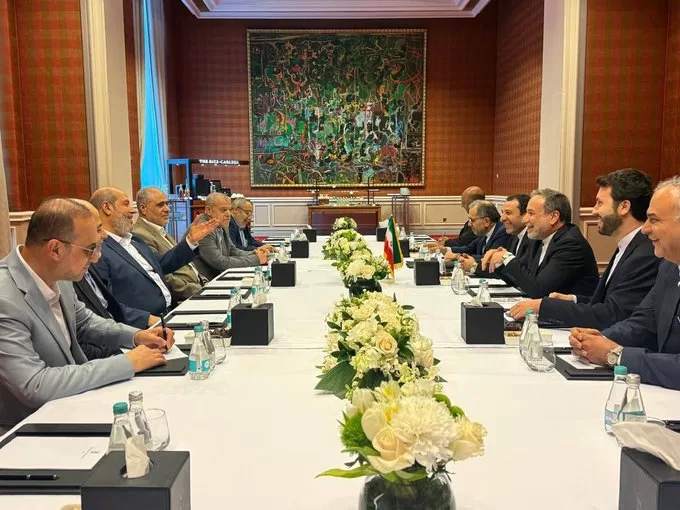
Regarding Iran’s potential involvement, a meeting between Iran’s Foreign Minister and Hamas leaders took place last week in Doha, Qatar, as confirmed by an official post from the Israeli government. This aligns with Iran’s long-standing support for Hamas, including an estimated $30 million annually since the 1990s, alongside military training for thousands of Hamas members at Revolutionary Guard bases in Iran and Lebanon, according to a 2020 U.S. Department of State report and Wikipedia. Iran’s backing is part of the broader Axis of Resistance, an Iran-led coalition opposing Israel and the U.S., which also includes Hezbollah and the Houthis. While Iran has not issued a direct statement on the Jerusalem attack as of 10:33 p.m. IST today, its historical denial of prior knowledge of Hamas’s October 7, 2023, attack—despite praising it as a victory, per The Times of Israel—raises questions about its influence.
Regarding potential escalation, the Houthis militia in Yemen, an Iran-backed group, conducted a drone strike on an Israeli airport on September 7, the day before the Jerusalem attack, marking a rare direct hit. A previous Israeli strike on August 31, 2025, which killed Houthi officials, prompted vows of retaliation, with analysts suggesting the group’s decentralised structure allows it to intensify attacks despite leadership losses.
The Indian Prime Minister, Narendra Modi, “strongly” condemned the heinous terrorist attack on innocent civilians in Jerusalem today. “India condemns terrorism in all its forms and manifestations and stands firm in its policy of zero tolerance towards terrorism,” Modi stated. The Prime Minister posted on X: “Strongly condemn the heinous terrorist attack on innocent civilians in Jerusalem today. We extend our heartfelt condolences to the families of the victims and wish a speedy recovery to those injured. India condemns terrorism in all its forms and manifestations and stands firm in its policy of zero tolerance towards terrorism.”
The attack unfolded against a backdrop of ongoing regional conflicts, including the Gaza War and recent Houthi drone strikes on Israel, supported by Iran. Investigations continue as authorities work to determine the full scope of the incident and its perpetrators.
– global bihari bureau