Photo credit: Florian Fussstetter/UNEP
World Environment Day 2025: UNEP’s #BeatPlasticPollution Push Faces Persistent Hurdles
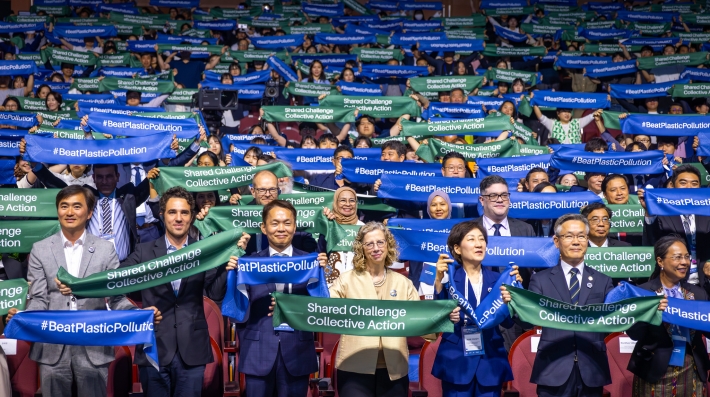
Jeju, South Korea: Jeju’s volcanic shores glowed under the dawn as the Republic of Korea’s island province hosted a summit for World Environment Day, rallying the globe under #BeatPlasticPollution. With 11 million tonnes of plastic waste flooding aquatic ecosystems yearly, microplastics infiltrating food, water, the United Nations Environment Programme (UNEP) has mobilised governments to tackle a crisis costing $300–600 billion. Plastic pollution—forms one pillar of the triple planetary crisis alongside climate change and biodiversity loss. As negotiations for a plastics treaty, initiated by a UNEP-2 resolution led by France, loom in Geneva from 5 to 14 August 2025, over 2,500 events worldwide mark this pivotal moment, with Jeju’s 2040 plastic-free goal inspiring global action.
Plastic pollution’s toll is immense. Of the 2.24 billion tonnes of plastic waste generated this century, oceans have absorbed 75–199 million tonnes, with 8 to 10 million tonnes added yearly—80% of ocean pollution. Globally, plastics 460 million tonnes annually annually, 70% becoming waste, with only 9% recycled. In the Pacific, Pacific garbage patches twice the size of Texas kill marine animals ingesting 15,000–30,000 tonnes of microplastics annually, tainting fish consumed by millions. In Sri Lanka, the Kelani River carries plastic debris to the sea, polluting fisheries. “Plastic waste clogs rivers, endangers wildlife, and infiltrates every corner of Earth, from Mount Everest to breastmilk,” said UN Secretary-General António Guterres at Jeju’s ceremony. “Collective action is our hope.” The crisis threatens 600 million livelihoods, particularly in developing nations reliant on fisheries and tourism.
UNEP’s galvanising efforts are transformative. Through the Global Partnership on Plastic Pollution and Marine Litter (GPML), UNEP launched the Global Plastics Hub on 4 June, a digital platform connecting 2,500+ partners—governments, NGOs, businesses—for data and collaboration on marine litter solutions, including regional hubs in the Caribbean and Mediterranean. The Clean Seas campaign, active in 70 countries, has driven 50 nations to ban single-use plastics by 2024. The Tide Turners Plastic Challenge, launched in Kenya and engaging 980,000 youth across 60+ countries, held an India summit on 2 June, showcasing coconut leaf straws and recycled plastic life jackets. In Sri Lanka, UNEP-backed youth trained 30,000 people to monitor river microplastics, while in Mexico, community clean-ups removed 500 tonnes of coastal waste in 2024. UNEP’s New Plastics Economy Global Commitment, with 500+ signatories, pushes businesses and governments to achieve 100% reusable, recyclable, or compostable packaging by 2025.
The Intergovernmental Negotiating Committee (INC), established by UNEP under UNEA resolution 5/14 in March 2022, is tasked with crafting a legally binding treaty on plastic pollution, addressing its full life cycle. The INC began work in November 2022 in Punta del Este, Uruguay (INC-1), followed by sessions in Paris (INC-2, May–June 2023), Nairobi (INC-3, November 2023), and Ottawa (INC-4, April 2024). The fifth session (INC-5) in Busan, Republic of Korea, from 25 November to 1 December 2024, saw 3,300 delegates from 170+ nations negotiate a Chair’s Text, advancing convergence on treaty structure but failing to finalise due to divergences on production cuts. The session was suspended, with INC-5.2 scheduled for 5–14 August 2025 in Geneva to resume negotiations, aiming for adoption in 2025 at a diplomatic conference potentially hosted by Ecuador, Peru, Rwanda, or Senegal.
Governments are responding. Mexico’s President, Claudia Sheinbaum, launched a 2025–2030 National Strategy for Beach and Coast Cleanup, targeting 100% plastic waste removal from coastlines, guided by UNEP. Jeju’s “Plastic Zero” plan, aiming for a plastic-free province by 2040, enforces waste separation at 34 recycling centres and pioneered South Korea’s disposable cup deposit system, cutting single-use plastics by 20% in hotels and restaurants since 2023. South Korea, hosting World Environment Day for the second time since 1997, leverages UNEP’s expertise for its life-cycle plastic strategy. “Governments, businesses, and citizens must unite for a circular economy,” said Vice Minister Lee Byounghwa. UNEP’s push for a global plastics treaty, backed by 100+ countries for a 40% production cut by 2040, could save $4.5 trillion by 2050. South Korea, the fourth-largest plastic polymer producer, faces pressure to lead, with groups like Uproot Plastics urging action.
Businesses are mobilised. UNEP’s Global Commitment drives circularity, with firms like Korea’s Lotte adopting biodegradable packaging. GPML partnerships promote seaweed-based alternatives, a $1.2 billion trade doubling since 2012, led by China (22.4 million tonnes) and Indonesia (9.2 million tonnes). Non-plastic substitutes like natural fibres hit $560 billion in trade in 2022, growing 30% faster than plastics. UNEP supports small businesses in developing nations, like Sri Lanka’s cooperatives, turning waste into textiles, creating jobs.
Communities are energised. Over 2,500 events—from Australia’s clean-ups to Kenya’s webinars—engaged millions, with #BeatPlasticPollution trending globally. Airports in Baghdad, Beijing, Brussels, Geneva, and Kansai, Japan, broadcast anti-plastic messages, as did metro stations in Beijing and Mexico City. New York’s Times Square billboards and Geneva’s Jet d’Eau, glowing green, amplified the call, alongside Brussels’ city halls. Leaders like Indian Prime Minister Narendra Modi, UAE President Sheikh Mohamed bin Zayed Al Nahyan, and UNEP Goodwill Ambassadors Jason Momoa and Dia Mirza lent their voices. “Ending plastic pollution is a health and economic imperative,” said UNEP’s Inger Andersen. “Recycling alone won’t do. We need a life-cycle rethink.”

The UN Decade on Ecosystem Restoration (2021–2030), co-led by UNEP and FAO, ties these efforts to broader goals. A 245-foot mural, Stand Tall, unveiled on 31 May in Chicago’s Prudential Building by Dutch artist Mr. Super A, celebrates this decade, curated by Street Art for Mankind as part of the #EcosystemRestorationMurals series, symbolising hope. The Decade’s 606 ocean-related measures in Small Island Developing States’ climate plans, 77% focused on coastal resilience, underscore UNEP’s role.
Despite UNEP’s galvanisation, challenges persist. Global plastic production, driven by petrochemical giants in countries like South Korea and Saudi Arabia, faces resistance to production cuts, with only 100 of 193 UN member states backing the treaty’s ambitious targets. The $2.4 billion in ocean-related aid in 2022 falls short of the $100 billion needed annually for SDG 14, leaving developing nations like Sri Lanka and Mexico underfunded for waste management infrastructure. Governance gaps hinder progress: while 50 countries have banned single-use plastics, enforcement is weak in low-income regions due to limited monitoring capacity. The plastics industry’s $1.2 trillion trade in 2022 dwarfs the $560 billion in non-plastic substitutes, constraining market shifts. UNEP’s Clean Seas and GPML rely on voluntary commitments, lacking binding mechanisms, and slowing global coordination. In urban India, where plastic makes up 46% of dry waste, rapid urbanisation has worsened the problem.
These barriers reflect entrenched economic interests and inequities. Petrochemical producers, supplying 99% of plastic polymers, wield lobbying power, delaying treaty progress. Developing nations, contributing 60% of marine litter, lack advanced recycling technologies, with only 15% of their plastic waste managed effectively. The seaweed sector, despite doubling to $1.2 billion, remains under-regulated, limiting scalability. UNEP’s efforts face a fragmented global response, with richer nations prioritising domestic policies over technology transfers. Stronger treaty enforcement, increased funding, and equitable access to circular solutions are critical.
From Jeju’s shores to Sri Lanka’s rivers, #BeatPlasticPollution gains momentum. UNEP’s leadership—through youth engagement, policy advocacy, and partnerships—sparks a global movement. With treaty talks looming, the world has a chance to redefine its relationship with plastic—but only if it overcomes these hurdles to act decisively.
– global bihari bureau