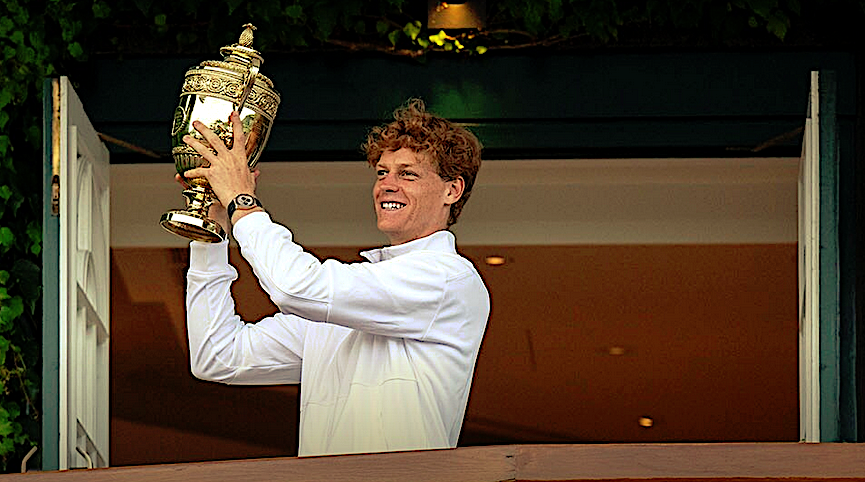
New Wimbledon Champion Jannik Sinner with the trophy.
Wimbledon: Jannik Sinner, Italy’s 23-year-old world No. 1, stood at Centre Court’s baseline on July 13, 2025, his focus unwavering, his dream within grasp. In a hard-fought three-hour, four-minute battle, he outlasted Carlos Alcaraz, the 22-year-old Spanish two-time defending champion, to win the Wimbledon men’s singles title 4-6, 6-4, 6-4, 6-4, becoming the first Italian man to claim the Challenge Cup. As he sank to his knees, a broad grin breaking through, the crowd in SW19—Wimbledon’s postal code district—erupted, celebrating a champion whose victory was historic for Italy. This triumph avenged his French Open final loss to Alcaraz 35 days earlier, a defeat he reflected on post-match: “It’s so special. I had a very tough loss in Paris. At the end of the day, it doesn’t matter how you win or lose; you have to understand what you did wrong. That’s what we did.”
Sinner’s Wimbledon journey showed resilience. A three-time Grand Slam champion, he’d never passed Wimbledon’s semifinals before. This year, his 6-3, 6-3, 6-4 semifinal win over Novak Djokovic ended the Serb’s chase for a 25th major. At Roland Garros, Sinner also beat Djokovic, 6-4, 7-5, 7-6(3), but fell to Alcaraz in a five-set, 5-hour, 29-minute epic, 4-6, 6-7(4-7), 6-4, 7-6(7-3), 7-6(10-2), despite leading by two sets and holding three championship points. At Wimbledon, facing Alcaraz—who’d won their last five meetings—Sinner turned the tables. Alcaraz took the first set with flair, but Sinner’s baseline game and clutch serving won in four sets. An ace sealed his fourth Grand Slam, his first on grass. “This means everything,” he told the crowd, as fans in SW19 cheered, their excitement reaching African audiences via local broadcasts and X posts in Nairobi and Lagos.
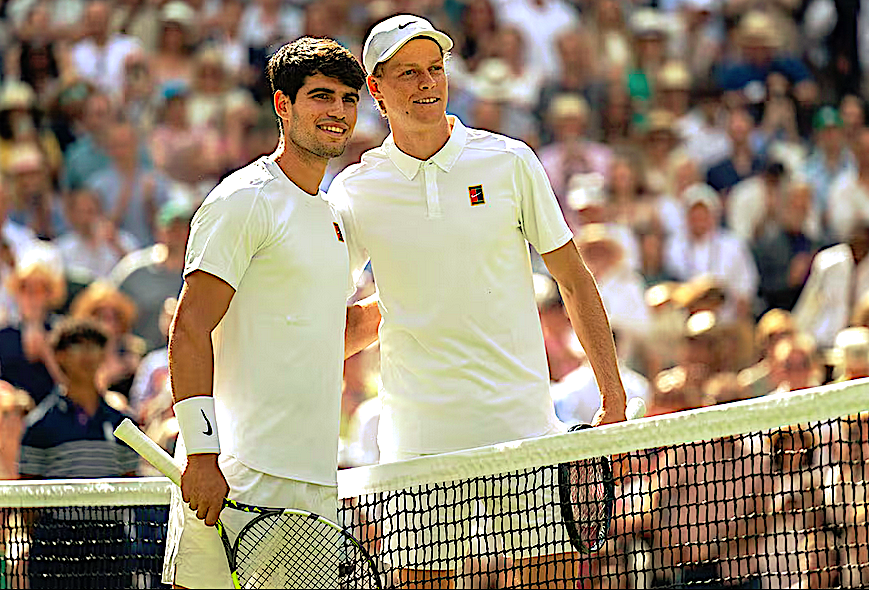
Alcaraz fought fiercely. The youngest man to reach three straight Wimbledon finals since Björn Borg, he’d won his first five major finals, including Wimbledon in 2023 and 2024. His Wimbledon semifinal against Taylor Fritz—a 6-4, 5-7, 6-3, 7-6(6) battle—showed his 88% first-serve win rate. At the French Open, his semifinal against Lorenzo Musetti ended early due to injury, but his final against Sinner saw him rally from 0-40, 3-5 in the fourth set, winning 14 of the final 17 points in a 10-2 tiebreak. At Wimbledon, he pushed Sinner to the limit, but the Italian prevailed. In his Centre Court interview, Alcaraz said, “It’s difficult to lose. It’s always difficult to lose. But first of all, I have to congratulate Jannik once again. He really deserves this trophy, and he played great tennis these two weeks. You have an amazing team around you, and keep it going. You’re improving every day. I’m proud of everything. At the beginning of the season, I was struggling a little bit, on the court and off the court. But I’ve been enjoying being on the court again. I’m excited every time I’m on the court, and I have to thank my team and my family. I just want to keep it going and to keep bringing joy on the court.” Their rivalry, spanning seven straight majors, gripped fans across the world, with newspapers and broadcasts spreading the drama to the globe.
Comparing the finals, Wimbledon’s four-set, 3-hour, 4-minute match was tighter than the French Open’s 5-hour, 29-minute, five-set epic—the longest in Roland Garros history. At the French Open, Alcaraz overcame a two-set deficit and three championship points, a rare feat. Wimbledon saw Sinner rebound from a one-set deficit, his mental growth evident after Paris, where he faltered in tiebreaks. The French Open’s fifth-set tiebreak, a first for Roland Garros, highlighted Alcaraz’s clay-court prowess, while Wimbledon’s four-setter showcased Sinner’s grass-court mastery, ending Alcaraz’s 24-match Wimbledon streak. Sinner’s win levelled their 2025 major final head-to-head at 1-1.
The Wimbledon men’s tournament was a whirlwind of upsets. A record 13 of 32 seeds fell in the first round, and 37 five-set matches set an Open Era benchmark. At the French Open, upsets were less severe, but eight top-10 seeds fell early. Fabio Fognini’s final pro match ended against Alcaraz at both events, while Djokovic hit his 100th win at each, only to exit in the semifinals. Wimbledon’s 138th edition, the first with electronic line calling, saw British players like Cameron Norrie and Jack Draper falter. Still, Alfie Hewett’s wheelchair singles final and doubles with Gordon Reid kept home hopes alive. At Roland Garros, Frances Tiafoe and Tommy Paul reached the quarterfinals, while Loïs Boisson’s semifinal run stirred French fans. Young talents like Oliver Bonding (boys’ doubles) and Ziying Wang (wheelchair singles) shone at Wimbledon, while the French Open featured Musetti’s semifinal.
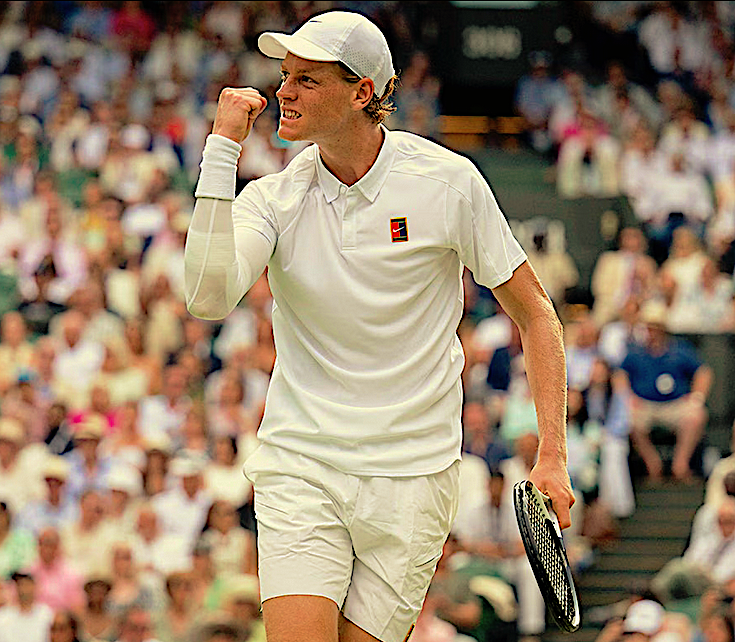
Sinner’s triumph was historic. At 23 years and 318 days, he’s the second-youngest man to reach all four major finals, behind only Jim Courier, and the first to contest four consecutive finals in the Open Era. His victory, the first Wimbledon men’s final without Djokovic since 2017, signalled a new era. As the Princess of Wales presented the trophy, Sinner thanked the crowd. For Indian fans, his determination felt like a desi athlete’s grind. For African fans, his story spread through local broadcasts and radio in Swahili and Yoruba, inspiring from Cape Town to Addis Ababa. As Sinner’s name joined Wimbledon’s Honours Board, his legacy as Italy’s trailblazer took root in SW19, a redemption after his French Open heartbreak.
– global bihari bureau