 By Vijay Jodha
Goodall’s Legacy: Seeing Souls in Chimps, Saving Worlds
Jane Goodall, who passed away last week at 91, was not only a pioneering primatologist who redefined ethology, but also a moral force who challenged the scientific and ethical assumptions of her time. For over six decades, she illuminated the lives of our closest genetic relatives—chimpanzees—through quiet observation, unshakeable patience, and a revolutionary empathy that rippled far beyond the forests of Gombe.
Her career began in 1960, when—without formal academic training—she travelled to what was then Tanganyika (now Tanzania) to study chimpanzees under the mentorship of anthropologist Louis Leakey. (Incidentally, International School Moshi – my high school in Tanzania would later sponsor one of her research projects.)
What she uncovered would overturn long-standing beliefs about the boundary between human and nonhuman life. She observed chimpanzees using tools—fashioning twigs to fish termites—a behaviour then considered uniquely human. Leakey’s now-famous response captured the significance: “We must now redefine man, redefine tool, or accept chimpanzees as human.”
But even more radical was her method. At a time when animals were assigned numbers to maintain ‘scientific objectivity,’ Jane named hers—David Greybeard, Flo, Fifi. She saw them not as specimens, but as individuals with interior lives: joy, grief, jealousy, compassion—even malice. That simple act caused a stir. It was viewed by many in the scientific establishment as unprofessional and dangerously anthropomorphic—akin to the worldview held by various indigenous cultures and religions that had long been dismissed as primitive or unworthy at the time.
Today, her approach — then derided — is de rigueur—not just in scientific animal behavioural research, but also among wildlife filmmakers and photographers. In addition to the obvious convenience, it reflects the deeper understanding we now have: that so-called human traits—family, companionship, joy, grief, tool usage, etc. are not uniquely human. They are widely found across many species we share this planet with. This shift has helped foster a more empathetic, conservation-minded worldview—a necessary contrast to our current ecological unravelling. Her approach fosters a conservation mindset, in contrast to the current ecological mess.
Goodall would go on to establish the Gombe Stream Research Centre, found the Jane Goodall Institute, and launch the global Roots & Shoots youth programme—all while writing prolifically and lecturing around the world. Her scientific contributions are unimpeachable. But more profoundly, she transformed how we relate to the animal world—not as rulers over it, but as kin within it.
A Meeting in Delhi
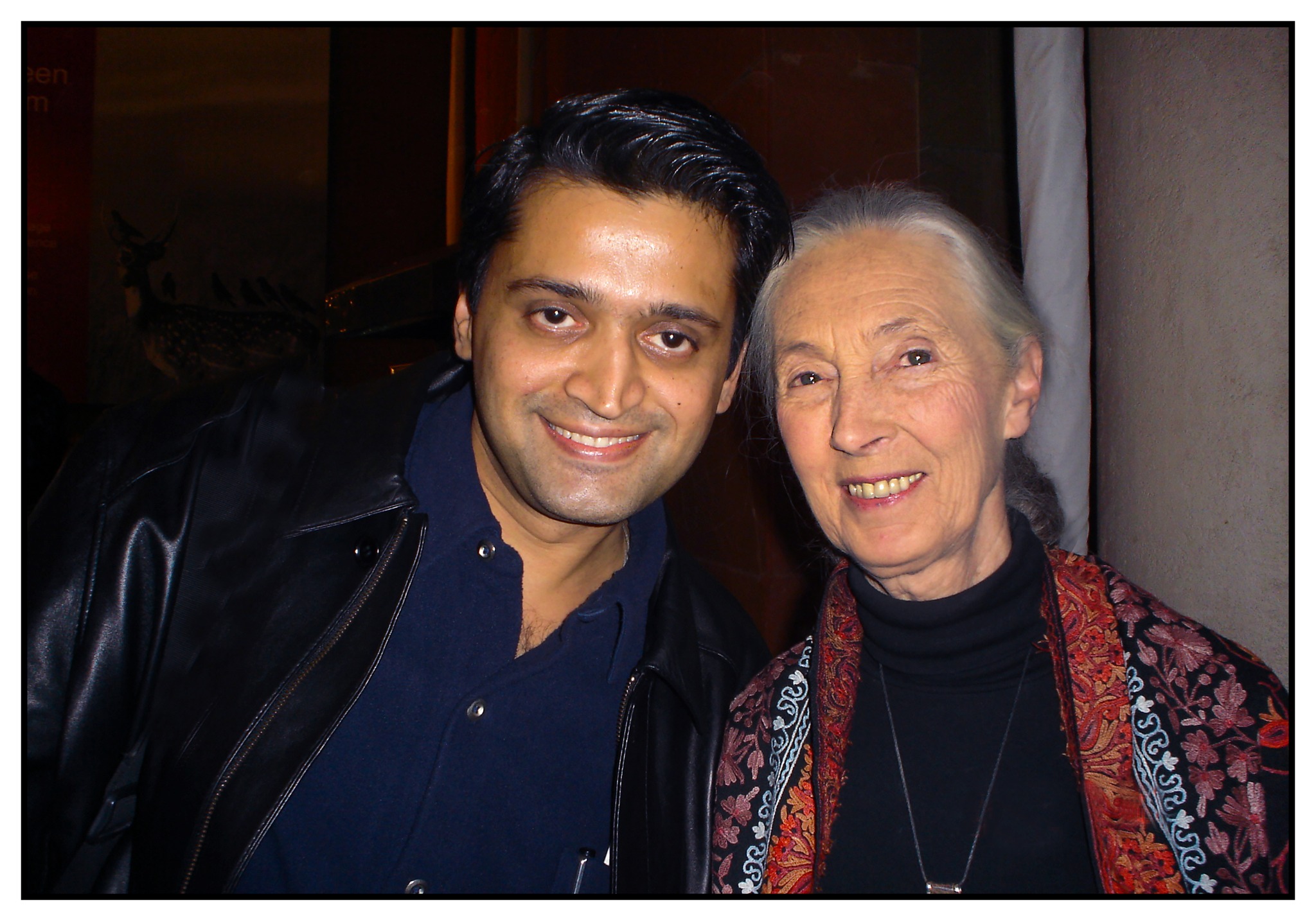
Beyond primatology, her larger role in the global conservation movement is perhaps her most enduring legacy. I recall a visit she made to Delhi twenty years ago, at an event hosted by the British High Commission. It was a quiet gathering of conservationists, activists, filmmakers, photographers, and journalists. I was honoured to be there, having just received the UK Environment Film Fellowship Award for directing one of India’s first climate change documentaries. What I remember most was not any grand speech, but the measured, quietly intense way Jane spoke. Unlike many who cite a life-changing epiphany, her inspiration was humble: Tarzan comics.
The adventures of Edgar Rice Burroughs’ hero, which many of us devoured as children, had captured young Jane’s imagination in England and set her on the path to Africa.
She spoke of her early years at Gombe—the scepticism she encountered, and how naming her chimpanzees sparked more controversy than her discovery of their tool use. Calm but deeply engaged, she spoke not as a public figure, but as someone still in awe of the natural world—and dismayed by the destruction we inflict on it.
The Moral Shift She Forced Upon Science
It’s easy now to forget how controversial her work once was. For decades, mainstream science viewed animals as instinct-driven automatons—incapable of thought or emotion. Goodall quietly dismantled that orthodoxy. She didn’t just study animals; she saw them. And in doing so, she forced us to see ourselves differently.
For those of us in India, or in other cultures where indigenous thought endures, these ideas aren’t new. Hindu and Buddhist traditions—and many other indigenous systems—have long acknowledged animals as sentient beings. Consider the Jataka tales: more than 2,000 years old, these 500+ stories depict the Buddha in past lives as various animals, each a moral parable told through vivid anthropomorphism. They, too, invite us to reimagine the boundaries between species—with empathy and insight.
Like these traditions, Goodall’s work reminded us that science is not the only way to understand the natural world. While some may dismiss spiritual beliefs as unscientific, their reverence for life and repeated affirmations of coexistence are difficult to ignore—especially now, in an age shaped by hyper-extraction, disconnection, and ecological collapse.
Hard Truths, Deep Dignity
Goodall’s empathy-fuelled science led to insights that were both groundbreaking and uncomfortable. Chimpanzees, she found, form deep familial bonds, play, grieve—and wage war. She moved beyond the idealised view of animals as innocent or purer than humans, but she never lost sight of the dignity they deserve. She insisted we accept what the evidence shows: animals reason, feel, plan, suffer, and remember. And yet we cage them, mutilate them, breed them by the billions in factory farms, and subject them to torturous experiments—all in the name of “progress.”
Her Most Radical Legacy
Goodall’s recognition of animal consciousness led her naturally to activism. In her later decades, she was among the few globally respected scientists to condemn not just the ecological costs of animal testing and industrial farming, but their moral foundations.
In a 2019 letter, after viewing undercover footage from a German biomedical lab, she described “some of the worst abuse I’ve ever seen.” Monkeys were yanked from cages. Cats are pinned down for blood extraction. Dogs are bleeding on concrete floors. Some animals, she wrote, were “virtually crucified.” Her verdict: “This is a living hell. Such a situation does not belong in the 21st century and must be stopped.”
This wasn’t a rogue operation. The lab in Hamburg was reputable, well-funded. Her fury wasn’t performative—it came from six decades of knowing, with scientific certainty, that these beings feel pain and fear.
She joined the board of the Nonhuman Rights Project, advocating for legal personhood for animals. She championed plant-based diets, denounced factory farming as one of the greatest moral atrocities of our time, and fought to end invasive primate testing—a goal achieved in the U.S. a decade ago.
These positions weren’t always popular. They put her at odds with many institutions that once celebrated her. Even in conservation, which often prioritises species over individuals, she pushed back. For Goodall, the suffering of one sentient being mattered—because suffering always matters.
What made her radical was not rhetoric but integrity: following the data wherever it led, even when that meant standing alone in rooms full of men discussing pig-breeding for organ transplants, feeling, as she once said, “like an alien in a world with no empathy.”
From Separation to Connection
Perhaps Jane Goodall’s greatest achievement was not in documenting chimpanzee intelligence, but in urging us to dismantle the false hierarchies we’ve built between species—hierarchies that justify exploitation, indifference, and extinction.
Today, her once-dismissed approach permeates scientific literature, wildlife filmmaking, conservation policy, and the ethics of a global youth movement. Cameras linger on the eyes of animals, searching for story and emotion—because Jane taught us to look.
She reminded us that conservation is not only about protecting habitats but about recognising relationships—that to care for the planet, we must first see the lives within it as valuable in themselves, not just for their utility to humans. The shift we need is emotional, philosophical—a move from dominion to kinship.
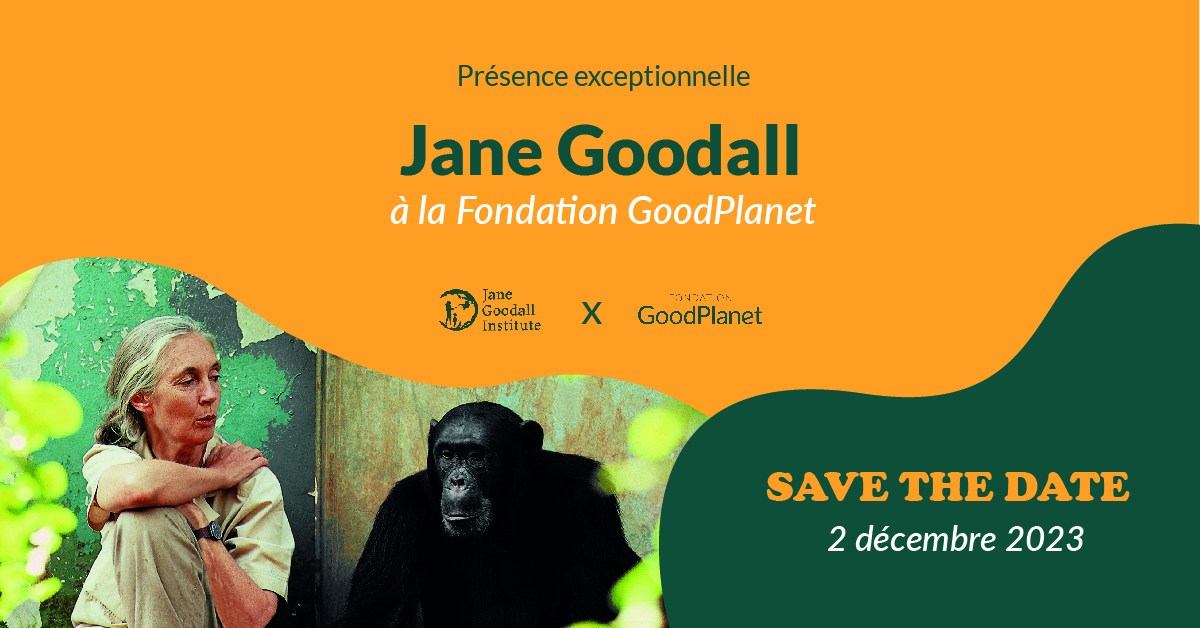
In 2023, she spoke at Cohabiter à GoodPlanet, one of the world’s largest environmental photography exhibitions. I had the honour of being one of the fifty-odd conservation photographers from around the globe whose work was showcased. Organised by Fondation GoodPlanet, the exhibition featured large, all-weather outdoor billboards displayed over nine months across the park surrounding the 19th-century Château du Domaine de Longchamp in Paris. By then, Goodall had become more than a scientist—she was a global conservation evangelist, advocating not just for wildlife and ecosystems, but for a fundamental rethinking of how we eat, consume, and coexist.
Her question still echoes: If animals think and feel, what then is our obligation? It is not a comfortable question. It demands we re-evaluate how we live, eat, research, and govern. It asks for restraint and compassion in a world driven by consumption and cruelty. But it also offers hope—because it invites us to become better, not just to other species, but to ourselves.
The Light She Left Behind
Jane Goodall never claimed perfection or sainthood. What she did possess was a rare kind of moral clarity—a quiet but unyielding conviction that empathy must guide both science and society. She bore witness. She spoke out. She stayed curious. She believed in change and in the difficult work that hope demands.
The world she envisioned—where animals are recognised as fellow beings and conservation is a form of moral attention—still feels distant. But it is closer because she lived. And because she made us look at a chimp called David Greybeard and see—not a number, not an object—but a soul.