This satellite image provided by the National Oceanographic and Atmospheric Administration shows Hurricane Melissa, Tuesday, October 28, 2025.
At least 3 dead; Island in Darkness as Hurricane Melissa Hits
Kingston: Jamaica was pummelled today by Hurricane Melissa, a Category 5 system that experts described as the strongest storm on the planet this year, unleashing winds of 280 kilometres per hour and bringing torrential rainfall, storm surges of up to four metres, and landslides that swept through several parishes. The United Nations and its humanitarian partners warned of a “severe and immediate” threat to life as the slow-moving storm advanced westward at barely six kilometres per hour, prolonging its destructive grip over the island and leaving a trail of devastation that could take months to assess.
At least three deaths were reported as the hurricane’s eyewall scraped across Jamaica’s southern coast, tearing off roofs, uprooting trees, and submerging entire neighbourhoods. Power outages extended from St Elizabeth to Kingston, while flooding in Clarendon, Manchester, and Westmoreland cut off vital access routes and isolated communities. “Roofs will be tested, floodwaters will rise, and isolation will become a harsh reality for many,” said Necephor Mghendi, the International Federation of Red Cross and Red Crescent Societies (IFRC) Head of Delegation for the English- and Dutch-speaking Caribbean. His warning proved prescient as reports poured in of washed-out bridges, submerged highways, and communities left unreachable by emergency services.
As night fell on October 28, 2025, Jamaica lay in near-total darkness. Emergency communication lines crackled intermittently, and heavy rain continued to pound the island’s southern half. Meteorologists warned that Melissa, still maintaining hurricane strength, would move slowly toward Cuba and the Bahamas, posing continued danger across the northern Caribbean. The Meteorological Service of Jamaica urged residents to stay indoors until official all-clear notices were issued. For now, the island braces through what may prove its longest and most harrowing night in living memory—a night when the winds of Hurricane Melissa rewrote the boundaries of endurance for a nation long tested by the sea.
The government had activated more than 800 shelters before landfall, but many were soon filled beyond capacity as storm surges reached the southern parishes. The eye of the storm crossed near New Hope in St Elizabeth, where coastal settlements between Black River and Treasure Beach were almost completely destroyed by surges measuring nearly four metres, sweeping inland for over a kilometre. Clarendon’s Rio Minho basin flooded beyond all recorded levels, submerging May Pen and collapsing its main bridge, while Manchester’s hill towns of Christiana and Mandeville were cut off by massive landslides. In the capital region, Kingston and St Andrew, torrential rains turned roads into rivers and overwhelmed drainage systems, forcing hundreds into emergency shelters. Farther east, St Thomas and Portland faced collapsing slopes and impassable mountain roads, while communication blackouts spread through northern parishes such as St James, Hanover, and Trelawny as wind gusts battered transmission towers.
Anne-Claire Fontan, tropical cyclone specialist with the World Meteorological Organization (WMO), said she had “never seen a forecast like this,” citing the United States National Hurricane Center’s warning that “total structural failure” was likely in Jamaica. The storm, she noted, was expected to deliver up to 700 millimetres of rain—three times the normal monthly average for October—creating conditions ripe for catastrophic flash floods and landslides. “In addition to the destructive wind and rain,” she said, “a storm surge of three to four metres will strike the southern coast with equally destructive waves.”
Jamaica’s utilities and transport systems collapsed within hours of impact. The Jamaica Public Service Company confirmed island-wide power outages following the failure of key transmission lines, while the National Water Commission reported contamination of reservoirs and disruption to water treatment plants. Fuel shortages began to surface as flooding crippled delivery routes and emergency vehicles struggled to reach the hardest-hit zones. The Office of Disaster Preparedness and Emergency Management (ODPEM) described the situation as “fluid and dangerous,” with rescues ongoing under extreme conditions.
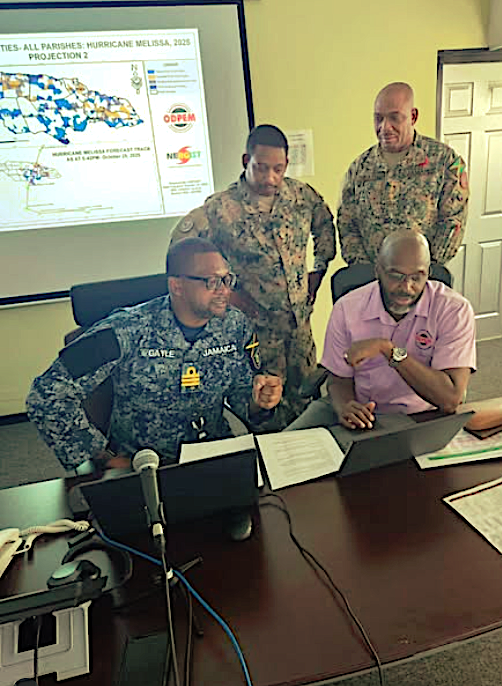
Humanitarian operations have been set in motion amid this chaos. IFRC officials said relief supplies for 800 households had been pre-positioned across Jamaica and that additional stocks for 60,000 families were on standby in regional hubs, ready for airlift within four hours once weather conditions allowed. Jens Laerke, spokesperson for the United Nations Office for the Coordination of Humanitarian Affairs (OCHA), said the first priority was to save lives through evacuation and sheltering. He confirmed that an anticipatory response mechanism had already been triggered in neighbouring Cuba and Haiti—also in the hurricane’s projected path—releasing a $4 million allocation from the UN Central Emergency Response Fund (CERF) to pre-position food, clean water, hygiene items, and medical kits.
“The immediate needs will be food, shelter, clean water, and medical care,” Laerke said, warning that when floodwaters recede, a second wave of health risks would emerge due to waterborne disease. IFRC teams across the Caribbean were mobilised to reinforce Jamaica’s operations, and global relief channels were expected to open once conditions stabilised. Mghendi stressed that the organisation’s emergency stocks would soon need replenishment. “After we release them, there will be a need for global solidarity,” he said. “This is one of the storms of the century, and we believe the global community will come together to respond collectively.”
The impact is already reshaping Jamaica’s economic and environmental outlook. The Caribbean Disaster Emergency Management Agency (CDEMA) estimated early losses above US$1.2 billion, excluding agricultural and tourism damages. Banana and sugarcane plantations in Westmoreland were flattened, and small fisheries along the southern coastline reported total losses. Analysts said the country’s catastrophe bond could trigger a US$150 million payout for immediate recovery, but restoration of critical infrastructure could stretch well into next year. The Jamaica Stock Exchange suspended trading and the Bank of Jamaica activated emergency liquidity support for affected enterprises, describing the situation as “a national economic reset.”
Melissa’s arrival has also revived fears about the compounding effect of extreme weather on vulnerable communities. Many families still rebuilding from Hurricane Beryl’s devastation just 16 months ago have now seen their livelihoods erased again. “This shows how extreme climate events are stretching communities beyond their capacity to recover,” said Mghendi. Informal settlements along floodplains and coastal zones—already strained by the rainy season—were hit hardest as saturated soils gave way to mudslides, swallowing entire dwellings.
– global bihari bureau