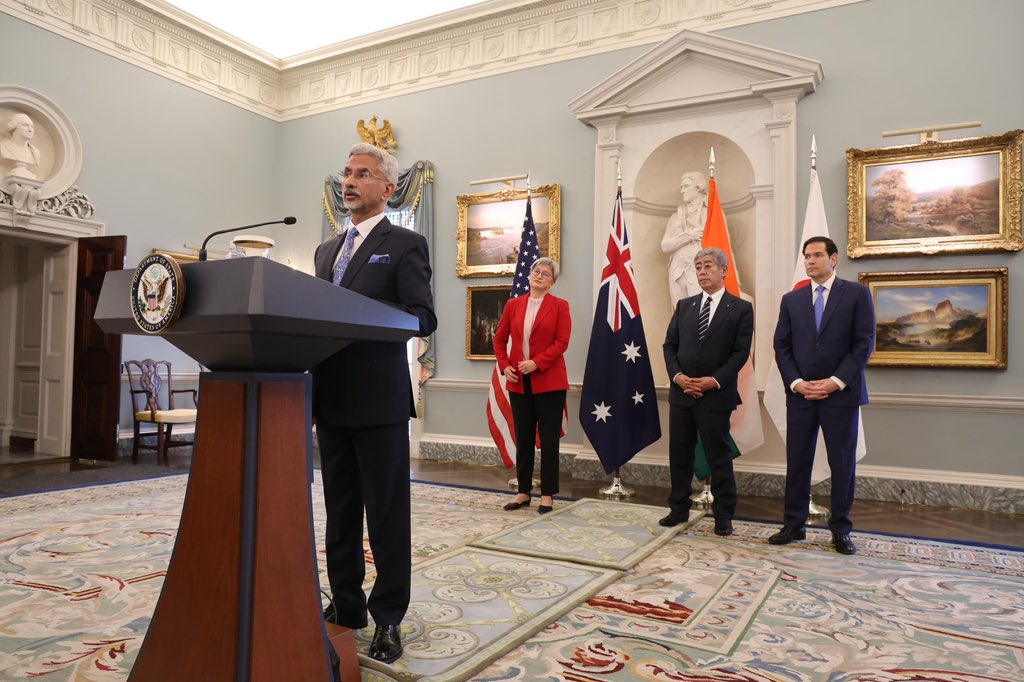
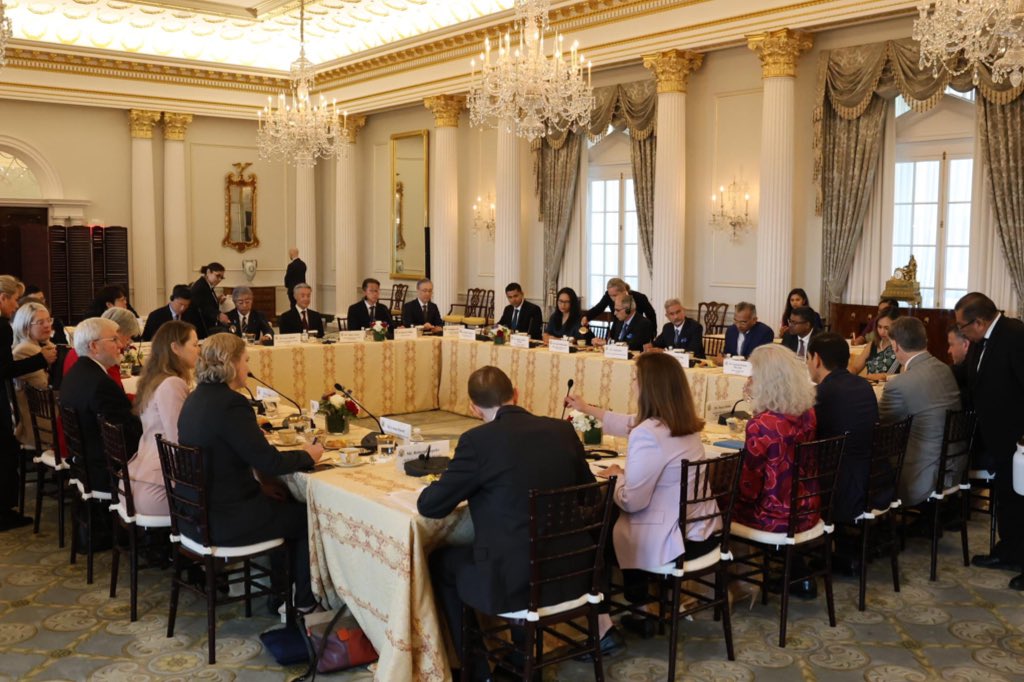
Indian External Affairs Minister Dr. S Jaishankar addressing the meeting of Quad Foreign Ministers in Washington DC, today.
Washington: Indian External Affairs Minister Dr. Subrahmanyam Jaishankar set a resolute tone at the Quad foreign ministers’ meeting, emphasising India’s firm stance on terrorism and calling for global zero tolerance while asserting the nation’s right to defend its people, expecting support from Quad partners.
With India poised to host the next Quad summit, Jaishankar expressed confidence in aligning proposals with the United States, Australia, and Japan to drive productive outcomes.
Hosted by U.S. Secretary of State Marco Rubio, the meeting in Washington, which included Australian Foreign Minister Penny Wong and Japanese Foreign Minister Iwaya Takeshi, marked the second gathering of 2025, underscoring the Quad’s commitment to translating dialogue into action amid rising global tensions and regional competition.
Jaishankar, speaking before the meeting, reaffirmed the Quad’s dedication to a free and open Indo-Pacific, grounded in a rules-based international order. He stressed the importance of ensuring Indo-Pacific nations have the freedom to make independent choices in development and security. Noting recent progress in Quad initiatives, including maritime domain awareness, logistics, education, and political coordination, he highlighted efforts to streamline working groups for a more cohesive and focused partnership. Jaishankar’s remarks underscored India’s anticipation of hosting the next summit, where discussions will aim to deepen convergence and expand common ground.
In a separate meeting with Iwaya, Jaishankar expressed pleasure at their continued engagement, noting their recent meeting on the sidelines of the January Quad session. He highlighted progress in India-Japan relations, referencing the interaction between Prime Ministers Narendra Modi and Shigeru Ishiba at the G7 Summit in Canada in June 2025. Jaishankar emphasised the deepening of the India-Japan Special, Strategic, and Global Partnership, anchored in mutual trust, respect, and a shared commitment to a free and open Indo-Pacific. He noted positive developments in political, security, defence, economic, infrastructure, and investment ties, as well as growing engagements between Indian states and Japanese prefectures, with preparations underway for the annual India-Japan summit in Japan.
Rubio emphasised the urgency of moving from discussions to concrete actions, particularly in economic development. He highlighted plans to diversify global supply chains for critical minerals, essential for technology and industry, noting that over 30 companies from the four nations would join discussions later in the day to explore collaborative opportunities. The partnership, Rubio stressed, extends beyond security to deliver benefits to member countries and others in the region, complementing strong bilateral ties with each partner nation.
Wong underscored the Quad’s critical role in addressing strategic challenges in a region shaping the 21st century. Representing nearly a quarter of the world’s population and over a third of global GDP, the four nations bring diverse perspectives but recognise their collective strength. She cited past cooperation, such as the Quad’s rapid response to Myanmar’s deadly earthquakes, as evidence of its ability to mobilise effectively. Wong emphasised practical cooperation in technology, supply chains, and maritime security to enhance regional stability and prosperity, expressing gratitude to Rubio for hosting and anticipating further engagement at upcoming ASEAN meetings.
Iwaya, speaking through an interpreter, highlighted the Indo-Pacific’s role as the global economy’s growth engine, home to over half the world’s population. He stressed the Quad’s responsibility as major regional powers to ensure peace and stability. The ministers’ rapid reconvening, just six months after their January meeting, reflects the partnership’s unity and significance. Iwaya anticipated in-depth strategic discussions on the global situation and future cooperation to advance a free and open Indo-Pacific, focusing on delivering benefits to regional countries.
The meeting, hosted at the State Department, reflects the Quad’s evolving role as a platform for addressing regional and global challenges. With India preparing to host the next summit, the ministers expressed optimism about building on recent progress to deliver measurable results, from economic resilience to regional stability, in a rapidly changing geopolitical landscape.
– global bihari bureau