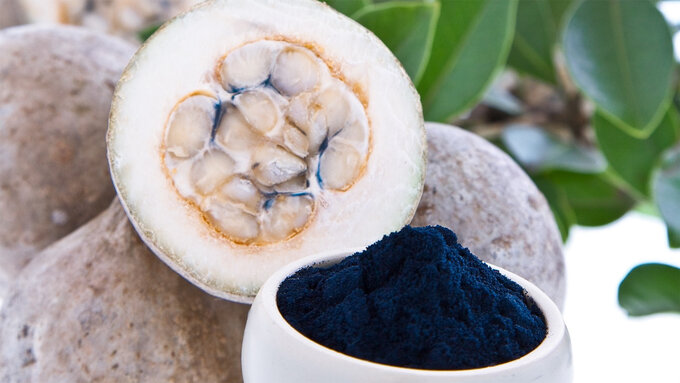
A unique natural blue food colouring from the fruit of a semi-deciduous tree growing in the forests of Colombia has become a “holy grail” of food colouring for the food industry. ©Ecofolora S.A.S
Codex Crowns Jagua Blue, Nature’s Last Colour
Deep in Colombia’s emerald forests, where the semi-deciduous Genipa americana tree sways, a fruit the size of a kiwi or guava is painting a new chapter in the saga of food. The jagua, as it’s known, holds a secret that’s captivated the food industry: when its unripe pulp meets air, it blooms into a deep, mesmerising blue. For generations, Indigenous Peoples across South America, including the Emberá along the riverbanks of Colombia’s densely forested northwestern Chocó region, have harnessed this pigment to adorn their skin, dye their clothes, colour ceramics, and even tint certain foods. Now, this natural marvel has been dubbed the “holy grail” of food colouring—the first natural blue hue that resists acids, completing the spectrum of nature-derived colours. Its recent inclusion in the Codex Alimentarius, the global “Food Code” forged over 60 years by the Food and Agriculture Organisation of the United Nations and the World Health Organisation, marks a milestone that blends ancient wisdom with cutting-edge science.
The journey to this triumph began in Colombia, where a private company embarked on a mission to bring jagua blue to the world. They meticulously gathered the data needed for a rigorous scientific assessment, proving the safety of this vibrant food additive. After years of scrutiny by a joint FAO/WHO expert committee, which pored over toxicological studies, consumption patterns, and maximum safe levels, jagua blue earned its place in the Codex standard governing food additives. This approval opens the door for its use in everything from confectionery to breakfast cereals, offering a natural alternative to synthetic blues. Sarah Cahill, Secretary of the FAO/WHO Codex Alimentarius Commission, sees it as a shining example of the dizzying variety of foods and ingredients crisscrossing the globe today. The Codex, she says, plays an essential role in ensuring consumers and traders can trust the safety and quality of what they eat, with good science and risk assessment as its unyielding foundation.

For Colombia, the stakes are monumental. Officials herald jagua blue’s Codex inclusion as a catalyst for economic uplift, particularly for Indigenous Peoples like the Emberá, who have long woven this pigment into their cultural tapestry. By tapping into new markets, the colourant could boost livelihoods in regions like Chocó, where traditional knowledge meets modern opportunity. Beyond economics, Colombia envisions jagua blue driving biodiversity conservation and sustainable agricultural practices, preserving the rich ecosystems that cradle the Genipa americana. Whatever production model emerges, the hope is that this safety standard will unlock a cascade of benefits, from forest preservation to global trade.
Colombia’s Blue Fruit Redefines Food Safety
The Codex Alimentarius itself is a titan in the world of food safety, its texts safeguarding consumer health and ensuring fair practices in a global food trade that’s ballooned over the past century, though its roots stretch back thousands of years. Setting standards for something like jagua blue is no small feat. It demands an evidence-based study of every possible hazard a foodstuff might pose, combined with data on consumption and toxicological limits to establish safety without compromise. The process for jagua blue took years, as scientists meticulously assessed risks to ensure no unacceptable harm to humans. This rigour, underpinned by science and the core values of transparency, inclusivity, collaboration, and consensus, keeps the Codex Alimentarius Commission as the international gold standard for food safety. It also bolsters FAO’s unique role in overseeing every link in the food chain, giving us confidence in what we eat.
From the jungles of Colombia to tables worldwide, jagua blue’s rise is a testament to how tradition and innovation can converge to colour our plates safely and sustainably.
Source: The FAO News And Media Office, Rome
– global bihari bureau