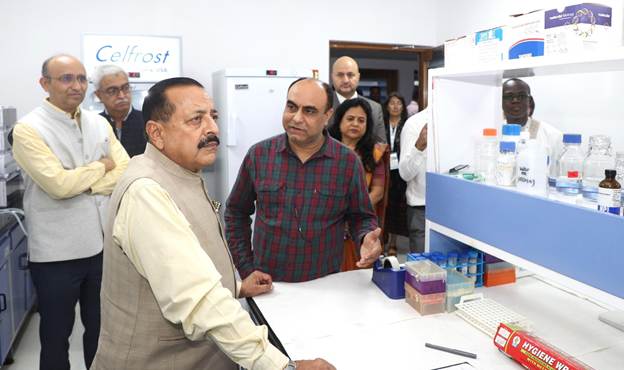
Union Minister Dr Jitendra Singh at the International Centre for Genetic Engineering and Biotechnology (ICGEB) in New Delhi, today.
Indian Astronaut to Study Space Food on International Space Station
New Delhi: Picture a future where astronauts sip nutrient-packed smoothies grown in space, their spacecraft humming with tiny organisms that recycle waste into food and oxygen. In New Delhi’s bustling science labs, this vision is taking shape, as India prepares to send its first biological experiments to the International Space Station (ISS), a floating research hub orbiting 400 kilometres above Earth. Union Minister of State for Science and Technology and Space, Dr Jitendra Singh, announced today that these experiments, part of the AXIOM-4 mission with Indian astronaut Group Captain Shubhanshu Shukla, will explore how to keep humans alive on long space journeys—perhaps to the Moon or Mars. Launched under the BioE3 policy, a national blueprint to advance biotechnology, India’s leap into space biology is a story of ambition, ingenuity, and a quest to sustain life among the stars.
The Indian Space Research Organisation (ISRO), the nation’s space agency, and the Department of Biotechnology (DBT), which funds cutting-edge biotech research, are partnering with NASA for this mission. The first experiment will focus on edible microalgae, microscopic algae that act like tiny, sunlight-powered kitchens. These organisms are packed with proteins, fats, and health-boosting compounds, making them a potential space superfood. In the near-weightless environment of space, called microgravity, and under harsh radiation, scientists want to see how microalgae grow compared to Earth. They’ll study the algae’s genes (transcriptomes), proteins (proteomes), and chemical reactions (metabolomes)—essentially, the biological blueprints that make them tick. The aim? Find the best algae for space, ones that can thrive in cramped, high-tech containers called photobioreactors. Some microalgae can double in just 26 hours, churn out oxygen to refresh spacecraft air, and produce more food per square inch than crops like rice or potatoes, offering a compact solution for feeding astronauts and keeping air breathable.
The second experiment dives into cyanobacteria, bacteria like Spirulina and Synechococcus that harness sunlight to grow. You might know Spirulina from health food stores—it’s a protein- and vitamin-rich powder often called a “superfood.” In space, researchers will test how cyanobacteria grow in two nutrient sources: urea, found in human waste, and nitrate, a fertiliser component. They’ll also check how microgravity tweaks the bacteria’s proteins and metabolism—the processes that keep them alive. The big idea is recycling. On a spaceship or future Moon base, there’s no garbage truck, so cyanobacteria could turn human waste into nutrients, creating a self-sustaining cycle for food, water, and air. This could make space missions cheaper and more independent, as resupplying from Earth is a logistical nightmare for distant destinations like Mars.
These experiments were crafted with scientists from the International Centre for Genetic Engineering and Biotechnology (ICGEB) in New Delhi, tying into India’s BioE3 policy, which stands for Biotechnology for Economy, Environment, and Employment. Approved by the Union Cabinet in 2024, BioE3 pushes India to lead globally in six biotech areas: bio-based chemicals, smart proteins, precision medicines, climate-smart farming, carbon capture, and research in oceans and space. It’s a plan to solve big problems, from feeding astronauts to building a greener Earth, while creating jobs and sparking innovation.
Singh shared the news during a visit to the new DBT-ICGEB Biofoundry, a state-of-the-art lab in New Delhi funded by DBT and opened virtually at the 31st ICGEB Board of Governors meeting. Think of the Biofoundry as a biotech playground, where ideas are born and tested. It follows a cycle: Design, Build, Test, and Learn. In “Design,” scientists use artificial intelligence, vast data sets, and bioinformatics—a mix of biology and computer science—to map DNA and plan experiments. In “Build,” they stitch together DNA and tweak organisms like bacteria or yeast. With a 20-litre production capacity, the Biofoundry can whip up biotech products for food, farming, medicines, chemicals, or energy, then pass them to startups or factories for real-world use. It’s a bridge from lab to life, turning science fiction into reality.
The AXIOM-4 mission, slated for late 2025, will see Shubhanshu Shukla, an Indian Air Force pilot, join an international ISS crew, following in the footsteps of Rakesh Sharma, India’s first astronaut in 1984. This mission is a milestone for ISRO, which is also gearing up for the Gaganyaan programme to send Indian astronauts to orbit by 2026 and eyeing a lunar landing by 2040. The experiments are a stepping stone to self-sufficient space habitats, crucial for long missions where Earth’s grocery deliveries aren’t an option. Imagine a Moon base where algae and bacteria keep astronauts fed and breathing—that’s the future India’s chasing.
Jelena Begovic, President of ICGEB’s Board of Governors, joined DBT Senior Adviser Alka Sharma and ICGEB New Delhi Director Ramesh Sonti at the announcement, praising India’s bold move into space biotech. The NASA-ICGEB collaboration shows India’s growing clout in global science, while the Biofoundry cements New Delhi as a biotech hub. As Shubhanshu Shukla prepares to carry these experiments to the ISS, India isn’t just studying algae and bacteria—it’s sowing the seeds for humanity’s next great adventure.
– global bihari bureau