UN Alleges Genocidal Acts in Gaza Campaign
Qatar Attack Sparks Regional Call for Justice
Geneva/Gaza City/Doha: Undeterred by the Organisation of Islamic Cooperation’s (OIC) and League of Arab States’ calls for punitive measures, Israel intensified its military operations in Gaza City, driving tens of thousands of families into a worsening humanitarian crisis marked by famine, forced displacement, and restricted aid access. The United Nations Children’s Fund (UNICEF) today reported harrowing conditions as families flee south to overcrowded, undersupplied areas like Al-Mawasi, where services are insufficient to support the influx.
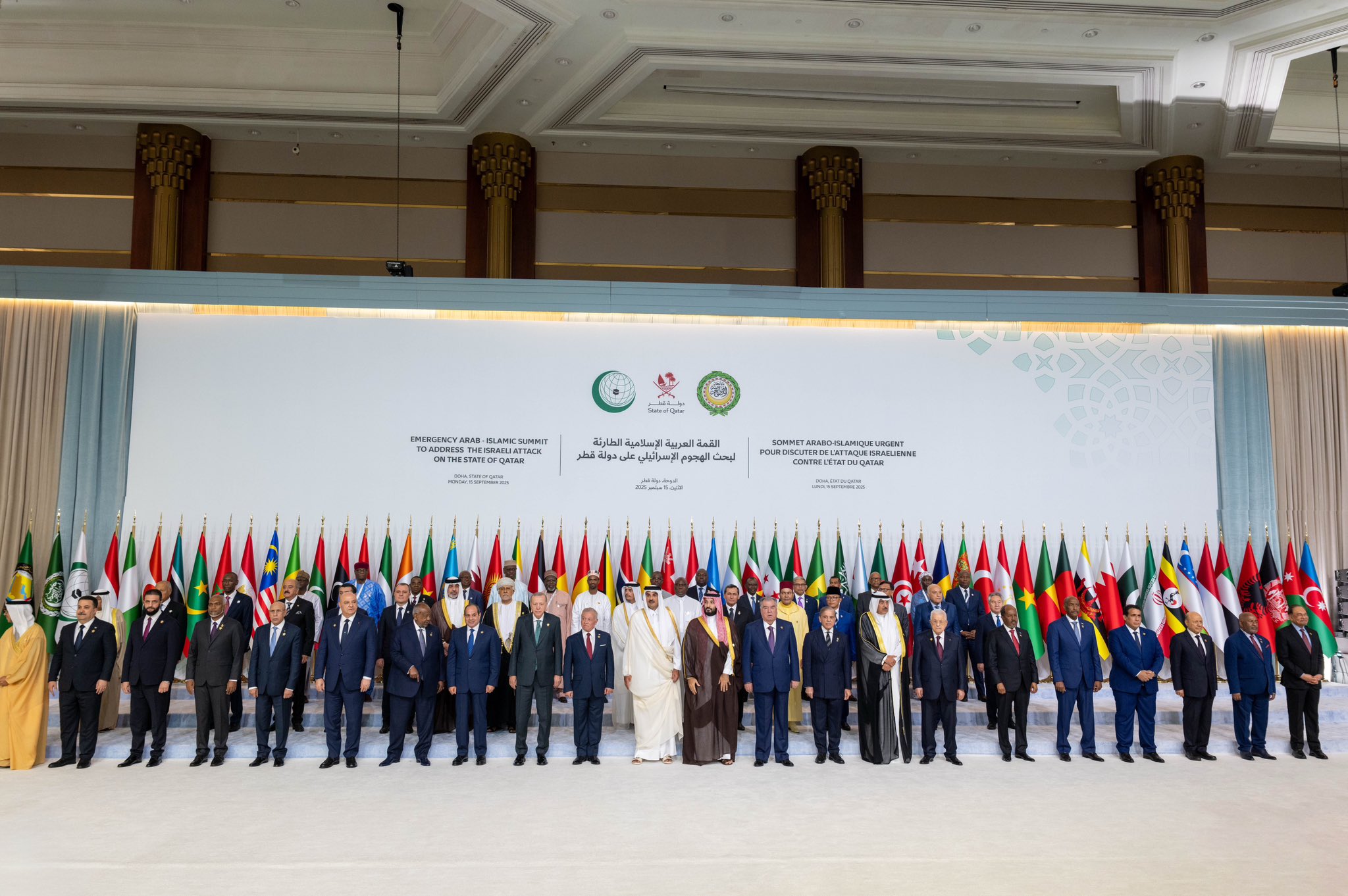
At an emergency summit in Doha on September 15, 2025, regional leaders condemned Israel’s actions in Gaza and its September 9, 2025, attack on Qatar, framing both as part of a pattern of aggression that undermines Palestinian survival and regional stability. A day after the summit, the United States Secretary of State Marco Rubio met with Qatari Amir Sheikh Tamim bin Hamad Al Thani and Prime Minister and Foreign Minister Mohammed bin Abdulrahman Al Thani in Doha today to reaffirm the “strong” bilateral relationship between the United States and Qata. He thanked Qatar for its efforts to end the war in Gaza and bring all hostages home. The Secretary reiterated America’s strong support for Qatar’s security and sovereignty, and discussed their “shared commitment to a safer, more stable region”.
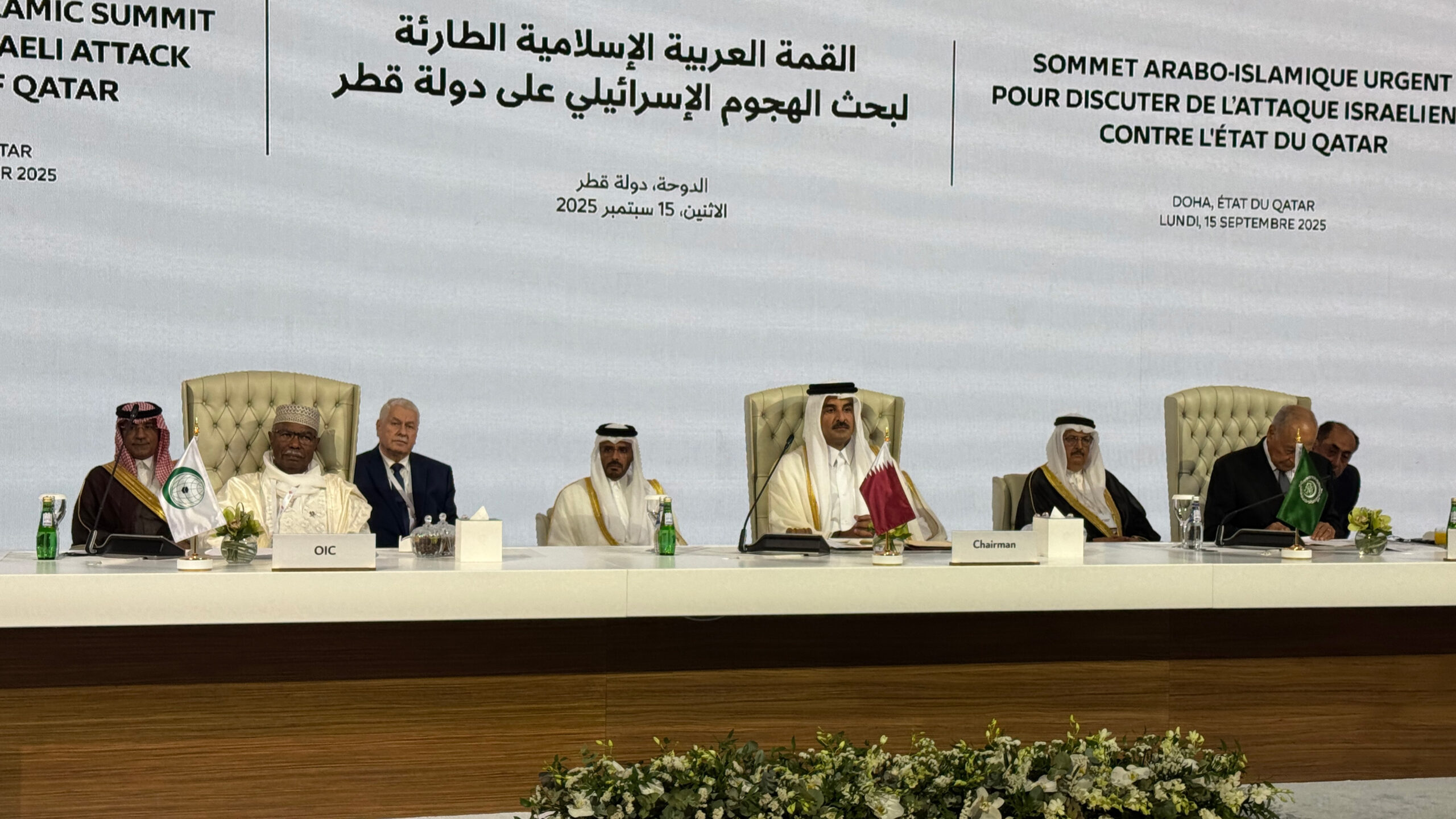
The Doha summit, chaired by Qatar’s Amir, Sheikh Tamim bin Hamad Al Thani, issued a final communiqué that first addressed Israel’s actions in Palestine, accusing it of genocide, ethnic cleansing, starvation, siege, and settlement expansion, which obstruct regional peace.
Expressing gratitude to Qatar for its hosting and mediation, the leaders welcomed the UN Security Council’s September 11, 2025, statement condemning the Doha attack, affirming Qatar’s mediation role. They criticised the absence of international accountability for emboldening Israel’s violations, weakening global justice, and threatening peace.
The communiqué urged states to impose sanctions, suspend arms supplies, review diplomatic and economic ties, and pursue legal proceedings against Israel. OIC members were called to examine Israel’s UN membership eligibility due to its disregard for UN resolutions and coordinate efforts toward suspension.
The OIC leaders condemned Israel’s use of siege, starvation, and deprivation of food and medicine as weapons of war, violating the Geneva Conventions, and demanded immediate, safe, and unimpeded humanitarian access across Palestinian territories. They rejected forced displacement of Palestinians from 1967 territories as crimes against humanity and ethnic cleansing, urging swift implementation of an Arab-Islamic reconstruction plan for Gaza at a Cairo conference once a ceasefire is secured, and called for robust international donor support.
The communiqué warned that Israeli annexation of Palestinian lands would assault Palestinian rights, nullify peace efforts, and violate UN resolutions. It supported the enforcement of International Criminal Court arrest warrants issued on 21 November 2024 against perpetrators of crimes in Gaza and compliance with International Court of Justice measures from 26 January 2024 on genocide prevention.
In Gaza, UNICEF detailed the devastating toll of Israel’s intensified operations. Spokesperson Tess Ingram, speaking from southern Gaza, recounted meeting a mother who trekked over six hours along Al Rashid Road with her five children, all dirty, thirsty, and starving, two barefoot. The UN’s Office for the Coordination of Humanitarian Affairs (OCHA) reported nearly 70,000 displacements southward in recent days and 150,000 over the past month, overwhelming the congested route. Families are directed to a humanitarian zone around Al-Mawasi, described by Ingram as a sea of makeshift tents and human despair, with services insufficient for the hundreds of thousands already there as more arrive. “It is inhumane to expect nearly half a million children battered and traumatised by over 700 days of unrelenting conflict to flee one hellscape to end up in another,” Ingram stated, emphasising the deadly threat to the most vulnerable.
Child malnutrition is spiralling, with UNICEF estimating 26,000 children requiring treatment, including over 10,000 in Gaza City. A UN-backed famine declaration in Gaza City last month heightened urgency, yet military escalation and evacuation orders have forced the closure of additional nutrition centres, severing access to a third of remaining life-saving treatment sites. OCHA noted that on Sunday, only four of 17 coordinated humanitarian missions were facilitated, with seven denied and others impeded or cancelled. Ingram highlighted the impossible choice Gazans face: stay in danger or flee to unsafe areas like Al-Mawasi, where an attack two weeks ago killed eight children, the youngest three, while queuing for water. Some families, finding “nowhere safe,” have returned to Gaza City.
Also read: Rubio-Netanyahu: Hamas End or No Peace
The Doha summit’s condemnation extended to Israel’s 9 September strike on a Doha residential neighbourhood, which targeted facilities housing negotiating delegations central to Qatar’s mediation efforts, alongside schools, nurseries, and diplomatic missions. The attack resulted in civilian casualties, including one Qatari citizen, and was described as a cowardly and unlawful act, a grave escalation exposing the extremist nature of Israel’s government, and a blatant breach of international law and the UN Charter. The leaders declared it an aggression against all Arab and Islamic states, undermining mediation efforts for a Gaza ceasefire and hostage-prisoner exchanges. They rejected any pretext for the strike, commended Qatar’s restrained adherence to international norms, and pledged absolute solidarity, supporting any measures Qatar takes to safeguard its security and stability per the UN Charter. The communiqué highlighted the attack’s timing as a direct assault on Qatar’s role as a principal mediator, alongside Egypt and the United States, in securing a Gaza ceasefire.
The summit endorsed the UN General Assembly’s “New York Declaration” for a two-state solution and an independent Palestinian state along 1967 lines with East Jerusalem as its capital, welcoming the Two-State Solution Conference on 22 September 2025, co-chaired by Saudi Arabia and France. It praised Arab and Islamic Security Council members—Algeria, Somalia, and Pakistan—for advocating for Palestine’s UN membership and ending Gaza’s aggression. The communiqué reaffirmed Jordan’s Hashemite custodianship over Jerusalem’s holy sites, emphasising Al-Aqsa Mosque’s exclusively Muslim status across 144,000 square meters under Jordanian administration, as affirmed in the 31 March 2013 agreement between King Abdullah II and President Mahmoud Abbas. It supported Morocco’s Al-Quds Committee and Bayt Mal Al-Quds Al-Sharif Agency to bolster Palestinian steadfastness in Jerusalem. The leaders stressed that peace requires adherence to the Arab Peace Initiative and UN resolutions, rejecting Israeli rhetoric exploiting Islamophobia to justify violations, including West Bank settlement projects and distortions of Arab and Islamic states.
The summit reaffirmed the necessity of confronting Israel’s schemes to impose a new regional fait accompli, which poses a direct threat to stability, and called for resistance to these efforts. It welcomed the League of Arab States’ resolution, “Shared Vision for Security and Cooperation in the Region,” emphasising collective security, unity against threats, and the need for mechanisms to implement these principles. The leaders stressed that regional arrangements must uphold international law, respect sovereignty, renounce force, end Israel’s occupation, establish a Palestinian state, and rid the Middle East of nuclear weapons and other weapons of mass destruction. They categorically rejected Israeli threats of renewed targeting of Qatar or other Arab and Islamic states, urging the international community to condemn these provocations and take deterrent measures.
The UN Human Rights Council investigators today alleged that Israeli authorities committed four of the five genocidal acts defined by the 1948 Genocide Convention, including imposing conditions aimed at Palestinian destruction. Israel rejected these findings. The accusations align with the Doha summit’s call for accountability, framing Israel’s actions as a challenge to international law and regional stability. The leaders’ reaffirmation of collective security and shared destiny emphasises unity against threats. The intertwined crises in Gaza and the Doha attack illustrate a region at a breaking point, where Israel’s actions exacerbate Palestinian suffering and threaten diplomatic efforts. The communiqué’s insistence on peace through the Arab Peace Initiative and UN resolutions reflects a consensus that bypassing the Palestinian cause through violence or attacks on mediators like Qatar will not yield stability. As Gaza’s families endure starvation, displacement, and loss, the international community faces mounting pressure to address the occupation, hold Israel accountable, and secure a resolution upholding Palestinian rights and fostering lasting peace.
– global bihari bureau