

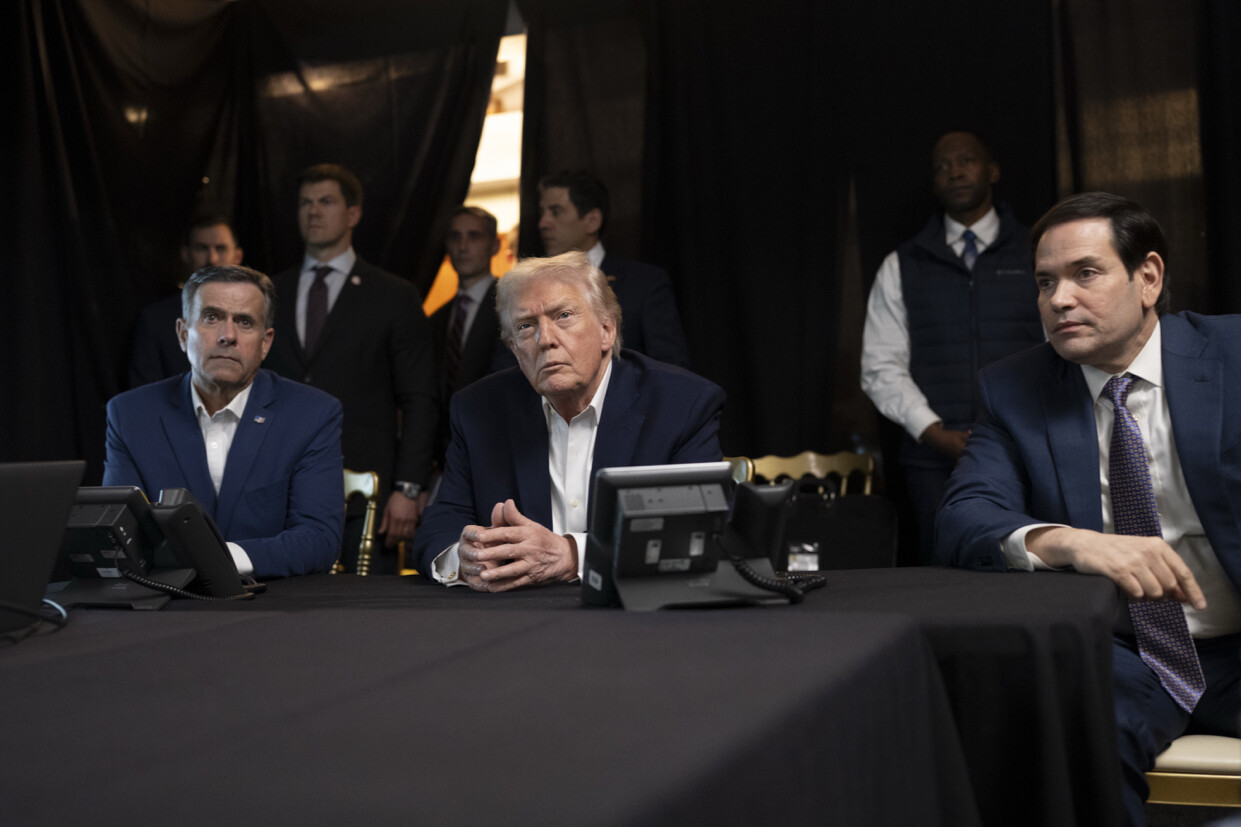
Donald Trump at the centre. Photo source: @TruthTrumpPost|X
 By Deepak Parvatiyar*
China’s Venezuela Outrage Amid Own Regional Assertiveness
The irony could not have been scripted better than now, and that too in Mandarin. As the United States forcibly seized Venezuelan President Nicolás Maduro and his wife, Beijing condemned Washington’s “blatant use of force,” even as China itself has recently projected military power through the Taiwan Straits, detained a UK-based Indian national from Arunachal Pradesh en route to Japan, and repeatedly clashed with the Philippines over contested maritime claims. Just three weeks ago, the Philippines Coast Guard accused the Chinese Coast Guard of using high-pressure water cannons that injured three fishermen and damaged multiple boats after smaller Chinese vessels cut anchor lines in strong currents, in waters within the Philippines’ exclusive economic zone, though claimed by China. The incident drew concern from the United States, Canada, Australia, and Germany, reinforcing the tangible consequences of overlapping territorial assertions and the assertive reach of Beijing’s regional posture.
China’s response to Venezuela is therefore both legal and strategic, blending normative principles with global calculation – Beijing is presenting itself as a defender of the established international legal order, regardless of its own conduct elsewhere. “China expresses grave concern over the U.S. forcibly seizing President Nicolás Maduro and his wife and taking them out of the country,” said Foreign Ministry spokesperson Lin Jian. “The U.S.’s move is in clear violation of international law, basic norms in international relations, and the purposes and principles of the UN Charter. China calls on the U.S. to ensure the personal safety of President Nicolás Maduro and his wife, release them at once, stop toppling the government of Venezuela, and resolve issues through dialogue and negotiation.” Beijing emphasised that no Chinese personnel in Venezuela were affected by the U.S. strikes, though the situation is being closely monitored. Analysts at the Chinese Academy of Social Sciences (CASS) and the China Institutes of Contemporary International Relations (CICIR) highlight that the operation represents a form of extraterritorial enforcement with broad implications for global sovereignty norms.
The U.S. operation itself, confirmed by Secretary of State Marco Rubio, included arrests conducted under domestic law enforcement authority, the seizure of sanctioned Venezuelan oil shipments, and oversight of critical energy-linked assets. Donald Trump framed these actions as a temporary means of allowing the United States to exert leverage over Venezuela’s resources, explicitly citing oil reserves and potential reconstruction profits for U.S. companies. Trump further noted that U.S. forces “would not remain” if Vice President Delcy Rodríguez cooperated, an unusual public articulation of operational leverage over a foreign government. Rodríguez assumed the acting presidency on January 3 with military backing, and Beijing has emphasised consistent respect for Venezuela’s sovereignty and the proper handling of internal affairs.
Beijing’s unease is heightened by broader U.S. statements, including Trump’s January 4 remark to The Atlantic suggesting Greenland is strategically necessary “because it is covered with Chinese ships” and that Venezuela may not be the last country subject to U.S. intervention. Lin Jian underscored that “China always advocates that relations between states should be handled in accordance with the purposes and principles of the UN Charter.” Analysts at CASS and CICIR observe that such assertions of unilateral leverage, framed as law enforcement or resource management, could establish precedents affecting regions far beyond Latin America, influencing policy calculations in Asia, Europe, and Africa alike.
China also foregrounds its material interests. Venezuela’s heavy, sour crude, requiring specialised refining capacity concentrated in certain global facilities, is central to China’s energy partnerships. “The cooperation between China and Venezuela is the cooperation between two sovereign states… No matter how the political situation in Venezuela evolves, China’s willingness to deepen practical cooperation with Venezuela in various fields will not change. China’s lawful interests there will also be protected in accordance with the law,” Lin Jian said. In the wider Latin America and Caribbean (LAC) context, Beijing frames the region as a “Zone of Peace,” opposing the use of force, external interference, and the imposition of spheres of influence. China stresses that LAC nations have the sovereign right to choose development paths independently, while maintaining equitable partnerships with Beijing grounded in mutual benefit.
The legal and normative dimension is intertwined with strategy. “The U.S.’s blatant use of force… seriously violates international law… and threatens peace and security in Latin America and the Caribbean region,” Lin added. China has signalled support for the UN Security Council convening an emergency session on Venezuela, stating that it stands ready to work with the international community to defend the UN Charter, international justice, and fairness.
The layered irony is not lost on analysts: Beijing condemns U.S. unilateral action while projecting military power in the Taiwan Straits, enforcing contested maritime claims in the South China Sea, and regulating transit through its own territory in ways that provoke neighbouring states.
Global reactions remain sharply divided. Russia and Iran issued strong condemnations, warning of dangerous precedents. Latin American responses are mixed: Argentina expressed cautious support for sanctions enforcement, while Brazil and Mexico urged multilateral engagement. Europe has largely adopted a measured tone, acknowledging long-standing governance challenges in Venezuela while questioning the legality of unilateral U.S. interventions. Energy markets have been immediately impacted, particularly the heavy crude segment, while humanitarian and migration pressures in Latin America are rising.
The implications extend beyond Venezuela. Analysts warn that the case could redefine the perceived limits of unilateral enforcement, sovereignty norms, and executive authority in a global context where domestic legal frameworks are increasingly invoked to justify extraterritorial actions. Beijing’s response—firm in principle, attentive to strategic interests, and bolstered by explicit legal argumentation—demonstrates a careful calibration between upholding norms and projecting power. As the standoff unfolds, the world is witnessing not just a bilateral crisis but a test of the resilience of international law in an era of competing great power prerogatives.
*Senior journalist


Nicely written
Well researched and balanced.
Incorporates global perspective.