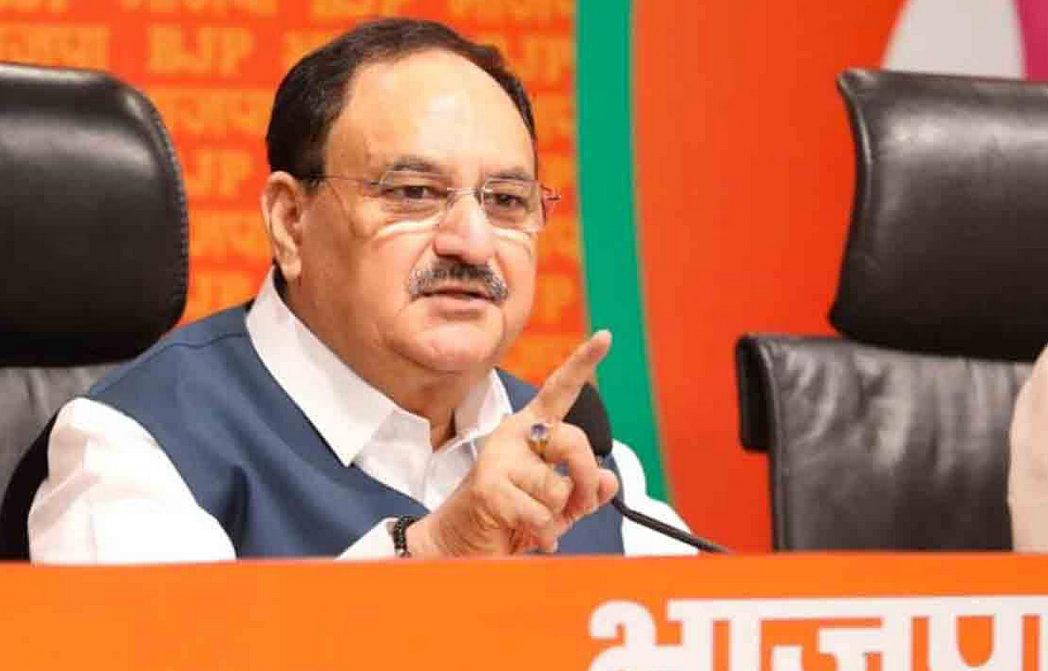
BJP president JP Nadda
 By G Krishna Mohan Rao*
New Delhi: The Bharatiya Janata Party (BJP) is engaged in a multifaceted process to select its new national president as Jagat Prakash Nadda’s extended tenure is set to conclude by mid-July. Nadda, who has served as the party’s national president since January 2020 and has also held a Cabinet position in the Union Government since 2024, was initially slated to step down in January 2023.
The party extended his term twice to maintain leadership continuity through the 2024 Lok Sabha elections and subsequent state assembly elections in Haryana, Maharashtra, Delhi, and Jammu and Kashmir. With his exit now approaching, the selection of his successor has sparked intense deliberations within the party and its ideological mentor, the Rashtriya Swayamsevak Sangh (RSS), as they seek to align organisational priorities with strategic electoral goals. Sources indicate that the BJP leadership has not yet finalised the name of the next national chief, due to differences with the RSS.
The BJP’s constitution requires that elections for the national president can only proceed after half of its 37 state and union territory units have elected their chiefs. Of the total 37 states and union territories, the party requires a minimum of 19 units to start the party chief selection process. The party has been using the pending polls in its state units as an excuse for the protracted delay in the election of its national president.
The nomination process for the national president, typically uncontested and guided by consensus, is poised to begin soon. Party sources indicate that the new president will be selected with a focus on upcoming state elections in Bihar, West Bengal, Kerala, and Tamil Nadu, as well as the next general elections. The candidate is expected to have deep organisational roots, a strong grasp of the party’s ideology, and the ability to foster unity among allies while navigating complex political landscapes.
The selection process is fraught with challenges. While potential contenders include Union Ministers Shivraj Singh Chouhan, Nitin Gadkari, Manohar Lal Khattar, Bhupendra Yadav, and Dharmendra Pradhan, each bringing significant organisational experience and political influence, differences between the BJP leadership and the RSS over the choice of candidate have delayed finalisation, with no name yet confirmed.
Internal factionalism and the need to balance caste and regional dynamics across state units are further complicating the process. In Telangana, the appointment of N. Ramchander Rao as state unit chief led to a significant backlash from three-term MLA T. Raja Singh Lodh, a prominent Hindutva advocate. Lodh, who sought to contest the state presidency but was denied the opportunity to file his nomination, resigned from the party’s primary membership in protest. In a detailed letter to Union Minister Kishan Reddy, Lodh expressed his dissatisfaction with Rao’s selection, urging the leadership to reconsider, which underscores the underlying tensions within the state unit.
In Andhra Pradesh, the transition was smoother, with P.V.N. Madhav replacing D. Purandeshwari as state unit chief. Madhav, whose father previously held the same position, was chosen for his organisational expertise and as part of the party’s strategy to bolster its presence in the Rayalaseema and north coastal districts, where it remains organizationally weak.
Purandeshwari, a Lok Sabha member, daughter of former Andhra Pradesh Chief Minister N.T. Rama Rao, and the sister-in-law of current Chief Minister Chandrababu Naidu, holds considerable political stature due to her family background and her prior role as a Union Minister in the United Progressive Alliance government during her time with the Congress. The BJP, a junior partner in Naidu’s cabinet, is pursuing a gradual approach to organisational growth in Andhra Pradesh, focusing on steady expansion.
In Tripura, the election for a new state president, originally scheduled for Sunday, June 29, 2025, was abruptly postponed due to sharp internal differences, with no rescheduled date announced.
In Uttarakhand, after initial hurdles, Mahendra Bhatt was retained as state unit chief, a decision reflecting caste balance by pairing a Brahmin president with Chief Minister Pushkar Singh Dhami, a Thakur. Bhatt, who is currently the state unit chief, had filed for reappointment. In Himachal Pradesh, veteran leader Rajeev Bindal was re-elected unopposed as state unit chief, as he was the only candidate to file his nomination. Bindal’s re-election leverages his Baniya community ties and long-standing association with the RSS in a state where Thakurs and Brahmins dominate politics. The presence of Jairam Thakur as Leader of the Opposition in the Himachal Pradesh Assembly and J.P. Nadda, a Brahmin, as a Union Minister highlights the party’s careful calibration of community representation.
In Maharashtra, working president and four-term MLA Ravindra Chavan is set to replace Chandrashekhar Bawankule as state unit chief. In Madhya Pradesh, a key organisational state, Hemant Khandelwal is emerging as a frontrunner for the state presidency. Mizoram and Puducherry have appointed K. Beichhua and V.P. Ramalingam as their state chiefs, respectively.
Over the next few days, the BJP is expected to announce new state presidents for West Bengal, Odisha, Gujarat, and Chandigarh, while the process has yet to commence in Karnataka, Madhya Pradesh, and Uttar Pradesh.
The leadership tussles in states like Telangana, Tripura, Uttar Pradesh, and Uttarakhand reflect the broader challenge of managing factionalism and maintaining caste and regional balance. As the BJP works to complete its state unit elections and prepare for the national president’s nomination, the outcome will shape its strategy for future electoral battles, balancing immediate state-level challenges with long-term national ambitions.
*Senior journalist