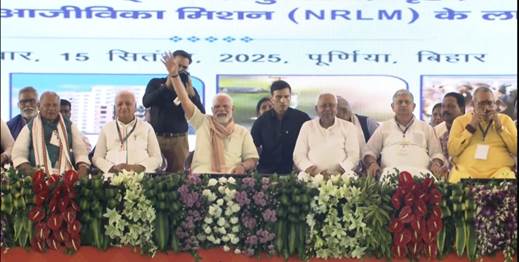
Purnea: Prime Minister Narendra Modi today raised concerns about demographic changes in Seemanchal and eastern India due to illegal infiltration, highlighting safety issues in Bihar, Bengal, and Assam, as Bihar gears up for its upcoming assembly elections later this year.
Referencing his Demography Mission announced from the Red Fort, Modi criticised opposition parties for supporting infiltrators for vote-bank politics, a pointed remark aimed at rallying support in a politically charged region. He affirmed that the government would take action to remove infiltrators, stating that Indian law would prevail and that efforts to shield them would not deter the government’s resolve to deliver results, a message likely to resonate in the election-bound state.
Ramping up his attack on the Opposition in the poll-bound state, the Prime Minister criticised them for past corruption, referencing former prime minister Rajiv Gandhi’s statement that 85 paise of every rupee sent by the government was lost to corruption. He cited a recent social media post by an opposition party comparing Bihar to a bidi, accusing them of defaming the state amid its progress, a narrative likely intended to discredit opposition campaigns. He highlighted government initiatives like free rations since the COVID-19 pandemic and free medical treatment up to Rs 5 lakh under the Ayushman Bharat scheme, questioning whether such benefits were provided under past regimes, reinforcing the NDA’s welfare credentials.
Modi credited Bihar’s women for keeping opposition parties out of power for two decades, noting their suffering under past regimes due to crimes like murder, rape, and extortion. He highlighted their current roles as ‘Lakhpati Didis’ and ‘Drone Didis’ through self-help groups, commending the Jeevika Didi campaign under Chief Minister Nitish Kumar, an ally whose support is vital for the NDA’s electoral prospects.
The sops continued to rain on Bihar and during the event, Modi inaugurated a Rs 10-crore sex-sorted semen facility at the Purnea semen station, aimed at supporting the dairy sector in eastern and north-eastern India through indigenous technology. Established under the Rashtriya Gokul Mission by the Department of Animal Husbandry and Dairying under the Ministry of Fisheries, Animal Husbandry and Dairying, the facility can produce five lakh doses annually. It uses the ‘Gausort’ technology, launched by the Prime Minister on October 5, 2024, under the ‘Make in India’ and ‘Atmanirbhar Bharat’ initiatives, making sex-sorted semen available to farmers at affordable rates. This move is seen as an effort to bolster rural livelihoods in Bihar, a key electoral issue.
The Purnea semen station, set up with central assistance of Rs 84.27 crore under the Rashtriya Gokul Mission, is one of the largest government-sector semen stations in India and the first dedicated facility for eastern and north-eastern states. Producing 50 lakh doses annually, it contributes to dairy development in the region. The sex-sorting technology increases the likelihood of female calf births to about 90 per cent accuracy, enabling farmers to produce more replacement heifers, reducing economic burdens, and increasing incomes. The facility is expected to benefit small and marginal farmers and landless labourers in the dairy sector, a significant voter base in rural Bihar.
This inauguration was part of a broader event where Modi laid the foundation stone and inaugurated development projects worth approximately Rs 40,000 crore in Purnea, covering railways, aviation, electricity, and water, signaling a strong push by the National Democratic Alliance (NDA) to showcase development achievements ahead of the Bihar elections. Addressing a gathering, he highlighted Purnea’s historical and cultural significance, noting it as the land of Maa Puran Devi, Bhakt Prahlad, and Maharshi Mehi Baba, and the birthplace of literary figures like Phanishwarnath Renu and Satinath Bhaduri, as well as the karmabhoomi of Vinoba Bhave, remarks aimed at connecting with local pride.
Modi noted that these projects aim to address the aspirations of the Seemanchal region, a key electoral battleground. He stated that over 40,000 beneficiaries have received permanent housing under the Pradhan Mantri Awas Yojana, enabling these families to move into their homes ahead of Dhanteras, Diwali, and Chhath Puja, festivals that hold significant cultural weight in Bihar’s electoral landscape. He reiterated the government’s commitment to housing, mentioning that over four crore permanent houses have been provided to the poor in the past 11 years, with plans for three crore more, reinforcing the National Democratic Alliance’s welfare narrative for the polls.
The Prime Minister highlighted the completion of Purnea Airport’s terminal building in under five months, inaugurating it and flagging off the first commercial flight, placing Purnea on the national aviation map with connectivity to major cities and commercial hubs. This infrastructure push is likely aimed at appealing to urban and aspirational voters in the state.
In the rail sector, Modi flagged off one Vande Bharat Express, two Amrit Bharat Express trains, and one passenger train, initiatives that underscore improved connectivity, a key electoral promise. He inaugurated the Araria-Galgalia rail line, worth over Rs 4,410 crore, establishing direct connectivity between Araria and Kishanganj districts in north-eastern Bihar. The foundation stone was laid for the Vikramshila-Kataria rail line, worth over Rs 2,170 crore, to provide a direct rail link across the Ganga river. The government has approved the Mokama-Munger section of the Buxar-Bhagalpur high-speed corridor, benefiting industrial areas like Munger, Jamalpur, and Bhagalpur, and the doubling of the Bhagalpur-Dumka-Rampurhat rail line, moves that could sway voters in industrially significant regions.
The flagged-off trains include the Vande Bharat Express between Jogbani and Danapur, covering districts such as Araria, Purnea, Madhepura, Saharsa, Khagaria, Begusarai, Samastipur, Muzaffarpur, Vaishali, and Patna; Amrit Bharat Express trains between Saharsa and Chheharta (Amritsar) and Jogbani and Erode; and a passenger train in the Araria-Galgalia section. These trains provide modern interiors, enhanced facilities, and faster travel to support economic, cultural, and social connectivity, addressing voter concerns about mobility and economic opportunities.
Modi stated that Bihar’s development is essential for national progress, with Purnea and Seemanchal as key focus areas, particularly as the NDA seeks to consolidate its hold in these regions ahead of the elections. He noted that the region faced challenges due to past governance issues and that current efforts aim to address these. A 2,400 MW thermal power project at Pirpainti in Bhagalpur, valued at Rs 25,000 crore and using ultra-super critical, low-emission technology, was inaugurated to strengthen Bihar’s energy security, marking the state’s largest private sector investment and appealing to voters concerned with industrial growth.
The foundation stone was laid for the first phase of the Kosi-Mechi intra-state river link project, worth over Rs 2,680 crore, involving upgrades to the Eastern Kosi Main Canal through desilting, reconstructing damaged structures, renovating the settling basin, and increasing discharge capacity from 15,000 to 20,000 cusecs. This will benefit north-eastern Bihar districts with irrigation, flood control, and agricultural support, addressing critical issues for rural voters.
Modi addressed the makhana sector, noting Bihar’s 90 per cent share in national production, with districts like Madhubani, Darbhanga, Sitamarhi, Saharsa, Katihar, Purnea, Supaul, Kishanganj, and Araria as key hubs due to their climate and soil. He announced the establishment of the National Makhana Board, with its notification issued on September 14, to promote production, technology, post-harvest management, value addition, processing, market access, exports, and branding for makhana farmers. A plan worth nearly Rs 475 crore has been approved for the sector, a move aimed at winning over farmers, a crucial voting bloc.
He announced the release of a Community Investment Fund of approximately Rs 500 crore for cluster-level federations under the Deen Dayal Antyodaya Yojana-National Rural Livelihoods Mission in Bihar to support village-level self-help groups and enhance women’s economic opportunities, a move targeting women voters. He contrasted this with opposition priorities, which he said focused on their own families rather than the public.
Ahead of Navratri, Diwali, and Chhath, Modi announced GST reductions effective from September 22 on items like toothpaste, soap, shampoo, ghee, food products, stationery, clothes, and shoes to reduce expenses for the poor and middle class, a populist measure aimed at appealing to voters during the festive season.
Referencing Purnea’s role in the freedom struggle, Modi highlighted a local resident’s contribution to Operation Sindoor and urged continued momentum in Bihar’s development, framing the state as central to national progress, a message tailored for electoral appeal.
The event included Griha Pravesh ceremonies for 35,000 rural beneficiaries under PMAY (Rural) and 5,920 urban beneficiaries under PMAY (Urban), with keys handed over to some. Cheques were distributed to cluster-level federation presidents, gestures aimed at showcasing tangible benefits to voters.
Bihar Governor Arif Mohammed Khan, Chief Minister Nitish Kumar, and Union Ministers Rammohan Naidu, Rajiv Ranjan Singh, Jitan Ram Manjhi, Giriraj Singh, Chirag Paswan, Nityanand Rai, Ram Nath Thakur, Raj Bhushan Choudhary, and Satish Chandra Dubey were present, reflecting the NDA’s united front as it campaigns to retain power. As Bihar’s assembly elections approach, these developments underscore the NDA’s focus on infrastructure, welfare, and regional issues like infiltration to consolidate support in Seemanchal and beyond, while opposition parties counter with critiques on employment, migration, and governance.
– global bihari bureau