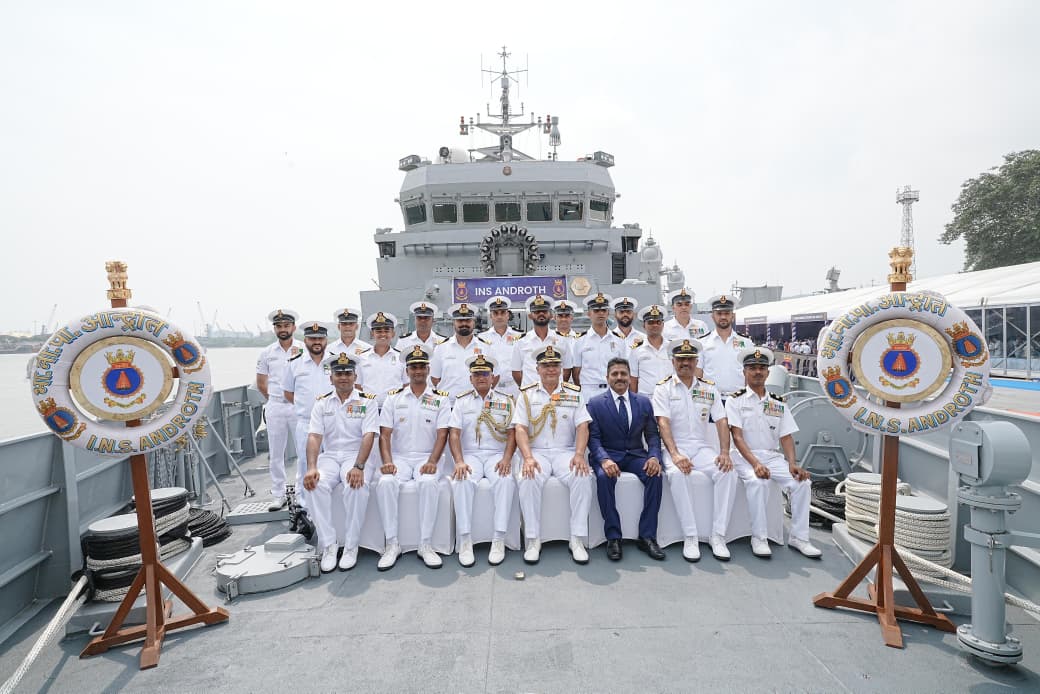
INS Androth
INS Androth Boosts Navy’s Anti-Submarine Might
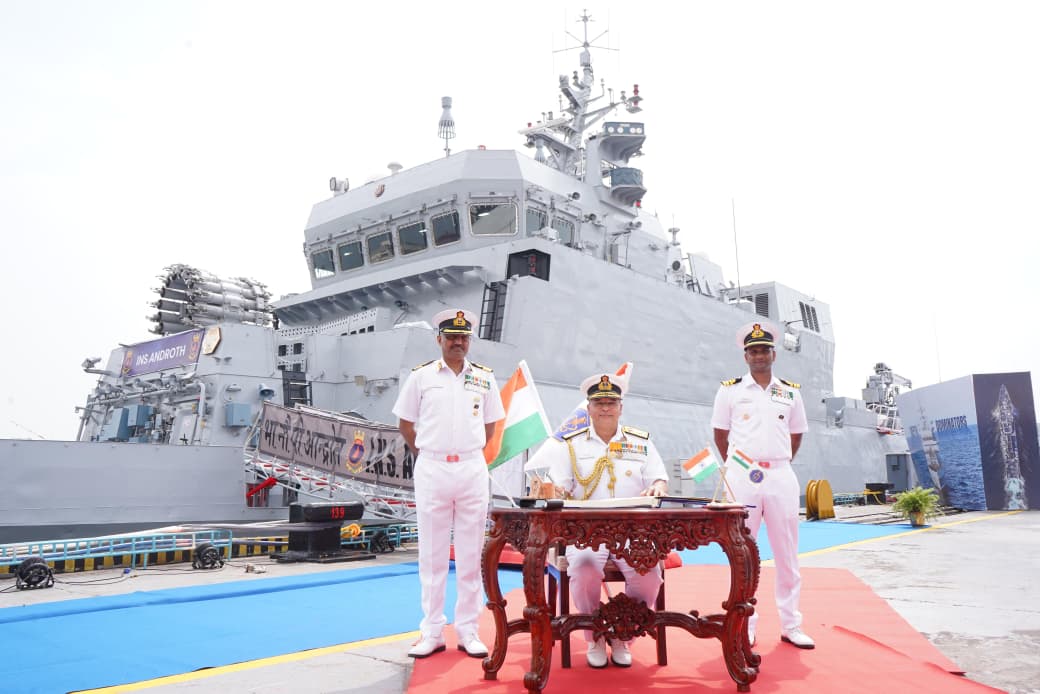
Visakhapatnam: The Indian Navy today commissioned INS Androth, the second vessel in the Anti-Submarine Warfare Shallow Water Craft (ASW-SWC) series, at the Naval Dockyard in Visakhapatnam, adding to its growing fleet of indigenously built platforms.
The ceremony was presided over by Vice Admiral Rajesh Pendharkar, Flag Officer Commanding-in-Chief, Eastern Naval Command, in the presence of senior naval officers, officials from Garden Reach Shipbuilders & Engineers (GRSE), Kolkata, and civilian dignitaries.
Billed as a significant step in advancing a maritime Aatmanirbhar Bharat, INS Androth reportedly features over 80 per cent indigenous content, developed through Indian shipyards and defence industries. The Navy describes the vessel as an example of India’s capacity to produce complex, technology-driven systems domestically—a goal long pursued to reduce dependency on foreign suppliers.
At 77 metres long and displacing around 1,500 tonnes, INS Androth has been designed for anti-submarine warfare in coastal and shallow waters, areas that demand high manoeuvrability and precision. The ship carries advanced weapons, sensors, and communication systems meant to detect and neutralise sub-surface threats. According to the Navy, it can sustain extended operations in littoral environments, aided by automated control systems and modern machinery.
Propelled by three waterjet systems driven by marine diesel engines, the ship is described as both agile and versatile, capable of taking on maritime surveillance, search and rescue, coastal defence, and low-intensity maritime operations. These capabilities, the Navy says, make it well-suited for modern littoral warfare where small, responsive platforms are increasingly relevant.
The commissioning of INS Androth, coming at a time of heightened attention to India’s maritime security needs, is seen as bolstering the Navy’s anti-submarine warfare capacity—a crucial element in countering undersea threats from adversarial forces in the Indian Ocean region. It also highlights the continuing partnership between the Navy and GRSE, which has played a key role in constructing these shallow-water crafts under a series of contracts awarded to Indian shipyards.
Named after Androth, the northernmost island in the Lakshadweep group, the vessel’s name reflects India’s maritime geography and its strategic island territories in the Arabian Sea.
In his address, Vice Admiral Pendharkar called attention to the growing importance of indigenous shipbuilding in strengthening India’s maritime posture. He noted that platforms like INS Androth would contribute not only to operational capability but also to regional stability and maritime cooperation.
After the commissioning, the Flag Officer Commanding-in-Chief visited key sections of the ship, was briefed on its construction and onboard systems, and interacted with the commissioning crew and GRSE officials, commending their work in meeting timelines and technological goals.
While the Navy views INS Androth as a milestone in India’s shipbuilding journey, the craft’s real-world performance in operations will be closely watched. As India expands its fleet of indigenous vessels, questions persist about supply-chain consistency, long-term maintenance, and interoperability with other assets—issues that continue to test the depth of self-reliance in defence production.
– global bihari bureau