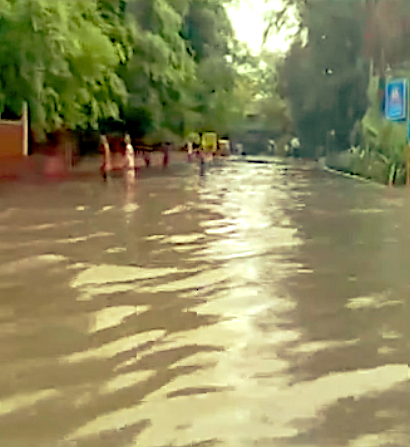
A water-logged Delhi road after rains on July 31, 2025.

New Delhi: On July 31, 2024, Delhi drowned under a monsoon deluge, its streets transformed into sewage-laced rivers. Connaught Place, the capital’s commercial heart, became a lake, stranding commuters as scooters sank in knee-deep muck. In Ghazipur locality, a mother and her three-year-old son perished in an overflowing drain, while three UPSC aspirants drowned days earlier in a flooded coaching centre basement in Old Rajinder Nagar.
The city’s 2,064 km stormwater drain network, covering only 50% of the National Capital Territory and built on a 1976 master plan for a population one-fifth of today’s 3.8 crore, got choked on silt and garbage. The Yamuna, swollen by upstream releases from Haryana’s Hathnikund Barrage, flooded ITO, Rajghat, and Mayur Vihar, paralysing the city.
These tragedies expose a water management system crumbling under outdated infrastructure, unchecked urbanisation, and climate-driven rains—a stark warning of systemic failures threatening India’s cities, rivers, and people.
India’s water management system is a leaking bucket, spilling lives, livelihoods, and hope. Rivers like the Yamuna choke on 641 million litres per day (MLD) of untreated sewage, poisoning communities. Groundwater fades in 751 over-exploited zones, leaving farmers staring at cracked fields. Himalayan glacial lakes threaten catastrophic floods, barely monitored. Irrigation projects stagnate, flood defences fail, and rural taps run dry despite ambitious promises.
The Ministry of Jal Shakti’s flagship programmes—Jal Jeevan Mission (JJM), National Mission for Clean Ganga (NMCG) via Namami Gange Programme (NGP), National River Conservation Plan (NRCP), and Jal Shakti Abhiyan (JSA)—report progress: 24.89 lakh water samples tested, 3,781 MLD sewage treatment capacity, 69,000 Amrit Sarovars revived, and 6,327 dolphins in the Ganga by 2023.
Yet, the Lok Sabha responses of July 31, 2025, reveal a system fractured by decentralised chaos, toothless enforcement, squandered funds, and superficial participation. Government initiatives like Jal Sanchay Jan Bhagidari (JSJB), National Water Informatics Centre (NWIC), and PM Gati Shakti’s GIS tools struggle with inconsistent execution and weak authority, underscoring persistent challenges in achieving water security.
The Jal Jeevan Mission, launched in August 2019, aims to provide safe water to every rural home, yet millions still trudge to distant wells. The 2022 Functionality Assessment reports 86% household tap connections, 85% adequate quantity, 80% regular supply, and 87% compliance with Bureau of Indian Standards (BIS) 10500:2012. However, only 38% of 24.89 lakh water samples from 3.92 lakh villages used Field Testing Kits (FTKs) in 2025–26, despite 24.80 lakh women trained, per the “Quality of Work Under JJM” response. This low community testing, despite extensive training, reflects the decentralised model, where states control planning and grievances, scattering accountability. The absence of centralised grievance records leaves 20% of households without a regular supply and 13% with substandard water, risking diarrheal outbreaks and child mortality.
The reliance on post-treatment checks, without real-time Water Quality Index (WQI) monitoring, allows contaminants to go undetected, undermining public health. The Nal Jal Mitra Programme (NJMP) trains plumbers, and Atal Mission for Rejuvenation and Urban Transformation (AMRUT) 2.0’s “AMRUT Mitra” engages schools, Anganwadi Centres (AWCs), and Self-Help Groups (SHGs), but the lack of participation data or consistent state-led training renders these efforts superficial. Split responsibilities between Public Health Engineering Departments (PHEDs) and Gram Panchayats fuel inefficiencies, compounded by water’s status as a state subject under the Indian Constitution (Entry 17, List II), which limits central oversight.
The National Mission for Clean Ganga (NMCG), executing the Namami Gange Programme with ₹26,824.86 crore allocated (2014–26, including ₹3,400 crore for 2025–26), seeks to revive the Ganga, an inter-state river under central purview (Entry 56, List I). By June 2025, 136 of 212 sewerage projects will have built a 3,781 MLD capacity across 5,220 km of networks. Effluent discharge dropped 28.6% (349 MLD to 249.31 MLD, 2017–2023), and Biochemical Oxygen Demand (BOD) halved (26 to 13.73 tons per day). Yet, 517 of 4,246 Grossly Polluting Industries (GPIs) remain non-compliant, and 76 Sewage Treatment Plants (STPs) are stalled by land disputes and statutory clearances, per the “Targets Achieved Under Namami Gange Mission” response.
Only ₹108.31 crore of ₹140 crore was spent on Yamuna projects in 2025, reflecting underutilised funds due to bureaucratic delays. Three Common Effluent Treatment Plants (CETPs) at Jajmau (20 MLD), Banther (4.5 MLD), and Mathura (6.25 MLD) operate, but 36% of projects remain incomplete a decade after NMCG’s launch.
State-led execution scatters accountability, allowing polluters to evade consequences, despite central authority over interstate rivers. The PRAYAG dashboard and Ganga Knowledge Portal (1,072 documents) track progress, and 139 District Ganga Committees (DGCs) held 4,377 meetings, but their lack of legal powers limits impact. The Ganga Task Force (GTF) plants trees, with seven biodiversity parks and 33,024 hectares afforested, and 160 lakh Indian Major Carp fingerlings and 6,327 dolphins by 2023, signalling ecological hope. However, the Central Pollution Control Board (CPCB)’s 2022 report of 311 polluted Ganga stretches (BOD 3–10 mg/L, exceeding the 3 mg/L bathing standard) reveals persistent failure. Festivals like Ganga Utsav, Nadi Utsav, and Ghat Par Yoga remain symbolic, lacking tangible impact on pollution.
The Yamuna’s condition mirrors NMCG’s challenges. Delhi generates 3,596 MLD of sewage, 641 MLD untreated, with 14 of 37 STPs (2,955 MLD utilised of 3,474 MLD capacity) failing Delhi Pollution Control Committee (DPCC) norms in June 2025. BOD levels at Nizamuddin (37–52 mg/L) and Okhla (23–50 mg/L), and faecal coliform counts of 16 million Most Probable Number (MPN)/100ml, endanger millions. Of 189 GPIs, 49 are non-compliant, discharging 1.33 MLD. Nine NGP projects (1,268 MLD at ₹1,951 crore) are complete, but only ₹108.31 crore of ₹140 crore was used in 2025, highlighting bureaucratic bottlenecks. The NRCP, covering 57 rivers, built a 2,945 MLD capacity at ₹8,970 crore, yet only ₹1,677 crore was released over five years, starving progress. The focus on infrastructure over enforcement allows pollution to persist, exacerbated by Delhi’s 2024 floods, where untreated sewage turned streets into sewers, linking pollution to urban disaster.
The Ground Water Action Plan, encompassing the Master Plan for Artificial Recharge (1.42 crore structures for 185 billion cubic meters), Mission Amrit Sarovar (69,000 water bodies), and Atal Bhujal Yojana, struggles with state-central disconnects. The Central Ground Water Board (CGWB) monitors 27,000 wells, identifying 751 over-exploited zones in 2024, threatening 80 water-stressed districts. Only 21 states adopted the Model Groundwater Bill, leaving the Central Ground Water Authority (CGWA) powerless, its Environmental Compensation (EC) a weak deterrent, per the Lok Sabha responses. State disparities—₹125.03 crore to Assam versus ₹7.78 crore to Bihar in 2023–24 under PMKSY-Har Khet Ko Pani (HKKP)—fragment recharge efforts, leaving farmers with barren fields and rural communities begging for water.
Water Harvesting Public Participation, through JSJB and Mission Amrit Sarovar, targets water body revival, but only 69,000 have been rejuvenated, a fraction of India’s needs. JSJB, launched in September 2024, is hampered by uneven state funding and training, per the Lok Sabha responses. “AMRUT Mitra” engages schools and AWCs, but the absence of participation data or legal authority renders it tokenistic, limiting community impact. Sustainable management, a core National Water Mission (NWM) goal tied to Nationally Determined Contributions (NDC), is undermined by 311 polluted river stretches, 751 over-exploited zones, and fragmented governance, reflecting a lack of integration between surface and groundwater efforts.
Flood and irrigation systems falter under neglect. The Flood Management and Border Areas Programme (FMBAP) protects 5.13 million hectares and 54.84 million people with 431 projects, yet only ₹7,260.50 crore of ₹13,238.37 crore was released by March 2025, exposing millions to floods like Delhi’s. The Pradhan Mantri Krishi Sinchayee Yojana (PMKSY) added 3.90 lakh hectares of irrigation potential, but 58 Surface Minor Irrigation (SMI) and Repair, Renovation, and Restoration (RRR) schemes (₹9,965 crore) are delayed by land and clearance issues. The Central Water Commission (CWC) tracks 902 Glacial Lakes and Water Bodies (GL&WBs), with Wadia Institute of Himalayan Geology (WIHG) monitoring 13 glaciers and National Centre for Polar and Ocean Research (NCPOR) overseeing six. The National Disaster Management Authority (NDMA)’s National Glacial Lake Outburst Flood (GLOF) Risk Mitigation Programme (NGRMP) in four Himalayan states is limited by poor high-altitude access, risking catastrophic floods.
India’s water crisis undermines its people, rivers, and future. Women testing water, festivals celebrating the Ganga, and dolphins leaping offer glimmers of hope, but untreated sewage, dry wells, and flood-ravaged cities reveal deep systemic flaws. The gaps in government initiatives—limited testing, stalled projects, depleted resources, and fragmented governance—expose a system failing to deliver water security. India’s rivers remain sewers, its wells graves, and its cities vulnerable to neglect.