New Delhi: As inclusivity principles face uneven implementation globally, India’s unique socio-cultural context demands a deliberate, locally rooted approach to ensure equitable participation in science, technology, engineering, mathematics, and medicine (STEMM).
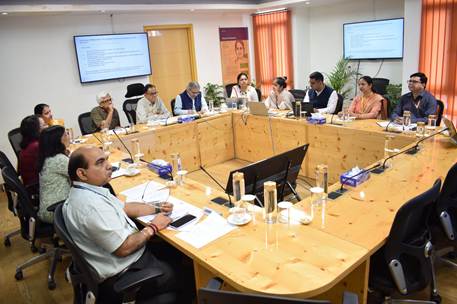
To address this, the Office of the Principal Scientific Adviser (OPSA) to the Government of India convened a high-level meeting today to discuss the operationalisation of the Inclusivity in STEMM Self-Assessment and Reporting Framework (Inclusivity-STEMM-SARF).
Chaired by Professor Ajay Kumar Sood, Principal Scientific Adviser, the meeting gathered key stakeholders to advance a structured strategy for fostering inclusivity tailored to India’s diverse STEMM ecosystem. Developed by OPSA through extensive stakeholder consultations, the framework will be implemented jointly by OPSA, the Capacity Building Commission (CBC), the Department of Higher Education (DHE), and the All India Council for Technical Education (AICTE). The meeting was attended by Dr. R Balasubramaniam, Member (Human Resources), Capacity Building Commission; Shri Vineet Joshi, Secretary, Department of Higher Education; Dr. Parvinder Maini, Scientific Secretary, OPSA; Ms. Soumya Gupta, Joint Secretary (Technical Education), Department of Higher Education; Ms. Navanita Gogoi, Deputy Director General (Statistics), Department of Higher Education; and Dr. Amit Dutta, Director, Policy & Academic Planning Bureau, AICTE.
Prof. Sood opened the discussion by underscoring the critical need for an inclusive STEMM ecosystem to bridge nuanced gaps in India’s scientific landscape. “Inclusivity in STEMM is not just a moral imperative, but also a scientific and developmental one. Diverse perspectives drive better innovation, more relevant research, and equitable outcomes,” he said. He highlighted that India’s demographic diversity and socio-economic complexity make inclusive scientific ecosystems both a challenge and a necessity. The Inclusivity-STEMM-SARF addresses gender equity, socio-economic, linguistic, and epistemic diversity, while promoting just, ethical, and open science principles.
Dr. Maini elaborated on the need for a locally rooted model, noting that global inclusivity efforts vary by country, sector, and discipline, often failing to align with India’s unique context. She highlighted OPSA’s commitment to inclusivity through initiatives like I-STEM, Rural Technology Action Group (RuTAG), the One Health Mission, One Nation One Subscription, and the National Livelihood Mission, which embody inclusivity in practice. Dr. Maini emphasised the importance of a structured, integrated, and measurable approach to allow institutions to assess their inclusivity, benchmark progress, and identify gaps, which inspired the development of the Inclusivity-STEMM-SARF.
The framework’s roots lie in the 2023 G20 Chief Science Advisers’ Roundtable (CSAR), where inclusivity in science and technology emerged as a core agenda. The roundtable agreed on the need to tackle systemic inequalities, promote knowledge plurality, and ensure linguistic and epistemic diversity. To adapt these global insights for India, OPSA drafted a position paper outlining priority inclusivity dimensions for India’s STEMM ecosystem, which evolved through extensive stakeholder consultations into the Inclusivity-STEMM-SARF. This framework aims to bring structure, insights, and accountability to how institutions approach inclusivity.
Dakshata Lingayat from OPSA presented an overview of the framework, detailing its parameters, stakeholder consultation process, and proposed action points. Designed to avoid a one-size-fits-all approach, the framework draws on global best practices while tailoring solutions to India’s specific needs through conceptual and contextual understanding, recognising the unique characteristics of India’s STEMM ecosystem.
Dr. Balasubramaniam stressed the need for a structured capacity-building module to embed the framework within governance structures, noting that it aims to foster institutional excellence beyond mere representation. He suggested that, once piloted and validated, the framework could serve as a benchmark for countries across the Global South. Shri Vineet Joshi highlighted the framework’s intersectionality across five parameters, urging that the pilot phase capture social, geographical, and economic aspects of inclusivity. Ms. Navanita Gogoi shared insights from the All India Survey on Higher Education (AISHE) database, focusing on its inclusivity-related aspects. Dr. Amit Dutta endorsed the framework, emphasising the importance of strong representation from technical institutions under AICTE’s purview.
The meeting concluded with key decisions to advance the Inclusivity-STEMM-SARF initiative. A pilot strategy for the Self-Assessment and Reporting Framework will be developed in collaboration with the Department of Higher Education. A capacity-building module on inclusivity in STEMM will be co-developed with the Capacity Building Commission. A joint working group, comprising representatives from OPSA, DHE, CBC, and AICTE, will be established to oversee and coordinate these efforts. These steps mark a significant stride towards creating an inclusive and equitable STEMM ecosystem in India, tailored to its diverse socio-cultural and scientific landscape.
– global bihari bureau