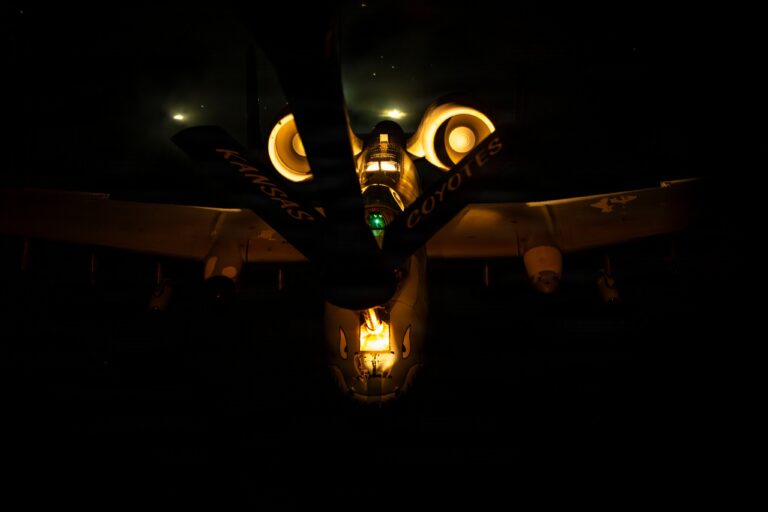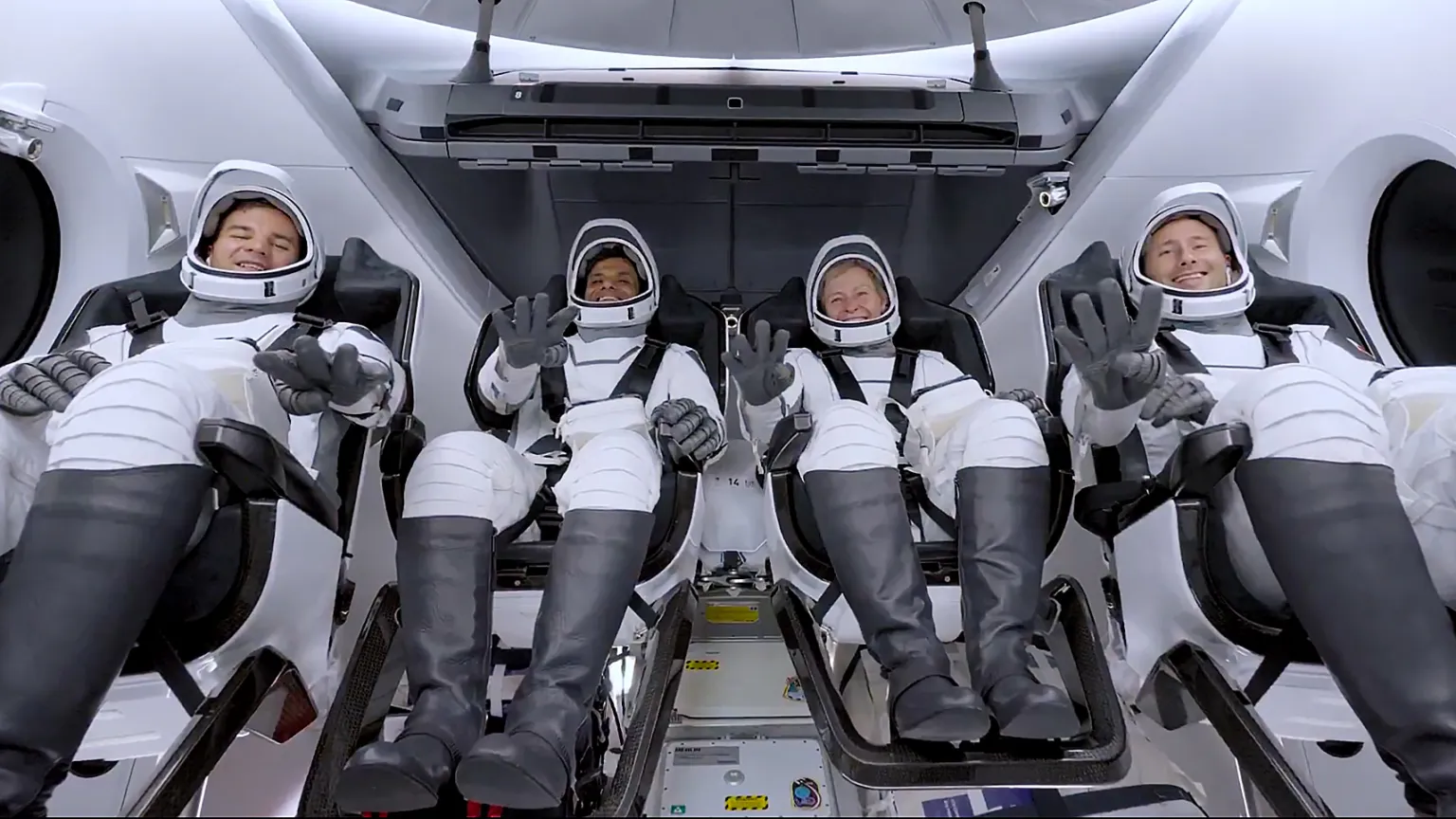
(From left) Ax-4 Mission Specialist Tibor Kapu, Pilot Shubhanshu Shukla, Commander Peggy Whitson, and Mission Specialist Sławosz Uznański-Wiśniewski wave from inside the Space Dragon spacecraft. Photo: NASA
San Diego: Group Captain Shubhanshu Shukla, India’s first astronaut to live and work aboard the International Space Station (ISS), stepped out of the SpaceX Dragon capsule Grace after splashing down in the Pacific Ocean off San Diego, California, at 3:01 PM Indian Standard Time (IST), today.
The 39-year-old Indian Air Force test pilot from Lucknow, part of the Axiom-4 commercial spaceflight organised by Axiom Space in collaboration with the National Aeronautics and Space Administration (NASA), the Indian Space Research Organisation (ISRO), and SpaceX, completed an 18-day mission, extended from 14 days to allow additional experiments and outreach.
Shukla, alongside mission commander Peggy Whitson of the United States, who has logged 695 days in space over five missions, Poland’s Slawosz Uznanski-Wisniewski, and Hungary’s Tibor Kapu, undocked from the ISS at 4:45 PM IST on Monday. The 22.5-hour descent included a de-orbit burn at 2:07 PM IST, two-stage parachute deployment at 5.7 km and 2 km altitudes, and re-entry through temperatures exceeding 1,600°C. The crew completed over 310 orbits, traveling more than 1.3 crore kilometers—equivalent to circling Earth 33 times to the Moon and back—and conducted over 60 scientific experiments, including seven ISRO-designed studies on microgravity’s effects on crop seeds, microalgae, muscle loss, and human physiology, advancing India’s Gaganyaan human spaceflight mission set for 2027 and global space research.
In Lucknow’s Triveni Nagar, Shukla’s family home glowed with celebratory lights and posters of “Shux,” his nickname, as relatives, neighbours, and well-wishers gathered. His parents, Asha Shukla, a homemaker, and Shambhu Dayal Shukla, a retired government officer, joined students and teachers at City Montessori School (CMS), Shukla’s alma mater, to watch the live splashdown on a projector screen. As the capsule landed, Asha, who had recited the Sundarkand and performed a Rudrabhishek prayer for her son’s safety, wept with relief, saying, “My son has safely returned, I thank God”, Shambhu Dayal, overcome with pride, told reporters, “He has made the country proud, but to us, he’s still the same boy we raised. The splashdown will be noted down in history”. Shukla’s sister, Shuchi Mishra, added, “We are very relaxed and happy as he has returned to Earth safely”. The family cut a three-tier cake symbolising the mission’s launch, ISS stay, and splashdown, joined by CMS management, while neighbours waved Indian flags and shared sweets. CMS director Geeta Gandhi Kingdon said, “I felt he had come triumphant, as if a member of my family returned”.
Prime Minister Narendra Modi celebrated Shukla’s return, posting on X: “I join the nation in welcoming Group Captain Shubhanshu Shukla as he returns to Earth from his historic mission to Space. As India’s first astronaut to have visited the International Space Station, he has inspired a billion dreams through his dedication, courage and pioneering spirit. It marks another milestone towards our own Human Space Flight Mission – Gaganyaan”.
Union Minister Dr. Jitendra Singh, addressing scientists, media, and officials after the splashdown, called it a “moment of pride for the world, a moment of glory for India,” adding, “One of Mother India’s illustrious sons is back. India has found a lasting space in the world of space”. He highlighted the mission’s unique experiments, noting, “These are experiments that have never been done before. This marks a new era for India’s scientific and technological ambitions,” with long-term benefits for humankind. Defence Minister Rajnath Singh told Shambhu Dayal that Shukla’s feat “lifted India’s aspirations to new heights,” emphasising national pride.
Shukla carried gajar ka halwa, a traditional Indian sweet, and a toy swan symbolising knowledge in Indian culture, sharing India’s heritage in space. During a satellite call, he thrilled his family by showing sunrises from the ISS “like a child with a new toy,” said Asha, who plans to cook his favourite gajar ka halwa and mathri.
The mission, costing ₹548 crore ($65 million) for Shukla’s seat and training, sparked debate but was defended by ISRO for its invaluable experience. Shukla, whose wife, Kamna, and six-year-old son, Kiash, reside in Bangalore, will remain in quarantine in California until July 23 for medical and re-adaptation procedures, followed by debriefings with ISRO, Axiom, and NASA starting on July 24. A return to India is expected around August 17, 2025.
The Axiom-4 mission unfolded alongside other ISS activities, reflecting its role as a global hub. The Expedition 73 crew, including NASA astronauts Jonny Kim, Anne McClain, and Nichole Ayers, conducted experiments under the CIPHER suite, studying heart and nervous system adaptations in microgravity using the Ultrasound 2 device and virtual reality goggles. Station Commander Takuya Onishi of the Japan Aerospace Exploration Agency (JAXA) and Kim prepared for electrical and life support maintenance, while Roscosmos cosmonauts Alexey Zubritskiy, Kirill Peskov, and Sergey Ryzhikov unpacked the Progress 92 resupply ship, delivering three tons of supplies on July 5.
On July 16, the Progress 91 cargo craft will boost the ISS’s orbit for the SpaceX Crew-11 mission, led by NASA’s Zena Cardman with Mike Fincke, Kimiya Yui of JAXA, and Oleg Platonov of Roscosmos, launching no earlier than July 31 for an August 2 docking. This collaboration builds on the 1975 Apollo-Soyuz mission, when U.S. and Soviet astronauts docked and conducted joint research, paving the way for the ISS’s 25 years of continuous human habitation, to be celebrated on November 2, 2025.
Dr. Singh tied the mission to Modi’s vision of Vasudhaiva Kutumbakam—the world as one family—calling Shukla a “Vishwa Bandhu, a global citizen” who embodied universal brotherhood. “This is not just a scientific mission, it is a reflection of India’s role as a trusted partner in the shared journey of humanity,” he said.
For India, Shukla’s mission—the first Indian spaceflight since Rakesh Sharma’s in 1984—is a milestone. Singh noted, “The call given by Prime Minister Modi to look to the skies and dream big has begun to take shape. This successful mission is just the beginning. It will inspire a new generation of Indians to pursue careers in science and space”.
In Lucknow, students like Malak Hasan, who imagined herself in Shukla’s place, and Chetan Chaturvedi, relieved after delays in other missions, felt inspired. As Shukla prepares to share his story, his family and nation see his journey as a beacon of hope, proving that dedication and global partnership can propel India to the stars.
– global bihari bureau