From Parliament to Corridors: A Familiar Minerals Script
New Delhi: In a written reply to a question in the Rajya Sabha today, the Minister of Coal and Mines, G. Kishan Reddy, outlined India’s rare earth resource base and policy initiatives, while the sector itself remains constrained by structural, technological and value-chain bottlenecks that have slowed commercial outcomes.
Reddy stated that the Atomic Minerals Directorate for Exploration and Research (AMD), a constituent unit of the Department of Atomic Energy (DAE), is carrying out exploration and augmentation of minerals of the rare earth group elements along the coastal and inland placer sands, as well as in hard rock terrains in several potential geological domains of the country.
Yet Another Grand Plan for Rare Earths, as Old Bottlenecks Remain
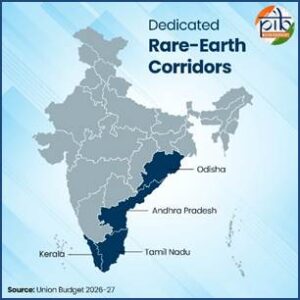
On February 1, 2026, the Union Budget 2026–27 unveiled a headline initiative: Dedicated Rare Earth Corridors in Odisha, Kerala, Andhra Pradesh and Tamil Nadu. The move is being presented as a decisive step toward self-reliance in critical minerals. In reality, after years of announcing strategies, missions and schemes to unlock India’s rare-earth potential, it is the latest policy push in a sector that has repeatedly struggled to convert ambition into sustained production.
 The corridors announcement comes against a long trail of earlier interventions. In 2023, Parliament amended the Mines and Minerals (Development and Regulation) Act (MMDR Act) to classify rare earths as critical minerals and empower the Centre to auction blocks directly. By early 2026, the Ministry of Mines had auctioned 46 critical mineral blocks and seven exploration licence blocks, including two for rare earth elements. In January 2025, the Union Cabinet also approved the National Critical Mineral Mission (NCMM), promising a long-term strategy covering exploration, mining, processing and recycling.
Yet despite these moves, commercial mining and downstream manufacturing of rare earths remain limited.
The latest corridors proposal builds on a ₹7,280-crore scheme approved in November 2025 to establish 6,000 metric tonnes per annum of Rare Earth Permanent Magnet (REPM) manufacturing capacity. The scheme offers ₹6,450 crore in sales-linked incentives over five years and ₹750 crore in capital subsidy for advanced facilities, with up to five beneficiaries to be selected through global competitive bidding. A two-year gestation period has been fixed for setting up plants, followed by incentive disbursement linked to production.
Also read:
- Budget Push on Rare Earths Triggers Mountain Concerns
- Rare Earths Take Centre Stage in Budget 2026-27
On paper, the scheme claims to span the entire value chain — from rare-earth oxides to finished magnets used in electric vehicles, wind turbines, electronics, aerospace and defence. On the ground, it enters a sector where India has long possessed geological resources but has failed to build viable large-scale commercial output or a mature value chain. Between 2022 and 2025, nearly 60–80 per cent of India’s permanent magnet demand by value and 85–90 per cent by volume continued to be met through imports, largely from China.
Large Reserves, Limited Usability
According to the Atomic Minerals Directorate for Exploration and Research (AMD), India has identified 136 deposits of beach sand minerals containing 13.15 million tonnes of monazite across Tamil Nadu, Kerala, Andhra Pradesh, Odisha, Maharashtra, Gujarat, Jharkhand and West Bengal. These deposits contain an estimated 7.23 million tonnes of in-situ rare earth oxide resources. In addition, three hard-rock deposits in Rajasthan and Gujarat account for another 1.29 million tonnes of rare earth oxide resources.
The Geological Survey of India has further reported 482.6 million tonnes of rare-earth ore resources across 34 exploration projects.
These figures suggest abundance, but the reality is more complicated. Indian rare-earth ores are low in grade, tied to radioactive elements such as thorium and uranium, and dominated by light rare earths. Extraction is therefore long, technologically complex and expensive. Monazite remains a “prescribed substance” under atomic energy laws, keeping mining and refining firmly under government control.
India is among a handful of countries with technical capability in rare-earth processing, yet commercial production has remained constrained by lack of separation technology, weak mid-stream industries and the absence of large private investment willing to tolerate regulatory uncertainty and environmental scrutiny.
Corridors Built on Existing State Infrastructure
The proposed Rare Earth Corridors in Odisha, Kerala, Andhra Pradesh and Tamil Nadu are intended to cluster mining, processing, research and manufacturing. Officials point to the presence of IREL (India) Limited — formerly Indian Rare Earths Limited — which has operated under the Department of Atomic Energy since 1963. IREL runs a Rare Earth Extraction Plant in Odisha and a Rare Earth Refining Unit at Aluva in Kerala, alongside facilities producing ilmenite, rutile, zircon, sillimanite and garnet with a total processing capacity of about 10 lakh tonnes per annum.
The corridors are meant to expand around this existing footprint. Whether they become functional industrial ecosystems or remain administrative designations will depend on resolving the same issues that have stalled earlier efforts: radioactive waste handling, forest and environmental clearances, separation technology, and sustained private investment.
To accelerate projects, the government has already introduced regulatory relaxations, including the exemption of critical mineral projects from public hearings and permitting compensatory afforestation on degraded forest land. These changes have raised concerns among environmental groups, even as officials argue they are necessary to avoid project delays.
Strategic Goals, Familiar Rhetoric
The rare-earth push is being framed around national priorities — Atmanirbhar Bharat, Net Zero 2070 and Viksit Bharat @2047. Rare earth magnets are central to electric vehicles, wind turbines, aerospace systems, defence equipment and precision sensors. A domestic supply chain is seen as essential to reduce dependence on imports and insulate India from global supply shocks.
Yet the dependence remains stark. China continues to dominate the global rare-earth market, and India’s own consumption of REPMs is projected to double by 2030 as electric mobility, renewable energy and electronics expand.
Looking Abroad for Security
Alongside domestic measures, India has sought overseas mineral security through bilateral and multilateral arrangements. The Ministry of Mines has signed agreements with countries including Australia, Argentina, Zambia, Mozambique, Peru, Zimbabwe, Malawi and Côte d’Ivoire. India is also part of the Minerals Security Partnership and the Indo-Pacific Economic Framework, both aimed at diversifying supply chains.
Khanij Bidesh India Limited (KABIL), a joint venture of NALCO, Hindustan Copper and MECL, has been tasked with acquiring overseas mineral assets. It has signed an agreement with CAMYEN in Argentina for the exploration and mining of five lithium brine blocks, reflecting a strategy that extends beyond rare earths into other critical minerals.
A Sector Still Waiting for Proof
India’s rare-earth strategy now consists of amended mining laws, a national mission, dozens of auctioned blocks, a ₹7,280-crore magnet scheme, four new corridors and a growing list of foreign partnerships. What it does not yet show is large-scale commercial output or a mature value chain.
For a country that has spoken of rare-earth self-reliance for decades, the latest Budget announcement adds another layer of policy architecture to a sector still weighed down by technical complexity, environmental risk and institutional caution. Whether the corridors will finally translate geology into industry — or join the catalogue of well-intentioned but unfinished initiatives — remains an open question.
– global bihari bureau