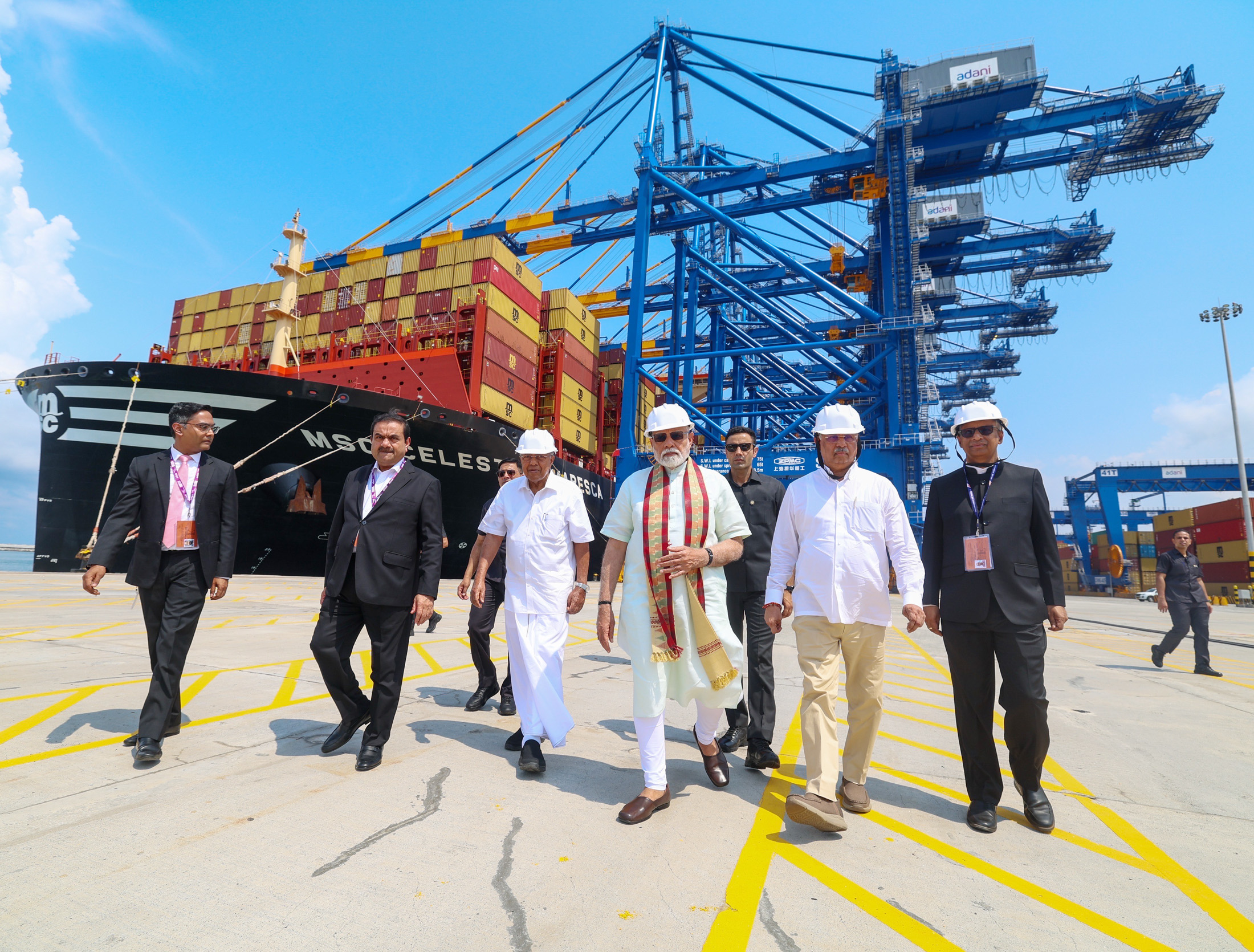
Prime Minister Narendra Modi launches Vizhinjam International Seaport in Thiruvananthapuram, Kerala on May 02, 2025.
Thiruvananthapuram: Prime Minister Narendra Modi unveiled Vizhinjam International Deepwater Multipurpose Seaport worth Rs 8,800 crore here today, calling it a symbol of new age development. He envisioned Kerala as a major centre for global maritime trade and announced the launch of ‘Maritime Amrit Kaal Vision’, which outlines India’s maritime strategy to achieve the goal of a developed India. He elaborated that after strengthening the country’s basic infrastructure, the focus has now shifted towards India’s strategic position in global trade.
The Prime Minister further stated that India is now setting ambitious targets to strengthen its shipbuilding capabilities. He referred to this year’s Union Budget, which introduced a new policy to promote the construction of large ships in India to boost the manufacturing sector. He said the Government of India, in collaboration with state governments, has upgraded port infrastructure under the Sagarmala Project and strengthened port connectivity. “Under ‘PM Gati Shakti’, waterways, railways, highways, and airways are being rapidly integrated for seamless connectivity,” he asserted and claimed these reforms in ease of doing business have led to greater investment in ports and infrastructure sectors.
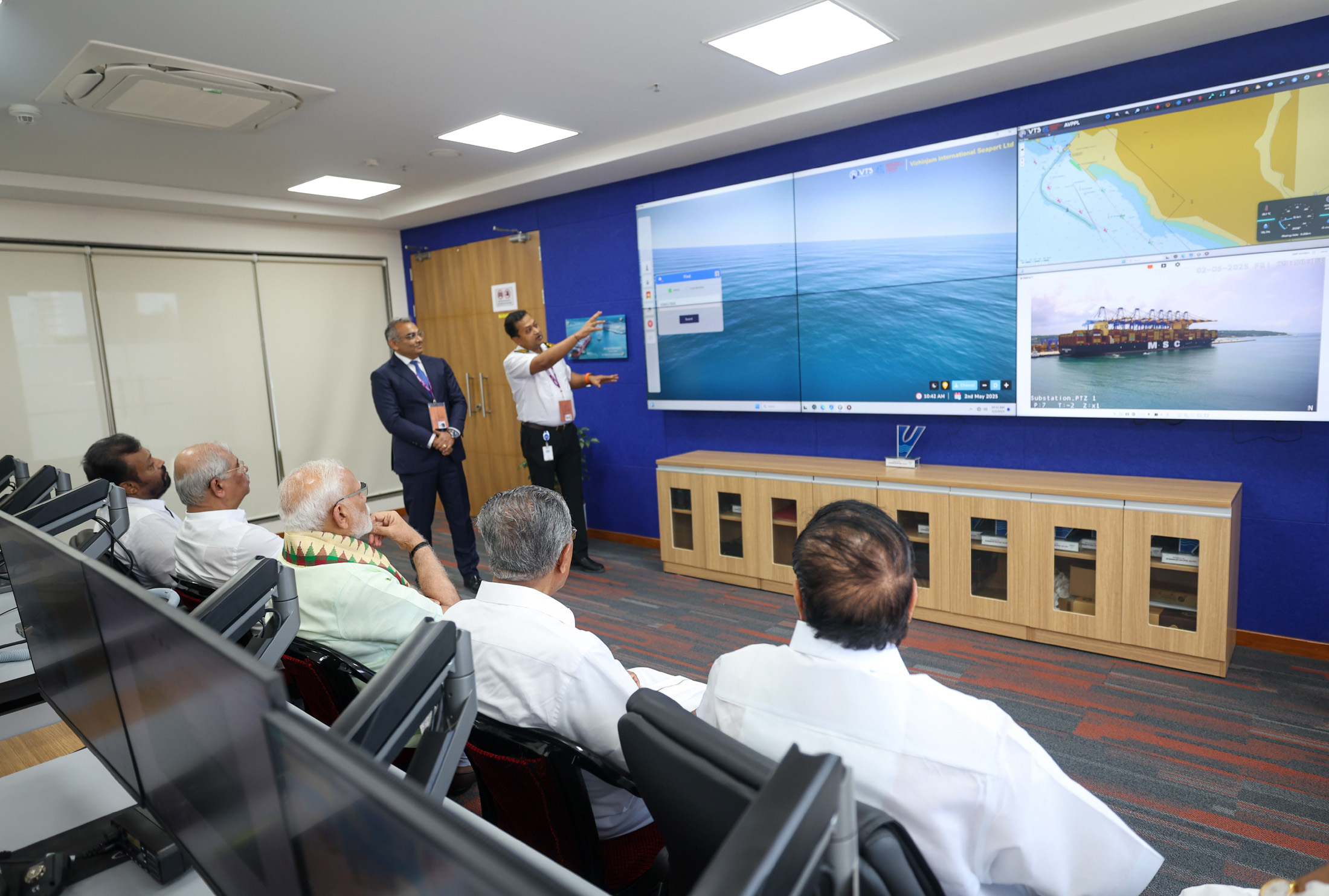
The Vizhinjam Deep-Water Sea Port has been developed at a cost of ₹8,800 crore. It becomes the country’s first dedicated container transhipment port, representing the transformative advancements made in India’s maritime sector.
Strategically important, Vizhinjam is identified as a key priority project and is expected to strengthen India’s position in global trade, enhance logistics efficiency, and reduce reliance on foreign ports for cargo transhipment. Its natural deep draft of nearly 20 metres and location near one of the world’s busiest sea trade routes further strengthen India’s position in global trade.
Also read: Vizhinjam Seaport: From scam to strategic powerhouse
Modi said that the capacity of this transhipment hub will triple in the coming years, enabling the smooth arrival of some of the world’s largest cargo ships. He pointed out that 75% of India’s transhipment operations were previously conducted at foreign ports, leading to significant revenue loss for the country. Emphasising that this situation is now set to change, he asserted that India’s money will now serve India, and the funds that once flowed outside the country will now generate new economic opportunities for Kerala and Vizhinjam’s people.
“The port economy reaches its full potential when infrastructure and ease of doing business are promoted together”, Modi emphasised. He stressed that over the past 10 years, this had been the blueprint of the Government of India’s port and waterways policy. He pointed out that just a decade ago, ships faced long waiting times at ports, significantly delaying unloading operations, which used to affect businesses, industries, and the overall economy. “The situation has now transformed and over the past 10 years, India’s major ports have reduced ship turnaround time by 30%, improving operational efficiency,” he said and remarked that due to enhanced port efficiency, India is now handling greater cargo volumes in shorter durations, strengthening the nation’s logistics and trade capabilities. He noted that over the past 10 years, India has doubled the capacity of its ports and expanded its National Waterways eightfold. “Today, two Indian ports are among the global top 30 ports, while India’s ranking on the Logistics Performance Index has also improved. India is now among the top 20 countries in global shipbuilding,” he said.
The Prime Minister also mentioned the Government of India’s moves to reform regulations concerning Indian seafarers, and claimed they are yielding “significant” results. He pointed out that in 2014, the number of Indian seafarers was below 1.25 lakh. Today, this figure has surged beyond 3.25 lakh, and India now ranks among the top three countries globally in terms of seafarer numbers.
Recounting Kerala’s contribution in building maritime strength and economic growth, Modi highlighted the state’s historical role in maritime trade through the Arabian Sea, which enabled India to maintain trade links with multiple nations. He noted that ships from Kerala carried goods to various countries, making it a vital hub for global commerce. “Today, the Government of India is committed to further strengthening this channel of economic power”, he added and asserted, “India’s coastal states and port cities will become key centres for the growth of a developed India”.
Referring to the establishment of a shipbuilding and repair cluster in Kochi, Modi emphasised that once completed, this cluster will create numerous new employment opportunities, providing Kerala’s local talent and youth with a platform for growth.
The dedication of the port to the nation coincided with the birth anniversary of Adi Shankaracharya. Modi recalled that three years ago, in September, he visited the birthplace of Adi Shankaracharya. He underscored that Adi Shankaracharya, originating from Kerala, established monasteries in different corners of the country, “awakening the consciousness of the nation”. He emphasised that his efforts laid the foundation for a unified and spiritually enlightened ‘Bharat’.
The Governor of Kerala, Rajendra Vishwanath Arlekar, Chief Minister of Kerala, Pinarayi Vijayan, were present among other dignitaries at the launch of the Vizhinjam International Deepwater Multipurpose Seaport.
– global bihari bureau