India’s Rare Earth Push Bolsters Defence, Tech Sovereignty
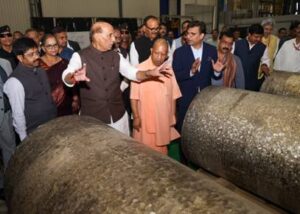
Lucknow: India’s strategic focus on rare earth minerals as a backbone for defence, aerospace, and high-technology industries gained tangible expression when Defence Minister Rajnath Singh inaugurated the Titanium and Superalloy Materials Plant at the Strategic Materials Technology Complex of PTC Industries Limited here today.
The facility, spread across 50 acres with an investment of ₹1,000 crore, has a production capacity of 6,000 tonnes per annum of aviation-grade titanium and nickel-based superalloys, produced from both domestic and recycled sources. These materials are integral to the manufacture of fighter jets, missiles, naval turbines, satellites, and aerospace components, and the plant has already secured Letters of Technical Acceptance (LoTA) from the Centre for Military Airworthiness and Certification (CEMILAC) under DRDO for producing titanium rear fin root castings for the Advanced Medium Combat Aircraft (AMCA) and oil tank assembly castings for the Kaveri Derivative Engine (KDE-2). The facility is also equipped to produce single-crystal ‘ready-to-fit’ turbine blades for KDE-2, representing one of the most complex components in modern jet engines.
 This inauguration is a concrete manifestation of India’s strategy to convert rare earth and critical mineral resources into defence and advanced manufacturing capabilities, addressing long-standing reliance on imports of refined rare earths, high-performance magnets, and strategic alloys for aerospace and defence applications.
The Defence Minister noted that, in the past, India had been dependent on other countries for the advanced materials and critical technologies needed for defence and aerospace, thereby slowing the growth of the defence sector, and the initiatives such as the Titanium and Superalloy Materials Plant indicate a reversal of this trend. He reiterated that India would acquire true strength only when it can manufacture its own materials, components, chips and alloys. According to Singh, this new plant puts India amongst a select group of nations which can make their own critical defence and aerospace materials. “With this, we will be able to manufacture the parts used in our fighter jets, missiles, naval systems and satellites”, he said.
India’s rare earth reserves are estimated at 8.52 million tonnes of rare earth oxide equivalent (REO), making the country the third-largest holder globally, after China and Brazil. The reserves occur primarily in two forms: monazite-bearing coastal sands and hard-rock deposits. Coastal monazite sands, often containing thorium, are distributed along the Kerala, Tamil Nadu, Odisha, West Bengal, Jharkhand, Gujarat, and Maharashtra coasts. Hard-rock deposits, increasingly targeted for extraction due to regulatory complexities associated with thorium, are concentrated in Andhra Pradesh, Rajasthan, Gujarat, and Jharkhand.
State-level production is critical to India’s current supply chain. In Kerala, the Chavara Mineral Separation Plant processes monazite sands to produce mixed rare earth chlorides, while Tamil Nadu’s Manavalakurichi facility and Odisha’s Chatrapur plant also contribute substantially to the production of mixed chlorides and refined oxides. Collectively, these facilities produce over 11,000 tonnes per annum of mixed rare earth chlorides and approximately 5,000 tonnes of refined oxides. Inland deposits in Andhra Pradesh and Rajasthan are under active exploration by the Geological Survey of India (GSI) and the Atomic Minerals Directorate (AMD), with particular focus on high-value elements like neodymium (Nd), praseodymium (Pr), dysprosium (Dy), and terbium (Tb), which are essential for permanent magnets used in EVs, wind turbines, robotics, and defence systems. The National Geophysical Research Institute (NGRI) has mapped hard-rock deposits, and the National Mineral Exploration Trust (NMET) is funding additional projects to secure domestic feedstock.
| State / Location | Type of Deposit / Facility | Key Minerals / Elements | Production Capacity / Output | Industrial / Strategic Role | Notes / Special Features |
|---|---|---|---|---|---|
| Kerala – Chavara | Coastal monazite sands | Thorium, REEs (mixed REOs) | ~5,000 tpa refined oxides, 11,000 tpa mixed chlorides | Primary REE extraction, feedstock for downstream industries | IREL-operated; historically central to the rare earth industry; contains thorium |
| Tamil Nadu – Manavalakurichi | Coastal monazite sands | Thorium, REEs | Part of 11,000 tpa mixed chlorides | REE extraction for downstream processing | IREL facility; coastal sand processing |
| Odisha – Chatrapur (OSCOM) | Coastal monazite sands | Ilmenite, rutile, zircon, sillimanite, garnet, REEs | 1 million tpa mineral processing; REE chlorides ~11,000 tpa | Feedstock for REE refining; supports alloys, electronics | IREL’s flagship plant; downstream separation & rare earth extraction |
| Andhra Pradesh – Hard rock deposits | Hard rock | Neodymium, Praseodymium, Dysprosium, Terbium | Under exploration, potential for future industrial scaling | Strategic source for high-performance magnets, aerospace | Explored by GSI & AMD; target for critical mineral expansion |
| Rajasthan – Hard rock | Hard rock | Nd, Pr, Dy, Tb | Under exploration | Future REE production; magnet-grade minerals | NGRI identified sites; NMET-funded projects |
| Gujarat – Hard rock / coastal | Mixed | REEs | Limited extraction; exploration stage | Supplement domestic feedstock | AMD & NMET mapping ongoing |
| Jharkhand – Hard rock / coastal | Mixed | REEs | Exploration phase | Potential domestic supply for high-tech applications | GSI & AMD active surveys |
| West Bengal – Coastal sands | Monazite sands | Thorium, REEs | Limited current extraction | Potential feedstock for downstream processing | Regulatory monitoring due to thorium |
| PTC Industries – Lucknow | Strategic Materials Technology Complex | Titanium, Nickel-based superalloys | 6,000 tpa | Defence and aerospace components; AMCA, KDE-2, turbine blades | LoTA approvals from CEMILAC; private sector pilot for high-value alloys |
| PTC Industries – JV with BDL | Defence propulsion systems | Aero-engines, guided bombs, UAV components | Project-based | Indigenisation of missile, UAV, and propulsion technologies | Strengthens the domestic defence supply chain |
| National Critical Mineral Mission (NCMM) | Nationwide | 30 critical minerals, including 17 REEs | ₹16,300 crore mission outlay; ₹18,000 crore PSUs investment | Secure supply chains, support strategic stockpiles | Integration of exploration, refining, and downstream production |
| IREL (India) Limited – Coastal & inland plants) | Chavara, Manavalakurichi, Chatrapur | REE chlorides, oxides | 11,000 tpa chlorides; 5,000 tpa refined oxides | Backbone of domestic REE supply | Under Dept. of Atomic Energy, regulatory compliance for thorium |
| Exploration Agencies (GSI, AMD, NGRI, NMET) | Nationwide surveys & mapping | Nd, Pr, Dy, Tb, mixed REOs | 482.6 million t ore identified; 34 projects | Expansion of the domestic resource base | Focus on inland hard-rock deposits; feedstock security |
Despite this resource base, domestic production in 2024 was approximately 2,900 tonnes, accounting for less than 1% of the global supply. To bridge this gap, India is intensifying both exploration and industrial initiatives. The Lucknow plant exemplifies this strategy, transforming domestic feedstock into high-value superalloys and aero-engine components. It also strengthens public-private partnerships, notably the memorandum of understanding between PTC Industries and Bharat Dynamics Limited (BDL), aimed at co-developing propulsion systems, guided munitions, small aero-engines, UAVs, and loitering munitions, thereby accelerating the indigenisation of critical defence technologies.
The industrial and defence impact of these initiatives is significant. The LoTA approvals for the AMCA and KDE-2 programmes enable the indigenous production of structural castings, turbine blades, and engine components, reducing dependence on imported materials and enhancing the country’s technological sovereignty. Combined with the Strategic Materials Technology Complex, these developments create direct and indirect employment opportunities, connect start-ups and MSMEs, and enhance the industrial landscape of Uttar Pradesh, particularly in the context of the UP Defence Industrial Corridor, which is envisioned as one of the most advanced manufacturing zones in Asia.
On the exploration and supply front, the National Critical Mineral Mission (NCMM) for FY 2024–25 to FY 2030–31 has been launched with an outlay of ₹16,300 crore and expected public sector investment of ₹18,000 crore, aiming to secure critical minerals, integrate the supply chain from exploration to downstream manufacturing, and build strategic stockpiles. India is also exploring international partnerships with countries such as Australia, Japan, Russia, and the United States for technology transfer, investments, and resilient supply chains, reflecting the recognition that rare earths are both industrial and strategic assets.
Global demand for rare earths is expanding rapidly, driven by electric vehicles, wind turbines, robotics, and advanced defence systems, with estimates projecting consumption to rise from 196 kilotonnes in 2025 to 260 kilotonnes by 2030, growing at 5–6% annually. Neodymium and praseodymium magnets account for the largest portion of this demand, while lighter rare earths are crucial for catalysts, phosphors, and electronics. Recycling and substitution will partially meet this demand, but primary production remains essential, reinforcing the urgency of India’s domestic initiatives.
The geopolitical context further underlines the importance of self-reliance. China dominates global production of refined rare earths and high-performance magnets, and its export restrictions have raised supply security concerns worldwide. India’s approach — expanding domestic production, fostering industrial partnerships, implementing stockpiling, and enabling private-sector engagement — is designed to mitigate dependency and ensure strategic resilience.
Challenges persist. The regulatory oversight for thorium-bearing monazite, limited domestic refining and separation infrastructure, and early-stage downstream manufacturing for high-value products like single-crystal turbine blades and NdFeB magnets remain bottlenecks. However, India’s combined strategy of state-level production, strategic exploration, industrial expansion, defence partnerships, and policy support creates a coherent roadmap. Analysts project that domestic and regional demand could be largely met within 3–7 years, although securing a significant global market share in refined rare earths and high-performance magnets may take over a decade.
Besides, China’s control shapes global supply chains for EVs, renewables, and defence (e.g., F-35 jets, missiles). While its export restrictions push countries like India, the US, and Australia to invest in domestic capabilities, replicating China’s refining scale could take 5–10 years. India’s National Critical Mineral Mission and partnerships (e.g., with Australia, Japan) aim to counter this, but China’s cost and technological edge persist.
However, the Lucknow inauguration, integrated with comprehensive state-level production, exploration programmes, private-sector participation, and policy missions, signals a clear trajectory. India is effectively translating mineral potential into high-value defence and technological capability, embedding rare earths at the core of its strategic, industrial, and economic ambitions, and charting a path toward technological sovereignty, industrial resilience, and global competitiveness.
– global bihari bureau