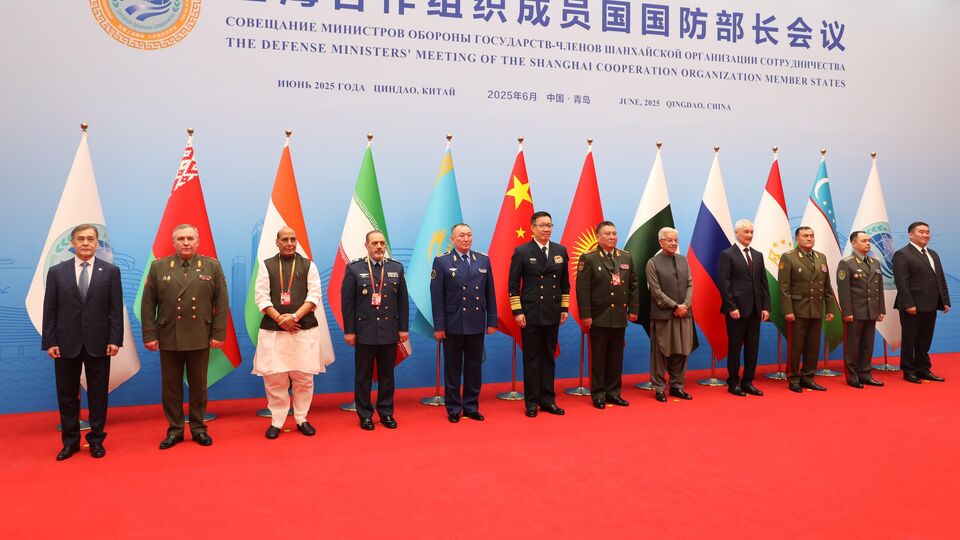
Rajnath Singh at the 22nd Meeting of Ministers of Defense of the Shanghai Cooperation Organization Member States in Qingdao on June 26, 2025.
No Safe Haven: India Vows to Hunt Terror’s Puppet Masters
Qingdao, China: A relentless tide of terrorism threatens to destabilise the region, and India’s Defence Minister Rajnath Singh issued a forceful call for the Shanghai Cooperation Organisation (SCO) to unite in eradicating the menace at its Defence Ministers’ Meeting today, rejecting a proposed joint statement that diluted India’s stance on terrorism and regional security. The draft, which omitted the brutal Pahalgam terror attack in Jammu and Kashmir while referencing militant activities in Balochistan, sparked discord, leading the bloc to abandon a collective statement due to disagreements over terrorism.
The summit, convening defence leaders from ten member states—including India, China, Russia, and Pakistan—focused on regional peace, counter-terrorism cooperation, and military collaboration. Singh pointedly condemned nations using terrorism as a state policy tool, a clear nod toward Pakistan, urging SCO members to confront radicalisation, extremism, and terrorism to secure collective safety and prosperity.
Addressing ministers, the SCO Secretary General, the Director of the Regional Anti-Terrorist Structure (RATS), and other delegates, Singh declared every act of terror criminal and unjustifiable, regardless of motive, time, place, or perpetrator. He highlighted Operation Sindoor, launched in response to the Pahalgam attack, where terrorists profiled and executed victims based on religious identity. The Resistance Front, a proxy of the UN-designated Lashkar-e-Taiba, claimed responsibility, mirroring patterns of prior assaults. India’s zero-tolerance policy, Singh emphasised, ensures that terrorism’s epicentres no longer enjoy sanctuary, with the nation ready to strike threats wherever they emerge. Perpetrators, organisers, financiers, and sponsors of cross-border terrorism must face justice, he insisted, condemning nations that nurture terror or provide safe havens. The SCO must reject such double standards and openly criticise offending countries, he asserted.
Singh stressed proactive measures to curb radicalisation among youth, commending the RATS mechanism’s role in tackling these challenges. He recalled the joint statement on countering radicalisation, separatism, and extremism from the SCO Heads of State during India’s chairmanship as a testament to shared resolve. Terrorists exploit advancing technology, Singh noted, using drones for cross-border smuggling of weapons and drugs, alongside cyber-attacks and hybrid warfare. These borderless threats demand a unified response rooted in transparency, mutual trust, and collaboration, as traditional borders no longer suffice as barriers in an interconnected world.
The SCO, representing 30 per cent of global GDP and 40 per cent of the world’s population, holds a critical stake in forging a safe, secure, and stable region to uplift lives, Singh said. Yet, globalisation’s retreat and weakening multilateral systems hinder efforts to address urgent challenges, from maintaining peace to rebuilding economies post-pandemic. Intensifying competition among major powers, with trade and technology wielded as geopolitical tools, further complicates the landscape. India advocates reformed multilateralism to foster dialogue and prevent conflict, creating mechanisms for cooperation, he added.
Singh emphasised India’s commitment to strengthening connectivity with Central Asia to boost trade and foster trust, while underscoring the need to uphold SCO charter principles, particularly respect for sovereignty and territorial integrity. He reaffirmed India’s steadfast support for peace, security, and stability in Afghanistan, prioritising humanitarian assistance and developmental needs. As Afghanistan’s largest regional development partner, India continues to drive capacity-building initiatives for its people.
Non-traditional security challenges, including pandemics, climate change, food and water insecurity, and societal disruptions, recognise no boundaries and demand collective action, Singh said. India’s Coalition for Disaster Resilient Infrastructure exemplifies global cooperation, promoting not only resilient infrastructure but also risk management, standards, financing, and recovery. India’s broader vision of SAGAR (Security and Growth for All in the Region) and MAHASAGAR (Mutual and Holistic Advancement for Security and Growth Across Regions) seeks to create a conducive environment for growth, with security and stability as cornerstones.
Singh urged SCO members to deepen cooperation and trust to fulfil the aspirations of their people while tackling today’s intricate web of challenges. Guided by the ethos of Vasudhaiva Kutumbakam—the world as one family—India seeks consensus to address global threats through mutual understanding and benefit. As terrorism and its enablers test the region’s resolve, Singh’s message from Qingdao rings clear: the SCO must stand united, act decisively, and dismantle terror networks to secure a stable, prosperous future for all.
– global bihari bureau