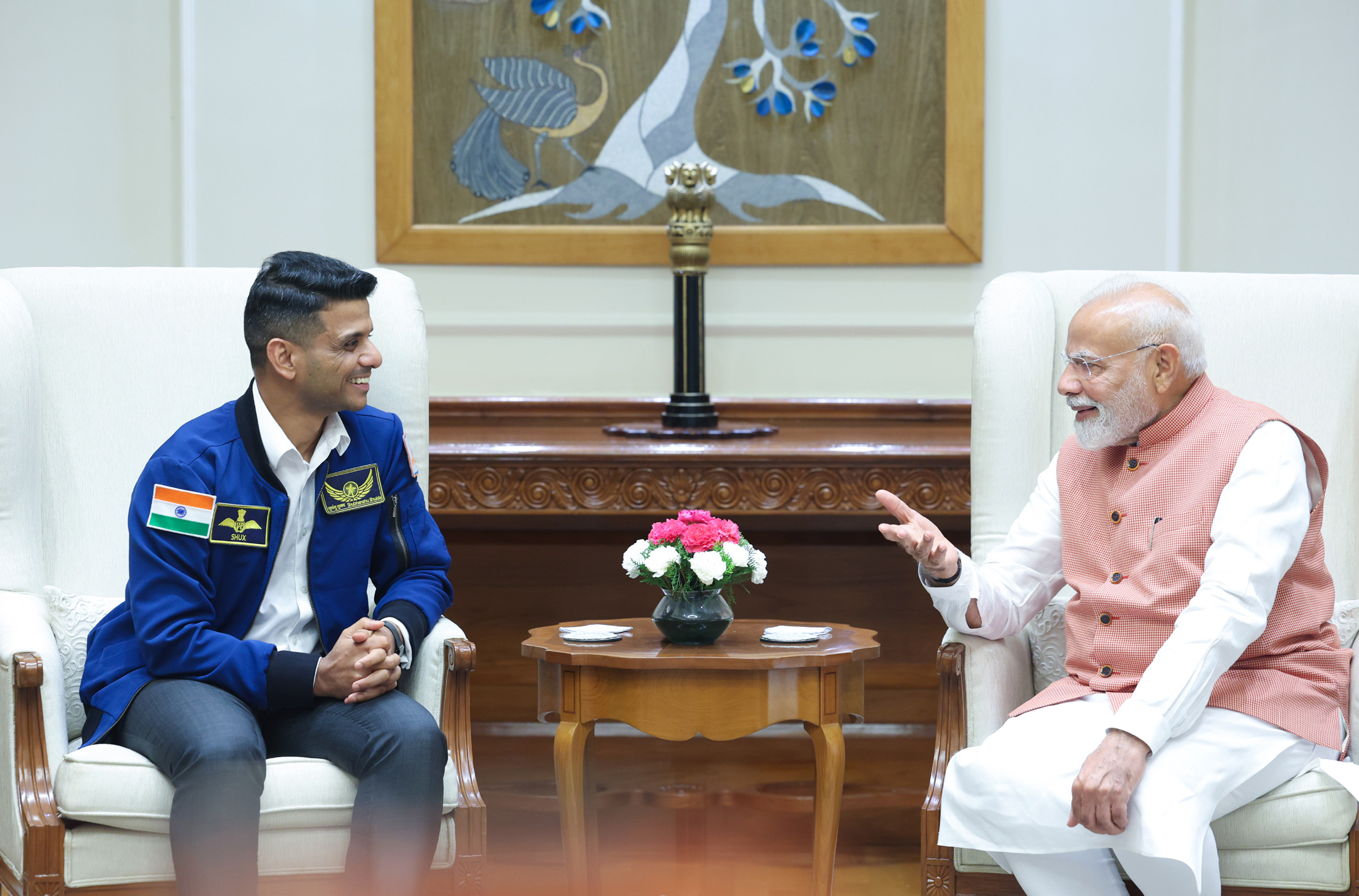
Group Captain Shubhanshu Shukla with Prime Minister Narendra Modi in New Delhi.
Cosmic Crops, Gritty Minds: India Soars
New Delhi: India has cracked the code to feeding astronauts and redefining human endurance in space, astronaut Shubhanshu Shukla revealed in a jaw-dropping conversation with Prime Minister Narendra Modi. Growing moong and fenugreek sprouts in orbit—India’s “cosmic secrets”—could solve food crises in space and on Earth, while the gruelling rewiring of body and mind in zero gravity showcases the grit behind India’s space ambitions, captivating global audiences.
Shukla, fresh from a historic mission, stunned Modi with tales of sprouting moong (mung beans) and fenugreek in microgravity using just a dish of water. “In eight days, sprouts appear,” he said, calling them “secrets of our country.” These nutrient-packed crops, thriving in cramped, costly space stations, could revolutionise astronaut diets and tackle Earth’s food security challenges. “This might solve our food security problem,” Shukla declared, sparking worldwide intrigue.
Life in orbit tests both body and mind, Shukla revealed. Floating freely in a capsule roomier than a fighter jet cockpit, he faced a slowed heartbeat and weightless freedom. But returning to Earth was a shock: “Even the fittest can’t walk immediately,” he admitted, recalling wobbly steps as helpers steadied him. “The brain has to be rewired,” he stressed, highlighting mental fortitude over physical strength. Adapting to zero gravity and back demands a mind that relearns movement, a feat as awe-inspiring as India’s cosmic crops.
Modi probed mission durations, learning some astronauts endure eight-month stints, with Shukla’s crewmates due back in December. Global astronauts, buzzing about India’s rise, peppered Shukla with questions about Gaganyaan, snagging his autograph and launch invites. “Everyone knew about Bharat’s progress,” he said, reflecting global awe.
Nicknamed a “tech genius,” Shukla credited Air Force and ISRO training, akin to engineering mastery, for his edge. Modi’s “homework” to build a 40-50 astronaut pool is advancing, Shukla reported, despite colleagues’ teasing. This mission, a launchpad for learning, marks India’s first step, not its last.
Unlike Shukla’s childhood, when astronaut dreams felt out of reach post-Rakesh Sharma’s 1984 flight, today’s kids boldly ask, “How can I become an astronaut?” during live and radio talks. Shukla, calling this a national win, vowed to mentor them. For Gaganyaan and India’s planned space station, he praised Modi’s self-reliance vision, citing Chandrayaan-3’s triumph after setbacks, and envisioned a Bharat-led orbital hub with global partners.
Shukla’s space photos of India—Bengaluru’s triangle, Hyderabad’s glow, Himalayan shadows, and a starlit sunrise—sealed the chat, framing India as a cosmic pioneer blending innovation, resilience, and vision.
– global bihari bureau