India’s Bold Move in Zapad-2025 Signals Strategic Autonomy
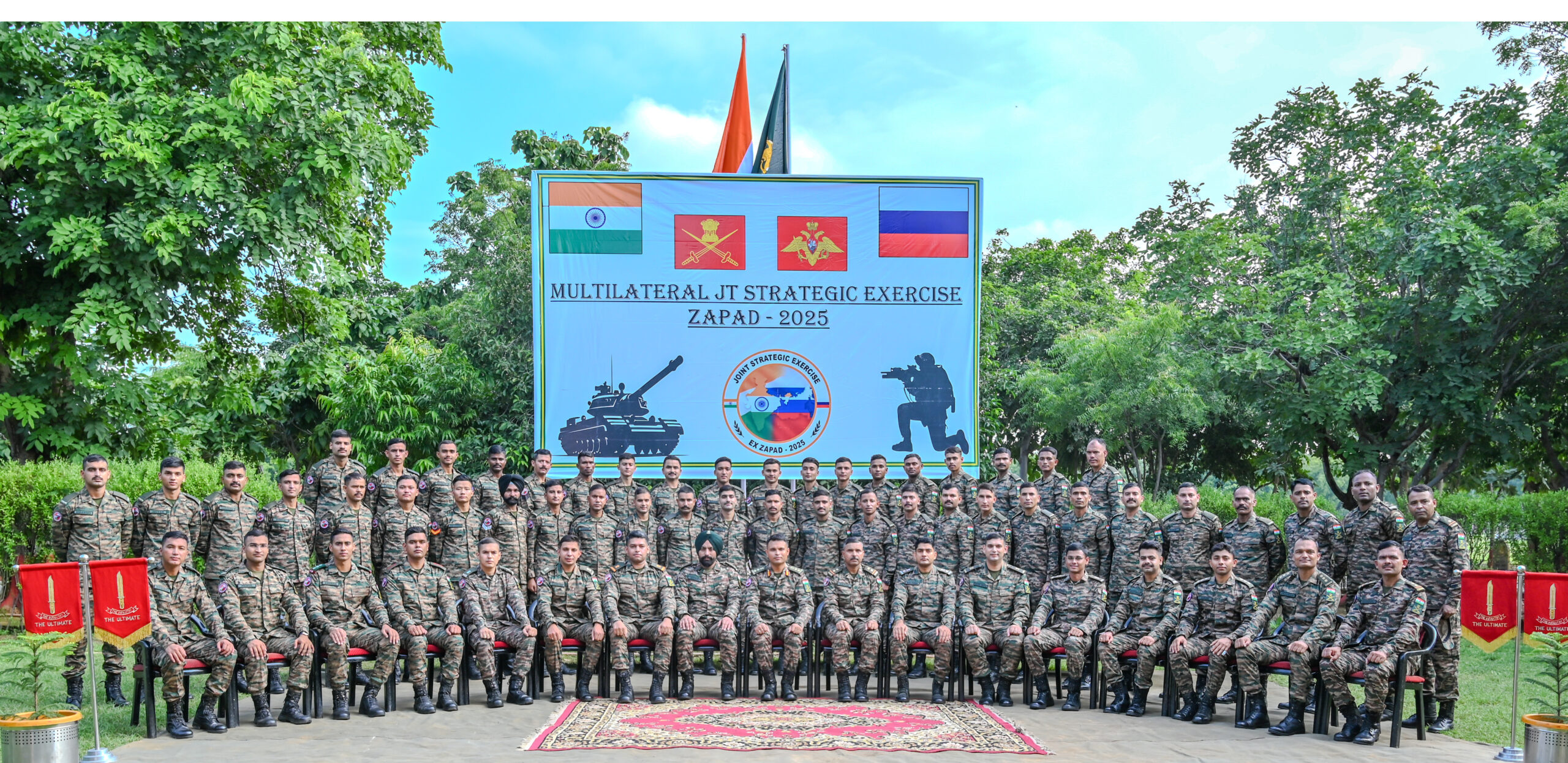
New Delhi: India deployed a 65-person military contingent to Russia’s Exercise Zapad-2025 on September 9, 2025, signalling strategic autonomy amid tensions with the United States and the North Atlantic Treaty Organization (NATO), as Russia’s war in Ukraine approaches its fourth year.
The contingent, comprising 57 Indian Army soldiers, seven Indian Air Force personnel, and one Indian Navy officer, arrived at Mulino Training Ground in Nizhny Novgorod, Russia, before joining drills at Belarus’s Barysaw ranges from September 12–16, 2025.
The Indian Army contingent is being led by a battalion of the Kumaon Regiment along with troops from other arms and services. The drills emphasise joint company-level operations, mission planning, tactical manoeuvres, and counter-terrorism, strengthening India-Russia and regional ties.
Earlier, the 14th edition of the exercise Indra, a bilateral India-Russia naval drill since 2003, was hosted off the coast of Chennai, India, from March 28 to April 2, 2025, and included the Harbour phase (28 to 30 March) in Chennai and the Sea Phase (31 March to 2 April) in the Bay of Bengal. The Russian Navy sent ships from its Pacific Fleet, including Pechanga (Dubna class), Rezkiy (Steregushchiy class), and Aldar Tsydenzhapov (Steregushchiy class). The Indian Navy deployed INS Rana (D52), INS Kuthar (P46) and one Boeing P-8I Neptune.
The Zapad-2025 exercise includes over 20 nations—Iran, Burkina Faso, Congo, Mali, Niger, Tajikistan, and others—with China, Pakistan, and others as observers. Bangladesh also sent a small training team focused on counterterrorism, and it aims to enhance counterterrorism capabilities amid challenges in the Chattogram Hill Tracts and Myanmar border unrest, balancing ties with Russia, the U.S., and China.
Russian Defence Minister Andrey Belousov called Zapad-2025 a key event for the Russia-Belarus Union State, involving 13,000 troops officially, though estimates suggest up to 30,000 with parallel activities, including nuclear training. Belarus invited all 56 Organisation for Security and Co-operation in Europe (OSCE) states, including NATO members, to observe, with responses due by late August, but NATO remains cautious, viewing the invitation as a formality amid concerns of rehearsals for Baltic conflicts near Poland and Lithuania. European Union (EU) analysts warn Zapad-2025 could be used to apply pressure near NATO’s eastern flank or serve as cover for escalation, even if the exercise is officially presented as defensive.
India’s participation, as a Quad member, and Bangladesh’s smaller role lend weight to Russia’s coalition, raising NATO’s concerns, with Secretary General Mark Rutte pledging close monitoring.
India’s involvement persists despite U.S. pressures, including a 50% tariff on Indian exports imposed in August 2025 (25% new, 25% existing) due to India’s neutrality on Ukraine and $65 billion trade surge with Russia since 2022, including $22 billion in annual crude oil imports. India balances these tensions with exercises like Yudh Abhyas in Alaska and Malabar 2025 with the U.S., Japan, and Australia in Guam. “Participation in Exercise ZAPAD 2025 will further strengthen defence cooperation and foster camaraderie between India and Russia, thereby reinforcing the spirit of collaboration and mutual trust,” the Indian Defence Ministry stated.
Bangladesh faces similar U.S. pressures for its Russian oil imports, complicating its defence cooperation with Washington, but continues engagement through equipment talks.
Zapad’s history dates back to 1981 Soviet exercises targeting NATO, revived in 1999 amid NATO’s Yugoslavia campaign. Past drills—Zapad-2009 (10,000–20,000 troops), Zapad-2013 (75,000), Zapad-2017 (12,700–100,000), and Zapad-2021 (200,000)—supported Russia’s 2022 Ukraine invasion.
The 2025 edition includes observers like Pakistan and China. The Shanghai Cooperation Organisation (SCO) Summit in Tianjin, China (August 31–September 1, 2025), saw discussions on multipolarity, with Russia supporting SCO members like India and Bangladesh. Collective Security Treaty Organisation (CSTO) members like Kazakhstan participate as observers.
Bangladesh’s participation aligns with its counterterrorism and regional stability goals, navigating U.S. pressures. India’s bolder role, backed by deep Russian ties, draws sharper Western focus due to its economic and strategic weight. Both nations assert autonomy through Zapad-2025, complicating Western efforts to isolate Russia in a tense geopolitical landscape.
– global bihari bureau